Over the years, the protection and care of people’s health have consistently received special attention from the Party and the State.
Many key targets completed
Documents and resolutions of successive Party Congresses, resolutions of the Party Central Committee, as well as conclusions and directives of the Politburo and the Secretariat, have all articulated policies, orientations, and priority goals for protecting, caring for, and improving people’s health. Alongside these are numerous medium- and long-term development policies for the health sector toward 2030, with a vision extending to 2045–2050.
According to the Ministry of Health, during the 2021–2025 period, despite the severe impact of the COVID-19 pandemic and profound global socio-economic disruptions, under the leadership of the Party, Viet Nam’s health sector achieved many important accomplishments. Of the key targets assigned to the health sector under the Five-Year Socio-Economic Development Plan for 2021–2025, pursuant to National Assembly Resolution No.16/2021/QH15 dated July 27, 2021, all four targets were achieved by 2025: average life expectancy reached 74.8 years (exceeding the assigned target), with healthy life expectancy at 67 years; the ratio of physicians reached 15 per 10,000 people (exceeding the target); hospital bed capacity reached 34.5 beds per 10,000 people (exceeding the target); and 95.15% of the population participated in health insurance (exceeding the target).
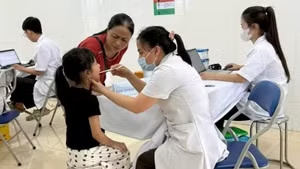
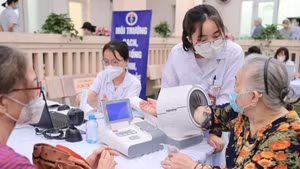
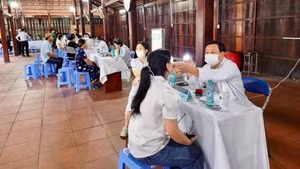
Notable achievements include proactive, flexible, and effective epidemic prevention and control. Viet Nam has successfully contained many dangerous infectious diseases and has been internationally recognised for its public health emergency response capacity. At the grassroots level, comprehensive management of non-communicable diseases—such as hypertension, diabetes, asthma, and chronic obstructive pulmonary disease—has also been implemented.
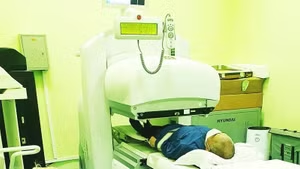
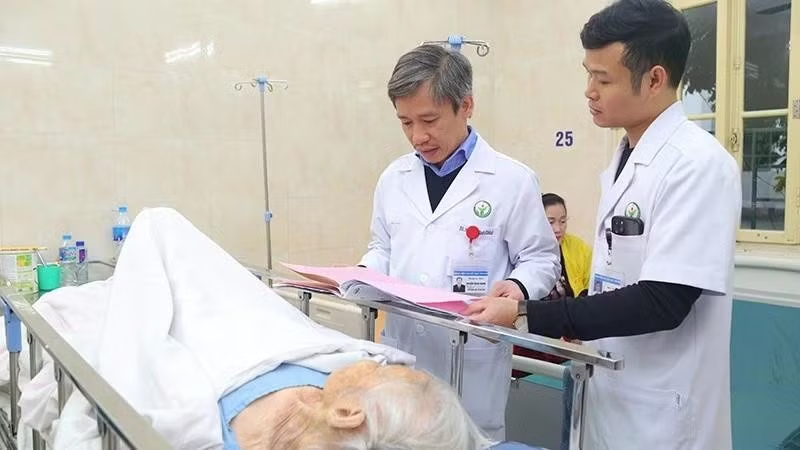
The healthcare delivery system, from central to grassroots levels, has been strengthened and has mastered many advanced medical technologies, including robotic surgery, precision radiotherapy for cancer treatment, AI-assisted diagnostic imaging, and the application of genetic and molecular biology technologies in personalised cancer treatment.
Vietnamese doctors have successfully performed many highly complex organ transplants on par with leading transplant centers worldwide. Notably, health insurance, one of the two pillars of the social security system, serves as a crucial public financial mechanism in healthcare, aimed at equity, efficiency, and development, and has received particular attention.
Key determinants identified
Alongside these achievements, Viet Nam’s healthcare system still faces shortcomings: uneven service quality across regions; weak primary healthcare with shortages in human resources and infrastructure; and insufficient investment in preventive medicine, with surveillance, forecasting, and early-warning capacities not yet meeting the demands posed by climate change and emerging diseases.
Moreover, financial mechanisms and hospital autonomy policies still face obstacles; overcrowding at central-level hospitals persists; healthcare digital transformation remains limited; and the healthcare workforce is insufficient in both quantity and quality. These bottlenecks must be addressed promptly to enable the health sector to develop rapidly, sustainably, and integrate more deeply with the world.
To build an equitable, high-quality, effective, and sustainable healthcare system, the Party and the State have issued a series of important orientations. On September 9, 2025, the Politburo promulgated Resolution No.72-NQ/TW on breakthrough solutions to strengthen the protection, care, and improvement of people’s health. This resolution is strategic, comprehensive, long-term, and action-oriented.
Notably, Resolution No.72 does not replace previously issued Party resolutions or directives; instead, it focuses on new and critical issues with significant impact, creating breakthroughs in health protection, care, and promotion to fulfill strategic goals in a practical, effective, and feasible manner.
One key emphasis of Resolution No.72 is the decisive shift from a treatment-centered approach to a prevention-centred mindset, positioning preventive medicine and primary healthcare as the foundation of the system. At the same time, it calls for accelerating digital transformation and the application of artificial intelligence and big data in diagnosis, treatment, epidemic forecasting, and personalised healthcare. These are seen as the keys to unlocking a modern, humane, and intelligent healthcare system, oriented toward comprehensive, continuous, and life-course-based health care.
Minister of Health Dao Hong Lan noted that the quality of services and operational effectiveness of the healthcare system depend on three critical factors: human resources; infrastructure and medical equipment; and financial mechanisms. In the coming period, the health sector and localities will prioritise allocating and mobilising resources, and adopt exceptional mechanisms and policies to develop a healthcare workforce that is adequate in quantity, quality, and structure—especially in remote, disadvantaged, and hard-to-reach areas.
Regarding infrastructure, essential medicines and medical equipment will be ensured to meet operational requirements. One hundred percent of commune-level health stations will be invested with basic facilities and equipment in line with their functions and tasks. In terms of operational and financial mechanisms, as well as organisational structure, commune-level health stations will be organised as public service units, ensuring the provision of basic and essential services in disease prevention, primary healthcare, medical examination and treatment, and social care services.