Experts emphasise that, besides support for smoking cessation, less harmful alternative measures are needed to protect public health, especially when the successful quit rate is only about 9.5%.
Viet Nam is facing a heavy burden from tobacco, as cigarette smoke contains more than 7,000 toxic chemicals that cause cancer, cardiovascular, and respiratory diseases. According to a 2019–2020 survey conducted in 34 provinces and cities, only 9.5% of smokers were able to quit, while new data from the World Health Organization (WHO) show that the smoking rate among adult men decreased slightly from 45.3% in 2015 to 38.9% in 2023; however, there are still around 15 million people of legal age who smoke.
A survey conducted by VnExpress in 2021 involving more than 4,000 participants revealed that 93% had thought about quitting smoking, but 43% failed in their attempts and 26% relapsed, while 94% agreed that reducing harm from tobacco smoke is important.
Many experts note that a harm-based control model, rather than an absolute ban as many countries have adopted, should be considered to increase feasibility. Currently, the Law on Prevention and Control of Tobacco Harms lacks solutions for those who are not ready to quit, leading to an annual healthcare burden of up to 108 trillion VND, according to a 2022 study by the Viet Nam Health Economics Association.
A draft amendment to the Law on Prevention and Control of Tobacco Harms in 2026 is being built by the Ministry of Health, focusing on banning electronic cigarettes and heated tobacco products from 2025, expanding bans on point-of-sale displays, and strengthening post-market inspections to reduce passive exposure.
The WHO initiated tobacco harm reduction under the Framework Convention on Tobacco Control (FCTC) in 2003, based on three pillars: reducing supply, reducing demand, and reducing harm. WHO’s TobReg group affirms that effectiveness can only be achieved when there is a transition to products less harmful than traditional cigarettes, under strict supervision.
However, Professor Tikki Pang, former director at WHO, pointed out challenges in Asia that have slowed progress, while the US has taken the lead with the strategy of the US Food and Drug Administration (FDA) by integrating harm reduction into its management framework.
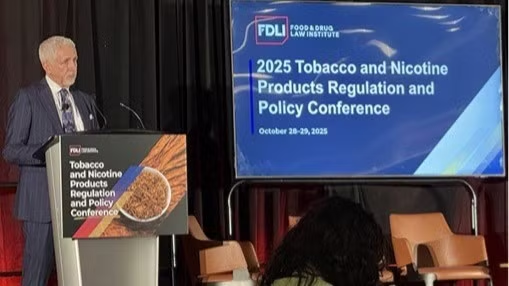
Recently, at the Tobacco and Nicotine Policy Conference organised by the US Food and Drug Law Institute, Bret Koplow, Acting Director of the Center for Tobacco Products (CTP) under the FDA, emphasised that tobacco harm reduction is a principle integrated into the entire FDA’s management framework.
This statement marks an important shift in the US tobacco management approach after many years of maintaining traditional measures.
According to public health experts around the world, the FDA’s approach is expected to gradually reduce dependence on cigarettes among users of nicotine-containing products. This means that the demand for nicotine does not necessarily have to be associated with smoking cigarettes, the most harmful product.
At the same time, the US has implemented comprehensive control over both cigarettes and other tobacco products. On the one hand, the country supports smoking cessation, warns harmful effects, bans advertising, and increases taxes on cigarettes. On the other hand, the FDA conducts rigorous scientific evaluation and conditionally permits the sale of certain non-combustible tobacco products as a lower-risk alternative for smokers.
The US also applies strict post-market surveillance, requiring businesses to ensure transparency of information and to control communication and marketing messages, so that consumers have access to accurate information about the health impacts of products.
The latest data from the US Centres for Disease Control and Prevention (CDC) for the 2017–2023 period show that although the total number of adults using nicotine has not changed significantly, consumption behaviour has shifted, with a decline in cigarette smoking rates.
In the context of modest smoking cessation rates and a large number of smokers, amendments to the Law on Prevention and Control of Tobacco Harms need to approach in a more comprehensive manner. In addition to the goals of reducing supply, reducing demand, and supporting smoking cessation, it is necessary to consider supplementing scientific evidence-based harm reduction solutions for those who cannot or are not ready to quit, in order to reduce exposure to tobacco smoke and the healthcare burden.
This approach is consistent with WHO recommendations and international experience, contributing to improving the effectiveness and sustainability of tobacco harm prevention and control policies in Viet Nam.