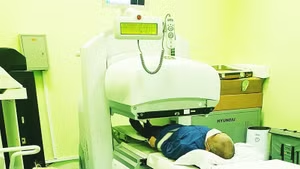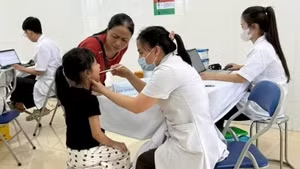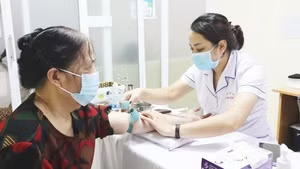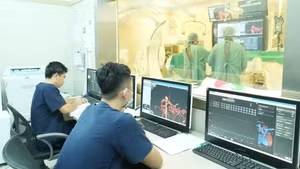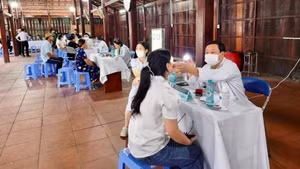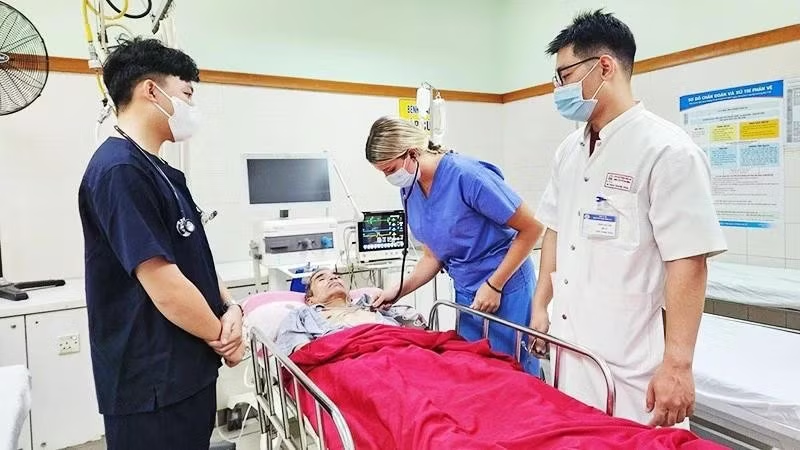
Coming from many countries in Asia, Africa, and even Europe, these students bring with them the desire to learn practical clinical experience in a healthcare system that is developing rapidly, rich in identity and humanity.
An “Open Classroom” of practical medicine
Unlike many developed countries, where medical training increasingly depends on high-tech simulation and closed processes, the hospital environment in Viet Nam still retains the characteristic of “open clinical practice.” As a result, students are exposed directly to patients, observing the entire process from examination and diagnosis to treatment and post-intervention follow-up.
At Viet Duc Friendship Hospital, the country’s leading surgical center, hundreds of operations take place every day, ranging from simple to highly complex: severe trauma, multiple trauma due to traffic accidents, gastrointestinal surgery, hepatobiliary surgery, organ transplantation, and neurosurgery. This is precisely the “living classroom” that many international medical students seek.
Currently enrolled in a medical program in Germany, Maria Weber shared that she chose Viet Nam for her three-month clinical internship because: “Here, in just one week, I can observe more cases than in several months of internship at my home hospital.” What impressed her most was the way Vietnamese doctors make decisions very quickly in emergency situations, when time and conditions do not allow hesitation.
Meanwhile, at Bach Mai Hospital, the largest general hospital in the country, international students gain comprehensive access to specialties in internal medicine, intensive care - emergency medicine, toxicology, cardiology, respiratory medicine, and endocrinology. Severe cases, complex pathologies, and multiple underlying conditions pose great challenges to medical staff, and at the same time serve as valuable practical lessons for learners.
Not a few international students admit that they choose Viet Nam because they want to “learn under real pressure.” In many countries, clinical interns mainly observe and have little opportunity to participate in in-depth professional discussions. In contrast, in Viet Nam, especially in intensive care departments, students are regularly required to monitor disease progression, participate in analyzing medical records, and listen to doctors explain the reasons for choosing specific treatment regimens.
Studying medicine and learning medical ethics
The greatest difference that foreign students remember about Viet Nam is not only the number of cases or professional techniques, but the way doctors pass on their knowledge. Many leading doctors at Viet Duc and Bach Mai are willing to carefully explain each surgical step and each clinical decision to students, even though their work is already highly demanding.
Associate Professor, Doctor Nguyen Manh Khanh, Deputy Director of Viet Duc Friendship Hospital, commented: “International students are often very attentive and eager to learn. They not only ask about surgical techniques, but also why a certain option is chosen and how to handle situations when conditions are not fully adequate. That also compels us to explain more clearly and scientifically what we do every day.”
According to Doctor Khanh, receiving foreign students is not only about sharing knowledge, but also an opportunity for Vietnamese medical staff to reflect on themselves, further standardize training processes, and enhance professional communication capacity in foreign languages.
At Bach Mai Hospital, Professor, Doctor Mai Duy Ton, Director of the Stroke Center, shared that many international students are particularly interested in how Vietnamese doctors communicate with patients and their families. “They told me that in Viet Nam, doctors must do more than just treat: they must explain, reassure, persuade, and share. That is very different from some healthcare systems where doctors and patients interact less,” Professor Ton said.
The fact that international students come to Viet Nam to study medicine shows an important shift in the position of the country’s healthcare system. From mainly receiving medical knowledge from abroad, Viet Nam is gradually becoming a place that shares and disseminates professional experience within the region. This is a sign that Vietnamese medicine has reached a certain level of maturity, sufficient not only to effectively treat domestic patients but also to participate in training and supporting international medical human resources.
Adewale Ogunleye from Nigeria, interning at the Intensive Care Center of Bach Mai Hospital, said he was deeply impressed by the working intensity of Vietnamese doctors. “There are night shifts that last all through the night, and doctors almost never leave the department. The pressure is enormous, yet they maintain the highest level of concentration and responsibility toward patients,” he shared.