This is not only a development goal but also the most important political task reflecting the Party’s strategic vision on human development, placing people’s health as the foundation for rapid and sustainable growth.
Resolution No. 72-NQ/TW of the Politburo sets out breakthrough solutions, prioritising disease prevention, improving the quality of primary healthcare, and meeting the increasingly diverse and higher demands of the people. In line with this spirit, Party committees and organisations nationwide are urgently translating the resolution into action programmes suitable with conditions of localities.
Hai Phong is one of the first localities to issue a programme to implement Resolution No. 72-NQ/TW, demonstrating strong political determination in the healthcare sector. In recent years, the city has concretised and implemented many important policies and resolutions of the central authorities, notably Resolution No. 07-NQ/TU issued on August 2, 2018 on building Hai Phong into a medical centre of the Northern Coastal region, as well as the targets set out in the Resolution of the Hai Phong Municipal Party Congress for the 2025–2030 term.
Thanks to decisive implementation of the policies and resolutions, the city’s healthcare system has been strengthened and developed. Hai Phong now has a relatively comprehensive healthcare network, including 19 municipal-level hospitals; five regional general hospitals; seven hospitals under the Ministry of Health; and 114 commune, ward, and special administrative zone health stations, with a total of more than 15,000 inpatient beds. The private healthcare sector has also developed strongly, with 13 hospitals, 89 general clinics, and numerous medical service facilities, contributing to diversified healthcare provision. The city’s health workforce has over 25,000 personnel, including more than 6,000 university-qualified doctors and pharmacists, equivalent to 14.46 doctors per 10,000 inhabitants and 4.1 pharmacists per 10,000 inhabitants. This is a crucial foundation for improving professional quality and deploying advanced medical techniques.
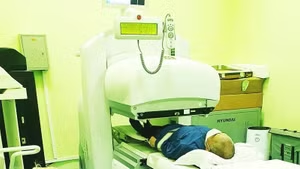
In addition to human resource development, the city has focused on investment in facilities and equipment. In 2025, the estimated budget for healthcare operations exceeded 2.32 trillion VND, while total funding for the 2021–2025 period surpassed 10.757 trillion VND. City-level hospitals have implemented 60–70% of the approved technical procedures; some have reached 80–85%, including 10–15% of specialised techniques. Strengthening joint ventures and partnerships in equipment investment has improved the quality of medical examination and treatment services and gradually reduced patient transfers to higher-level facilities.
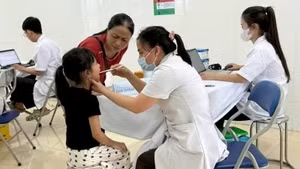
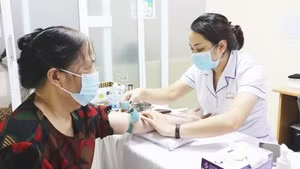
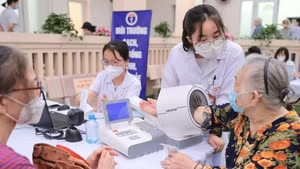
A significant shift in enhancing the healthcare system’s capacity and improving public healthcare came on January 12, 2026, when the Hai Phong Municipal People’s Committee approved the project on “Enhancing the capacity of Hai Phong’s Healthcare System to implement Resolution No. 72-NQ/TW.” The project sets the goals that from 2026, residents will receive periodic health check-ups or free screenings at least once a year; while health insurance coverage will exceed 95% and strive to reach 100% by 2030. The total projected funding exceeds 44.3 trillion VND, of which nearly 3.9 trillion VND of regular expenditure during 2026–2030 will focus on training, attracting personnel, and investing in facilities and equipment. This funding is expected to bring about clear improvements in healthcare quality, reduce the financial burden of medical services on citizens, and strengthen social security.
Following the city’s action programme, several Party committees and units of localities have proactively built their own action programmes with specific plans. In Ha Dong Commune (Hai Phong), the Standing Board of the Commune Party Committee has issued a programme to implement Resolution No. 72-NQ/TW, clearly defining responsibilities of the political system. By 2030, the commune health station is set to be comprehensively upgraded, with four to five doctors, so as to be capable of meeting local examination and treatment needs, thereby easing pressure on higher-level facilities.
Vu Duc Hanh, Secretary of the Ha Dong Commune Party Committee, shared that the Commune Party Committee’s resolution goes beyond infrastructure investment but focus on improving the quality of primary health management, intensifying communication, mobilising people to raise their awareness and encouraging them to carry out periodic health check-ups, and gradually forming a healthy lifestyle to protect and enhance the health of individuals and the community as a whole.