According to the Ministry of Health, as Viet Nam’s disease pattern is undergoing rapid and complex changes, with the emergence of many new infectious diseases, particularly the steadily rising prevalence of non-communicable diseases and mental disorders, there is an increasingly urgent need to proactively and sustainably strengthen preventive healthcare capacity. Therefore, the formulation and promulgation of the Law on Disease Prevention, with a comprehensive scope of regulation covering disease prevention in its entirety, is highly necessary.
The promulgation of the Law on Disease Prevention has fully and comprehensively institutionalised the Party’s and the State’s guidelines and policies on disease prevention, as affirmed in the Constitution: Everyone has the right to health protection and care, equality in accessing medical services, and the obligation to comply with regulations on disease prevention, medical examination, and treatment; as well as Resolution No. 72-NQ/TW dated September 9, 2025, of the Politburo on breakthrough solutions to strengthen the protection, care, and improvement of people’s health; Resolution No. 20-NQ/TW dated October 25, 2017, of the 12th Party Central Committee on strengthening the protection, care, and improvement of people’s health in the new situation, among others.
In recent times, the health sector has been strongly shifting from a mindset focused on “medical examination and treatment” to one of “proactive disease prevention”, “preventing disease early, from afar, and from the grassroots level”, with an emphasis on protecting, caring for, and comprehensively improving health in a continuous manner throughout the life cycle.
Sharing key highlights of the Law on Disease Prevention, Deputy Minister of Health Nguyen Thi Lien Huong said that the Law consists of six chapters and 46 articles, and is formulated on the basis of inheriting, revising, supplementing, and developing provisions of the Law on Prevention and Control of Infectious Diseases that remain relevant.
The Law is promulgated with the objective of completing the legal framework on disease prevention, contributing to improving physical and mental health, stature, life expectancy, and quality of life of the Vietnamese people. It comprehensively regulates matters related to the prevention and control of infectious diseases; prevention and control of non-communicable diseases; prevention and control of mental disorders; nutrition in disease prevention; as well as the conditions necessary to ensure effective implementation of disease prevention activities. The Law applies to domestic and foreign agencies, organisations, and individuals operating in Viet Nam, demonstrating its comprehensive, unified nature and alignment with international practices.
Notably, the Law inherits five provisions relating to the scope of regulation, interpretation of terms and the national reserve regime for medicines, vaccines, and medical biological products; and revises 38 provisions on general regulations and measures for the prevention and control of infectious diseases, such as biosafety surveillance, vaccine use, border health quarantine, epidemic declaration and reporting, measures for personal protection, and medical isolation of organisations and individuals.
At the same time, the Law adds 17 important new provisions on biosafety in testing; development of disease prevention services; research and application of science, technology, innovation, and digital transformation in disease prevention; prevention and control of non-communicable diseases, mental disorders, and nutrition in disease prevention. One of the new additions compared with existing regulations concerns the prevention and control of non-communicable diseases, including provisions on preventive measures, disease risk factors, early detection, disease prevention, and community-based disease management.
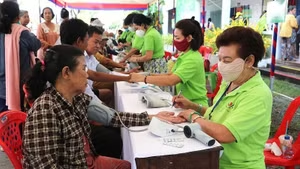
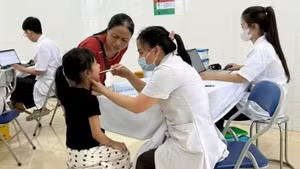
The Law on Disease Prevention also adds provisions entitling people to free periodic health check-ups or screening at least once a year, according to target groups and priority roadmaps, to realise Resolution No. 72-NQ/TW of the Politburo, which clearly sets out the objective that “from 2026, people will receive free periodic health check-ups or screening at least once a year”.
The Law further stipulates risk factors, early detection, and preventive measures for mental health disorders; the rights and responsibilities of agencies, organisations, and individuals in the prevention and control of mental health disorders; and principles for implementing nutrition in disease prevention, emphasising that nutrition must be ensured throughout the life cycle, with special attention to nutrition during the first 1,000 days of life, from pregnancy until a child reaches 24 months of age.
The Law also establishes a sustainable financial mechanism for disease prevention, under which the state budget ensures recurrent funding and focuses investment on preventive healthcare; establishes a Disease Prevention Fund to create stable and long-term resources for disease prevention activities; and introduces various incentives for personnel working in disease prevention, especially at the grassroots healthcare level and in preventive medicine. It encourages public-sector participation in providing disease prevention services; allows preventive healthcare facilities to decide on additional income levels from lawful revenue sources; and designs many preferential policies specifically for border areas, islands, ethnic minority areas, mountainous regions, and other particularly disadvantaged areas.
Deputy Minister Nguyen Thi Lien Huong affirmed that the Law on Disease Prevention represents a strong shift from a mindset centred on “medical examination and treatment” to one of “proactive disease prevention”, “preventing disease early, from afar and from the grassroots level”, with an emphasis on protecting, caring for, and comprehensively improving health continuously throughout the life cycle. To ensure that the Law on Disease Prevention is promptly implemented in practice, the Ministry of Health is urgently coordinating with relevant ministries and sectors to develop and finalise detailed regulations and guidance for implementation, while intensifying communication efforts so that people clearly understand their rights and responsibilities in proactively preventing disease. Through this, Viet Nam aims to build a sustainable, equitable, and effective healthcare system, taking the health of the people as the benchmark for the success of the Vietnamese health sector in the new era.