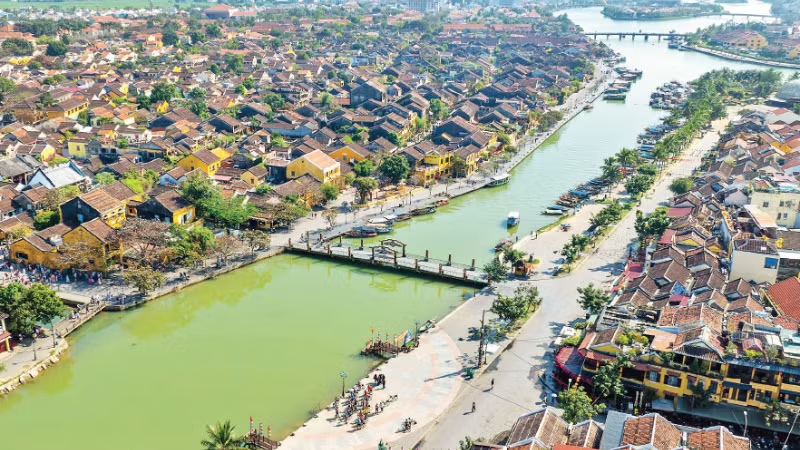
Currently, Da Nang is focusing on synchronising the previous planning of Quang Nam Province and Da Nang City, ensuring continuity, inheritance, and uniformity in urban spatial organisation.
Adjusting planning in open space
The formation of satellite cities linked to industry, services, tourism, logistics, and eco-cities will help alleviate pressure on the central area, expand growth potential, and effectively utilise resources.
The urban characteristics of Da Nang after the merger will be an eco-city, a smart city; linked to a free trade zone, an international financial centre, an industrial and logistics centre, a centre for innovation and entrepreneurship, and a liveable tourist city.
Da Nang is positioned as a regional linkage centre, playing a pioneering role in leading innovation and creating a ripple effect on the central region and the whole country. Urban development will be linked to the preservation and promotion of tangible and intangible heritage values, natural heritage, while aiming to create contemporary heritage values and a unique identity in the modernisation process.
As a growth pole in central Viet Nam, Da Nang plays a central role in the socio-economic and scientific-technological development of the North Central and Central Coastal regions, acting as the driving force for the effective implementation of Resolution No. 26-NQ/TW dated November 3, 2022, of the Politburo on socio-economic development and ensuring national defence and security in the North Central and Central Coastal regions until 2030, with a vision to 2045. Connecting and leveraging the complementary strengths of Da Nang (services, finance, information technology, tourism) and Quang Nam (mechanical industry, Chu Lai Open Economic Zone, high-tech agriculture) will form a multi-sectoral growth pole, creating a sustainable development impetus for the entire region.
According to the draft revised plan, the overall goal by 2030 is to build Da Nang into an ecological city with rich identity, a modern, smart, and dynamic urban area. With its prosperous rural areas, civilised and high-quality living standards, Da Nang is one of the major socio-economic centres of the country and Southeast Asia, playing a national and regional role in many fields.
By 2050, Da Nang aims to be an ecological and smart city with complete and modern infrastructure, a safe, clean, and high-quality living environment; an international financial centre, a high-tech industrial centre, a science and technology and innovation centre, a national and international logistics centre, and a liveable tourist city of regional Asian class.
Experts believe that the spatial development orientation of the city’s central urban area is established towards increasing value, enhancing attractiveness, and highlighting the unique characteristics and identity of a coastal, riverside, and mountainous city. It is necessary to create favourable conditions to attract investment, renovate, rebuild, and develop urban areas according to a modern, ecological, and smart model.
Urban spatial planning needs to specifically define the scale, nature, and functions of compact urban areas, concentrated urban areas, border urban areas, and satellite cities. This includes “compacting” the existing development space of the old Da Nang urban core, developing satellite cities with specialised functions to support and alleviate the burden on the core. The selection of a “backbone” economic axis within these satellite cities will serve as a foundation for connecting to the overall planning.
The central urban space should prioritise the strong exploitation of the scenic advantages of the Han River, Thu Bon River, the bay-sea system, and the network of natural lakes, linked to the development of service, tourism, and marine trade industries. Building a multi-functional green infrastructure system, including waterways, drainage and climate-regulating corridors, public open spaces, and riverside and coastal parks, aims to create a distinctive urban coastal landscape for Da Nang.
After the merger, the new Da Nang continues to inherit the development orientation and specific mechanisms and policies previously issued by the Central Government for the city. Implementing the policy of reorganising administrative units nationwide is not only a management requirement but also an opportunity to review and reassess the entire development picture of the city. It involves reviewing and adjusting truly necessary content to suit the actual situation of the merged city, with a selective and unified approach to development thinking.
Permanent Vice Chairman of the People’s Committee of Da Nang City, Ho Ky Minh
According to the Standing Vice Chairman of the People’s Committee of Da Nang City, Ho Ky Minh: After the merger, Da Nang continues to inherit the development orientation and specific mechanisms and policies previously issued by the Central Government for the city. Implementing the policy of reorganising administrative units nationwide is not only a management requirement but also an opportunity to review and reassess the entire development picture of the city. It is necessary to review and adjust only the truly essential contents to suit the actual situation of the city after the merger, with a selective and unified approach to development thinking.
Dr. Dang Viet Dung, Chairman of the Viet Nam Construction Association, stated that Da Nang needs to review its population size indicators and urban classification, and carefully calculate population scenarios up to 2045 to ensure feasibility. At the same time, the determination of type two cities must adhere closely to population size criteria, avoiding setting unrealistic targets. Planning needs to clarify the functions of each urban area and region, such as administration, industry, services, tourism, etc.
Synchronised planning, harmonious development space
Party Central Committee member and Secretary of the Da Nang City Party Committee, Le Ngoc Quang, stated that one of the key tasks and solutions set forth by the City Party Committee in the Action Programme implementing the Resolution of the First City Party Congress is to effectively implement specific mechanisms and policies; remove obstacles, strongly develop the private economy, mobilise resources to invest in infrastructure development, and promote rapid and sustainable growth.
The city needs synchronised planning, ensuring harmonious development and effectively exploiting the potential of the eastern and western regions. Urban development should be oriented towards smart, green, and sustainable development... Research urban development models based on public transportation. Prioritise the development of transportation, healthcare, education, information technology, and telecommunications infrastructure in mountainous areas, reducing the disparity with lowland areas; the plan involves relocating residents to stabilise production and develop ecotourism; expanding inter-commune and inter-village transportation systems, small-scale irrigation, and the national power grid.
The merger of Quang Nam and Da Nang has created a completely different environment for the current city of Da Nang, opening up development space both vertically and horizontally. A key highlight of Da Nang is its free trade zone, but an approach suitable to the current global economic trends is needed. Consideration should be given to expanding the free trade zone to the Chu Lai Open Economic Zone.
Associate Professor, Dr. Tran Dinh Thien, former Director of the Vietnam Institute of Economics
Associate Professor, Dr. Tran Dinh Thien, former Director of the Viet Nam Institute of Economics, affirmed: The merger of Quang Nam and Da Nang has created a completely different environment for the current city of Da Nang, opening up development space both vertically and horizontally. A key highlight of Da Nang is its free trade zone, but an approach suitable to the current global economic trends is needed. Consider expanding and adding a free trade zone to the Chu Lai Open Economic Zone.
Looking from the current central urban area, Da Nang will establish satellite cities, with the goal of building and developing Da Nang into an international financial centre, a smart, green, and liveable city, a centre for innovation, science and technology, and high-quality education for the whole country and the Southeast Asian region, and the nucleus of the Central-Western Highlands key economic region.