Courage forged through dedication
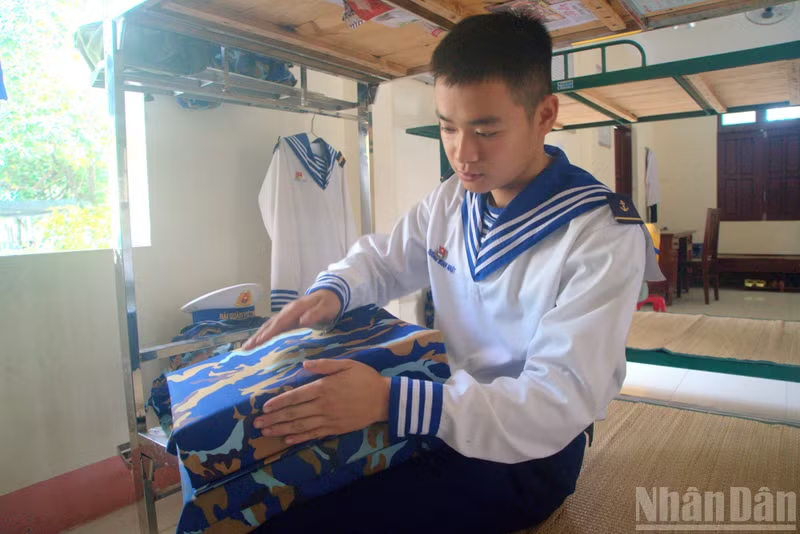
Among the young people serving on Sinh Ton Island, the name Duong Minh Nhat stands out as a typical representative of Generation Z who “dare to think and dare to act”. Born in inner-city Hai Phong in 2006, Nhat was once seen as a “pampered son” in his family’s eyes. With an outstanding academic path ahead, he once stood at the threshold of studying abroad or continuing university at home, yet he chose a different path that many of his peers described as “going against the current.”
At an age when he might have been enjoying the most vibrant days of student life or opting for a smoother route overseas, Nhat instead chose a completely different turning point: setting aside university to become a gunner at Combat Cluster 2 on Sinh Ton Island. He said he did not feel drawn to going abroad while still young; deep within him was a constant urge to contribute more directly to his country.
Nhat’s decision to enlist also stemmed from a “silent understanding” with his parents. Although they never imposed or explicitly expressed it, he knew they wished for their son to be trained in the military environment to become more resilient and mature.
Understanding that wish, he proactively deferred his university admission, volunteered for military service, put away his fashionable clothe, and donned the navy uniform. He set off with a single goal: to serve at the nation’s outpost and continue the tradition of safeguarding the seas and islands built by previous generations.
His early days on Sinh Ton Island were a cultural shock for the young man from the port city. Gone were parental indulgences and urban conveniences. Corporal Nhat had to learn everything from sweeping floors and cooking under limited conditions to handling firearms and standing guard under a blazing sun.
From a “pampered son” unaccustomed to hard labour, he gradually adapted to the scorching training ground and high-pressure combat readiness shifts. He shared that this environment taught him independence and responsibility. Although service on the island sometimes involves dangers and hardships beyond words, he has never regretted his choice.
“The most important thing is developing independence, self-discipline, and responsibility. Here, manpower is limited; no one can rely on others. Each person must fulfil their duty well for the collective to function smoothly. I have learned that defending the Fatherland begins with disciplining oneself in the smallest matters,” Nhat affirmed.
On this distant island, Nhat does not feel alone. He considers his commanders and comrades — those who eat, sleep and stand guard alongside him — as family. That strong bond has inspired him to aspire to enter officer training to dedicate himself long-term to the navy.
The man who “counts the wind and measures the sky”
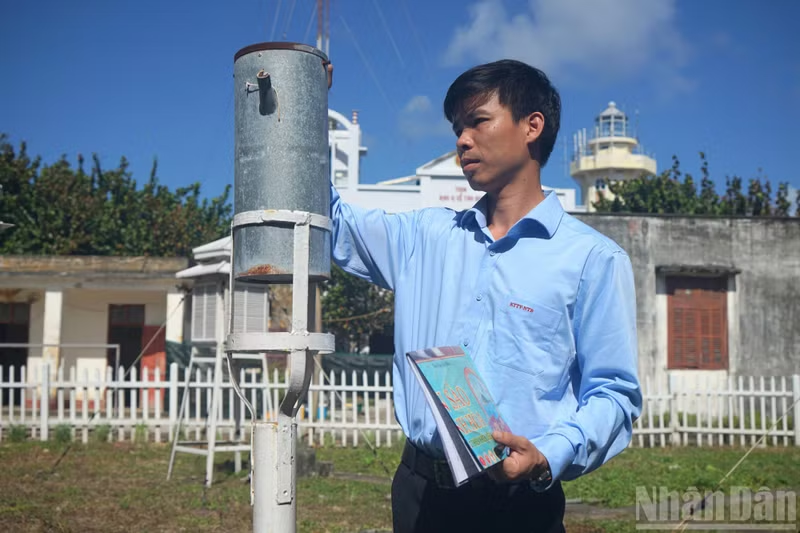
If Nhat represents youthful dedication, then Phan Nhat Thanh — a meteorological officer at the Truong Sa Marine Meteorological Station — symbolises perseverance, patience, and composure forged through life’s storms.
Thanh’s story is a shining example of resilience. Losing his mother in his 9th grade, the young 1992-born man grew up with a father who struggled to raise his child alone. During his university years in Ho Chi Minh City, he worked 12-hour night shifts as a security guard to pay tuition fees.
“There were nights on duty when I used a metal signboard as a bed on the cold pavement. At those times, I only dreamed of a stable job to support my father and younger sibling,” Thanh recalled emotionally. When fate led him to meteorology — a profession both his parents had pursued — he did not hesitate to choose Truong Sa as his starting point.
“At that time, the Director of the South Central Regional Hydro-Meteorological Station asked whether I could go to Truong Sa. I immediately replied that wherever the Fatherland needed me, I would go,” he recounted. Thus began his five-year journey with the seas and islands, starting with tearful emotions on receiving his assignment. “I felt I had to go, to not disappoint those who trusted me when I had nothing,” he shared.
Working as a meteorological engineer at the front line is extremely harsh. Each day consists of eight observation shifts, regardless of day or night, rain or storm. He recalled a violent storm in 2023 when winds reached 43 metres per second, snapping the wind-measuring mast. As sheets of roofing were torn away like rice leaves, he and his colleagues still clung to the equipment to transmit reports to the mainland.
His dedication also entails personal sacrifice. His wife, also a meteorological officer in Buon Ho (Dak Lak Province), sees him only a few months a year during leave. Brief phone calls amid unstable signals are their only connection. Yet for Thanh, this is a choice rooted in ideals: remaining in Truong Sa to safeguard the “eye of the storm” for the mainland’s peace.
Asked about his motivation to continue such arduous work, he smiled gently: “My parents started from nothing and built their lives through this profession; now I do the same. My wife encourages me, saying our family has little, so I should strive a bit more. Having a phone signal on the island is already a joy; hearing loved ones each day gives me the strength to endure many more storm seasons.”
The mission of a special teacher
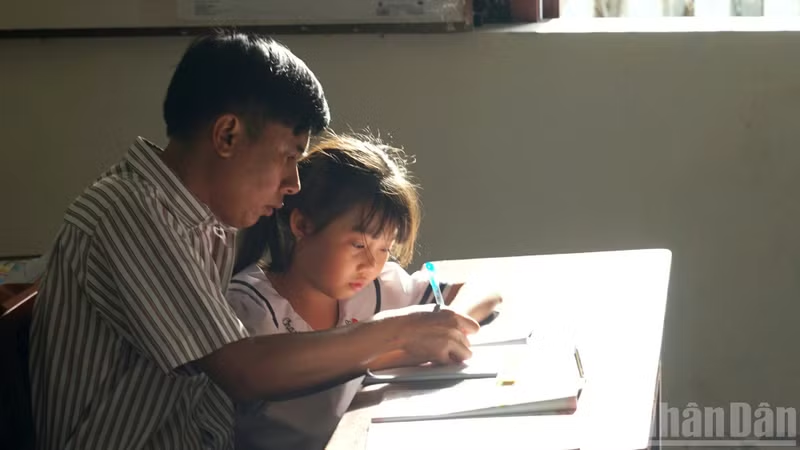
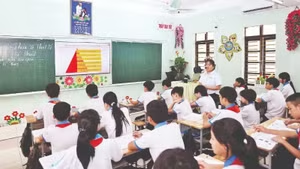
In the summer of 2023, teacher Le Thanh Chien (Song Tu Tay Primary School) arrived on the island with the mindset of someone sowing seeds of hope. From initial unfamiliarity with combined classes and limited conditions, he quickly adapted to become a fatherly and avuncular figure to the “little citizens.”
Teaching in Truong Sa is entirely different. He must conduct multi-grade classes, teaching pupils from Year 1 to Year 5 in the same space. Lesson plans must be flexible, and teaching methods adjusted to suit children born of salty sands. “The greatest challenge is not the lack of teaching aids but ensuring the children do not feel disadvantaged compared to peers on the mainland,” he confided.
Each day begins early with cleaning the classroom and welcoming pupils. He teaches mathematics and literature, as well as the heroic history of the archipelago.
“The children are living witnesses to the sacred sovereignty of the Fatherland. That moves me deeply and strengthens my desire to dedicate myself, together with other forces, to support them so that when they grow up, wherever they are, they will always carry the will to protect the sacred Fatherland,” he said emotionally.
Far from his wife and children, he has moments of longing, especially when his young child falls ill and he cannot be present. Yet the joy of seeing pupils progress and hope flourish on the island helps him overcome everything.
For him, each child growing up here will one day be a defender of the Fatherland. Watching innocent eyes studying amid the sound of waves strengthens his conviction in the path he has chosen: sowing knowledge to safeguard sovereignty.
A life-and-death anchor at the frontline
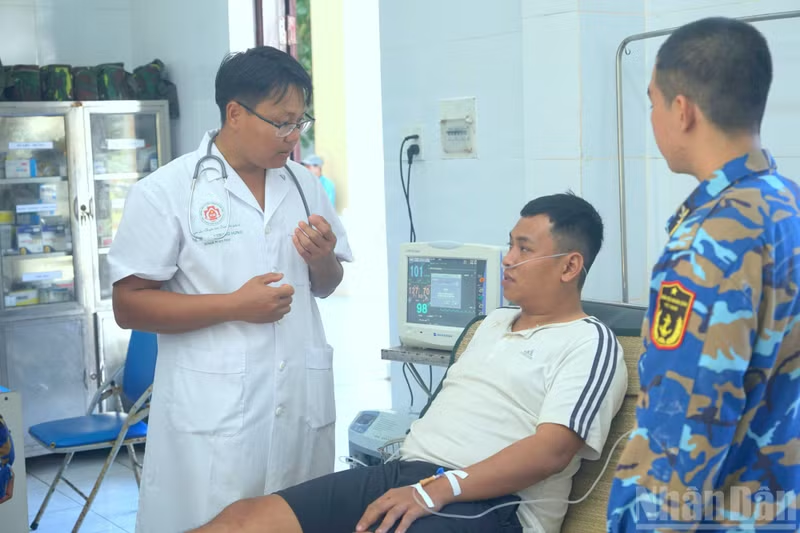
Amid the vast sea surrounding Song Tu Tay Island, beyond waves and harsh sunlight, there is the quiet presence of military doctors — “angels in white” who serve as life-and-death anchors for soldiers and fishermen. Major and Dr Nghiem Trung Hung, head of the Song Tu Tay infirmary, is one such figure. For him, each case at the frontline is not merely a duty but a command from the heart.
After graduating from the Military Medical Academy as a general practitioner and completing a master’s degree in urology and andrology at 108 Military Central Hospital, he brought specialised knowledge to the island. Yet reality there is harsher than textbooks. The infirmary handles not only surgical cases but all emergencies, from dermatology and respiratory illnesses to maritime accidents.
Recalling his early days, he said: “I experienced many emotions, from excitement to anxiety. I did not know what challenges lay ahead in ensuring the best healthcare for soldiers and civilians.”
Pressure at the island infirmary differs from that in major hospitals. Here, doctors must be versatile, managing internal medicine, surgery, and paediatric emergencies independently. That pressure, however, drives him and his colleagues to constantly improve and remain ready to operate independently amid the surrounding sea.
He recounted tense midnight emergencies, including fishermen suffering decompression syndrome after deep dives and arriving in cardiac arrest. Under torchlight and guided via Telemedicine consultation with mainland hospitals, he fought to reclaim their lives.
Over the past five months, the infirmary has handled an enormous workload, at times equal to an entire previous year combined. Particularly notable were five severe decompression cases.
He recalled one critical case involving a patient who had dived 43 metres and arrived in cardiac arrest. The island’s doctors performed cardiopulmonary resuscitation while consulting online with major mainland hospitals. When the patient’s heart began beating again, some of the suffocating pressure on the infirmary head was finally lifted.
Confidence among island doctors is strengthened by the Telemedicine system connecting them directly with leading mainland specialists. Yet perhaps his greatest source of spiritual support is his family. Coming from a family with a military tradition — his father an army officer and his wife also a military doctor — mutual understanding sustains him. He smiled, saying that each phone call home, with his wife’s reminders about his health, is precious medicine that steadies him at the frontline.
Dr Hung defines love for the Fatherland through medical dedication. He sees each fisherman as a living marker of sovereignty, and his duty is to protect those “markers.” Despite separation from family, he remains steadfast in his mission. For him, standing at the frontline to save lives is how his youth shines most brilliantly.
“For me, the wind symbolises dreams, aspirations and ambitions. Love is my family, the Fatherland and fulfilling my responsibility as a military doctor,” he affirmed.
Taken together, these lives form a vivid portrait of Truong Sa’s youth today. They are not mythical heroes but flesh-and-blood individuals with everyday worries, homesickness, and vulnerable moments. Yet above all, the ideal of defending the Fatherland has forged them into steadfast steel.
For them, Truong Sa is not merely an assignment but a place where aspirations, love, responsibility, and youthful ideals are refined and shine. And thanks to them, Truong Sa will forever remain an inseparable part of beloved Viet Nam.