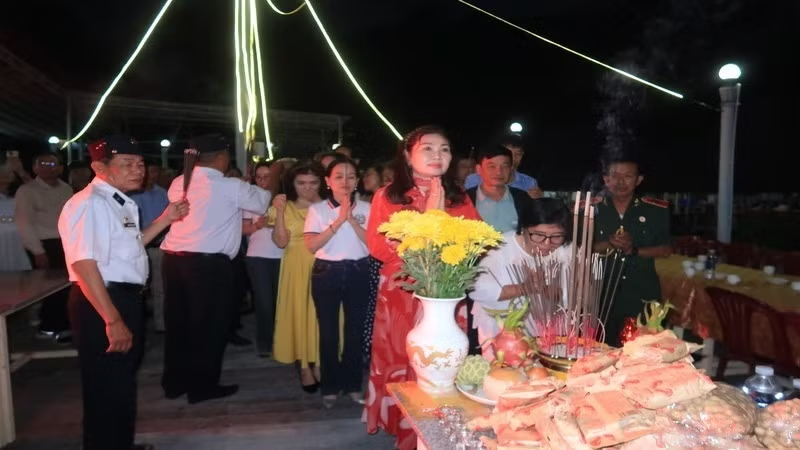
Truong Sa veterans met one another with firm handshakes and beaming smiles. The night was cold, yet the Thien Phuoc guesthouse suddenly felt warm with clasped hands and tight embraces. Many had moist eyes. Here, memories of Truong Sa’s sea and islands, of a shared trench, rose up as if it were yesterday; now, hand in hand, they asked after one another’s lives, recalling years that were harsh yet heroic.
A war invalid, in frail health, Truong Sa veteran Nguyen Van Dung returned home to build the Thien Phuoc enterprise. More than once he has been recognised as an outstanding war-invalid entrepreneur. Thinking of his comrades, especially as Tet approaches, he often organises reunions, simply for the chance to see fellow soldiers again — to ask after them, and to revisit the months of training and combat on the nation’s farthest front line.
Tonight, I met Tran Thi Thuy, the daughter of heroic martyr Tran Van Phuong. When Phuong fell in the Gac Ma naval battle, Thuy was a two-month foetus. A father never saw his child’s face. A child never saw her father’s. Is there any pain greater?
Today, Captain Tran Thi Thuy serves in the very unit where her father once served: Brigade 146, a Hero of the People’s Armed Forces. I have once travelled to Truong Sa with Thuy. During a memorial service for the heroic martyrs in the area of Gac Ma, Co Lin, and Len Dao, she stared into the distance, as though searching for her father’s silhouette on the waves. Seeing her again this time, in Navy uniform, she looked so composed and grown up.
The space fell quiet. Incense smoke drifted, faint and lingering. Comrades offered incense, facing a small raft bobbing on the water, bearing the words: “Forever grateful to the heroic martyrs.” Tonight, veteran Nguyen Van Dung, moved with emotion, presented gifts to the families of the martyrs: Dinh Ngoc Doanh, Tran Van Phuong, Vo Dinh Tuan, Nguyen Van Anh, Truong Dinh Binh, and Tran Van Thanh. The veterans shared their affection with the martyrs’ families — as though sharing it with the comrades of those days themselves.
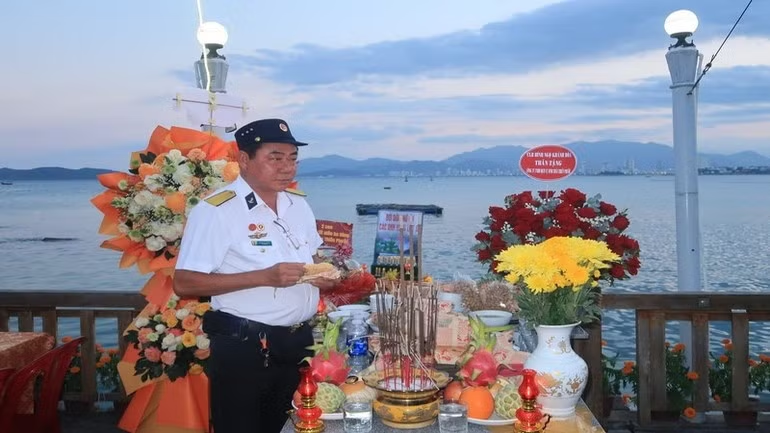
Before the spirits of the heroic martyrs who sacrificed bravely for the sacred sovereignty of the homeland’s seas and islands, veteran Nguyen Van Dung recited, overcome with feeling: “Your bodies have become one with the waves, but your names and will have become part of the flesh and blood of Mother Viet Nam. The sea may be salty, but it cannot be saltier than a mother’s tears as she waits for her child; waves may rise high, but they cannot rise higher than the mettle of the sailor-soldier.
These sticks of incense, these fresh petals, and the affection from the mainland — please let them cross the waves to reach the soldiers.
No one needed prompting. In silence, each person held a moment of remembrance for those who chose death to keep the nation’s territory whole — so that the national flag could fly proudly in the open sky above Truong Sa.
The sea kept singing its love song. And I heard the veterans, hands clasped, sing a refrain about Truong Sa always being close at one’s side.