Elections are a method of expressing the will, aspirations, and right to self-governance of the people
According to the guidance of the Coordinating Council for Legal Dissemination and Education of the Ha Noi People's Committee, the election of deputies to the National Assembly and People's Council is one of the basic political rights of citizens recognised by the Constitution.
Elections are a method of expressing the will, aspirations, and right to self-governance of the people in building a socialist rule-of-law state in general and establishing state power organs at the central and local levels in particular.
The election of deputies to the 16th National Assembly and People's Councils at all levels for the 2026–2031 term will be held nationwide on Sunday, March 15, 2026, in the context of the country's reform process after 40 years, which has achieved great achievements with historical significance in all areas of life and society; at the same time, active implementation of restructuring and streamlining of the political system's organisational apparatus, reorganising administrative boundaries, and operating a two-tiered local government model to ensure lean, strong, effective, and efficient governance in entering a new era of national development.
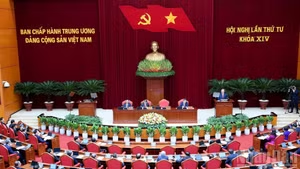
This is an important political event of the country, taking place immediately after the 14th National Party Congress. It concretises the Congress’ Resolution associated with the Party’s cadre work, relating to the responsibilities of all levels and sectors. It is also an occasion for voters to exercise their mastery rights of citizens, to choose and elect outstanding and worthy deputies to represent their will, aspirations, and mastery in the National Assembly and People’s Councils at all levels for the new term, thereby contributing positively to building, consolidating, and perfecting the socialist rule-of-law State of the people, by the people, and for the people under the leadership of the Communist Party of Viet Nam.
Elections based on universal, equal, direct, and secret ballot principles
The guidelines also clearly state that elections are the most important method for implementing democracy and exercising the power of the people.
The election of deputies to the National Assembly and People's Council is conducted according to the principles of universal, equal, direct, and secret ballot.
Regarding voting age, as of election day, Sunday, March 15, 2026, citizens of the Socialist Republic of Viet Nam who are 18 years of age or older (i.e., born on or before March 15, 2008) have the right to vote.
The right to vote is a fundamental political right of citizens as stipulated by the Constitution and laws. A citizen's right is inseparable from a citizen's duty.
Through elections, citizens directly vote to elect representatives who embody their will, aspirations, and right to self-governance, acting on their behalf to exercise state power, contributing to establishing the state apparatus to carry out social management activities. Therefore, exercising the right to vote is a citizen's responsibility to the country.
Regulations on the standards of deputies of National Assembly and People's Council
The guidelines of the Coordinating Council for Legal Dissemination and Education of the Ha Noi People's Committee also clearly state the standards of deputies of the National Assembly and People's Council.
Accordingly, the standards for deputies of the National Assembly are:
- Loyalty to the Fatherland, the people, and the Constitution; striving to carry out the renewal cause for the goal of a prosperous people, a strong, democratic, equitable, and civilised country.
- Possessing only Vietnamese nationality.
- Having good moral qualities; being diligent, thrifty, honest, upright, selfless; and exemplary in complying with the law; having courage and resolutely combating corruption, wastefulness, bureaucracy, arrogance, authoritarianism, and other violations of law.
- Having educational and professional qualifications; having enough capacity, health, work experience, and prestige to perform the duties of a National Assembly deputy.
- Maintaining close contact with the people, listening to their opinions, and enjoying their trust.
- Having conditions to participate in National Assembly activities.
The standards for representatives of the People’s Council are:
- Loyal to the Fatherland, the people, and the Constitution; striving to carry out the renewal cause for the goal of a prosperous people, a strong, democratic, equitable, and civilised country;
- Possessing only Vietnamese nationality;
- Having good moral qualities; being diligent, thrifty, honest, upright, selfless; and exemplary in complying with the law; having courage and resolutely combating corruption, wastefulness, bureaucracy, arrogance, authoritarianism, and other violations of law;
- Having educational and professional qualifications; having enough capacity, health, work experience, and prestige to perform duties of a representative; having conditions to participate in activities of People’s Council;
- Residing or working in an agency, organisation, unit, or enterprise within the administrative unit where he or she serves as a People’s Council representative;
- Maintaining close contact with the people, listening to their opinions, and enjoying their trust.
All citizens with the right to vote are registered on the voter list and issued voter cards for the election of deputies to the 16th National Assembly and the People's Councils at all levels for the 2026–2031 term, except for the following cases:
These are: Persons currently deprived of the right to vote by a legally effective court judgment or decision; Persons sentenced to death awaiting execution, or persons serving prison sentences without probation; Persons who have lost civil act capacity.
Each citizen may only be registered on one voter list in their place of permanent or temporary residence. The voter list is compiled by the People's Committee at the commune level for each polling area.
The election day for deputies to the 16th National Assembly and the People's Councils at all levels for the 2026–2031 term is Sunday, March 15, 2026.
Voting begins at 7:00 am and ends at 7:00 pm on the same day. Depending on the local situation, the Election Team may decide to start voting earlier, but not before 5:00 am, or end later, but not later than 9:00 pm on the same day.
Voting principles
Each voter has the right to cast one ballot for National Assembly deputies and one ballot for People’s Council deputies corresponding to each level of People’s Council.
Voters must vote in person; they are not allowed to have someone else vote on their behalf, except in the cases stipulated below; they must present their voter card when voting.
Voters who cannot write their ballot themselves may ask someone else to write it for them, but they must cast the ballot themselves; the person writing the ballot must ensure the secrecy of the voter's ballot. In cases where a voter is disabled and unable to cast their ballot themselves, they may ask someone else to place the ballot in the ballot box.
In cases where voters are ill, elderly, or disabled and unable to come to the polling station, the Election Team will bring a supplementary ballot box and ballots to the voter's residence or place of treatment so that the voter can receive the ballot and cast their vote.
For voters who are in temporary detention, undergoing compulsory education measures, or compulsory detoxification measures in facilities where no separate polling area is organised, or voters temporarily held at detention houses, the Election Team shall bring a mobile ballot box and ballots to such facilities for voters to receive ballots and conduct voting.
When voters write their ballots, no one may observe, including members of the Election Team. If a ballot is spoiled, the voter has the right to exchange it for another. After voting, the Election Team is responsible for stamping “Voted” on the voter card. Everyone must comply with the regulations of the polling station.
In addition, the voting regulations must adhere to the following principles:
1. Strictly comply with voting principles and procedures;
2. Voters must queue in order, giving priority to the elderly, persons with disabilities, and pregnant women;
3. Maintain security, order, and safety at the polling area; strictly prohibit acts of vandalism against facilities and property or causing disturbances at the polling station or polling stations;
4. No election campaigning in any form is allowed at polling stations;
5. Weapons, explosives, flammable materials, documents, banners, or slogans with malicious, hostile, or distorted content against Party and State guidelines and policies are prohibited in polling areas and polling rooms;
6. Persons without duties are not allowed to enter polling rooms;
7. Members of election bodies and persons serving election duties must wear badges as prescribed by the Provincial/City Election Committee; members of the Election Team must guide voters how to cast their ballots and answer their questions;
8. Any person who uses deceit, bribery, coercion, or obstruction to interfere with citizens’ voting rights; violates regulations on election campaigning; any person responsible for election work who falsifies documents, commits ballot fraud, or uses other methods to distort election results, or violates other regulations of the election laws, shall be subject to disciplinary action, administrative penalties, or criminal prosecution depending on the nature and severity of the violation.
Regulations on ballot
A valid ballot must meet all the following requirements:
- The ballot must be issued by the Election Team and bear its stamp;
- The ballot casts the correct number of deputies or fewer than the number of deputies to be elected as stipulated for the electoral unit;
- The ballot does not include any names of individuals not on the list of candidates or any other additional content.
The following ballots are invalid: Ballots not in the prescribed format issued by the Election Team; ballots without the Election Committee's stamp; ballots selecting more candidates than the prescribed number for the electoral unit; ballots crossing out all candidates’ names; ballots adding names outside the candidate list or containing additional content.