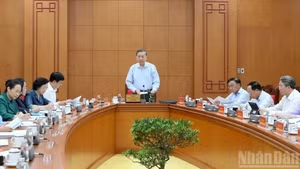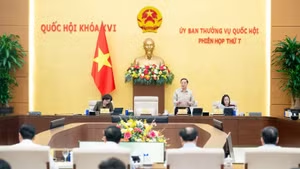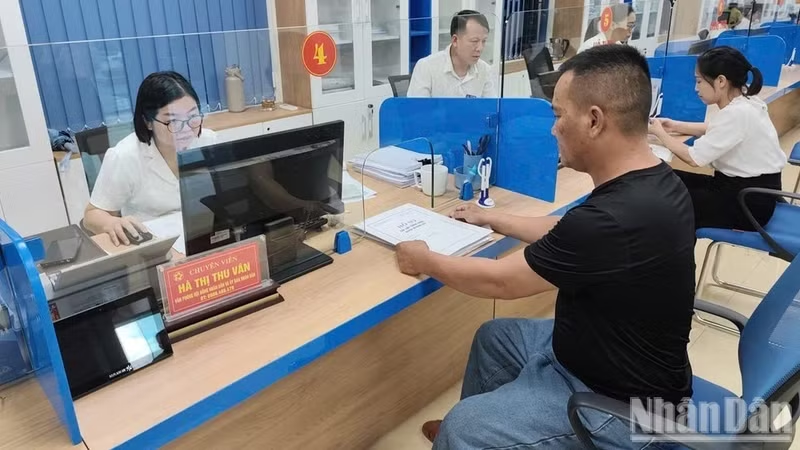
Throughout the Party's theoretical thinking on renewing its leadership and governance methods, one principle has remained constant: whenever national governance enters a new stage of development, the Party's methods of leading the political system and society must also be restructured in a corresponding and coordinated manner.
As the three-tier government model is operating across the country and Party Central Committee directives can reach the grassroots within hours through integrated databases and shared software platforms, renewing the Party's leadership and governance is no longer merely a theoretical issue. It is reflected in every Party cell meeting and every executive decision taken at the grassroots level.
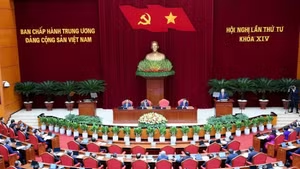
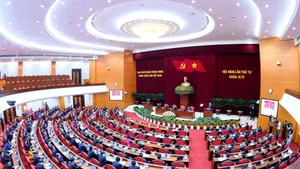
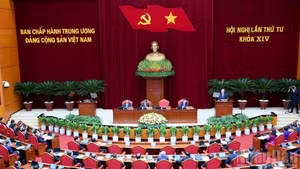
In July 2026, the third plenum of the 14th Party Central Committee translated this requirement into a new development framework centred on the "four strategic shifts". The first of these is to strengthen the Party's leadership and governance capacity while improving the operational quality of both the Party and the State apparatus.
This provides the theoretical and practical foundation for the 11th National Press Award on Party Building – the Golden Hammer and Sickle Awards in 2026, which focus on the 10 Party-building tasks, three breakthrough solutions for Party building, and the six key tasks and three strategic breakthroughs adopted by the 14th National Party Congress.
An essential requirement for a new stage of development
The year 2026 has been identified as a pivotal one. It marks the first year of implementing the Resolution of the 14th National Party Congress and the resolutions of Party congresses at all levels for the 2025–2030 term. It is also the year in which elections to the 16th National Assembly and People's Councils at all levels for the 2026–2031 tenure will be held.
At the same time, it has been designated as the "Year of Grassroots Cadres", when the entire political system operates under a streamlined, strong, efficient, effective and high-performing three-tier government model.
Against the backdrop of an increasingly complex and unpredictable regional and international environment, the need to renew the Party's leadership and governance methods has never been more pressing. Doing so is essential not only to safeguard political stability and strengthen the confidence of officials, Party members and the people, but also to lay the groundwork for the country's rise in a new era.
The operation of the new governance model requires corresponding changes in the Party's methods of leadership. A leadership model characterised by multiple administrative layers and heavy reliance on paperwork and traditional meetings, if left unchanged, would become an obstacle rather than a driving force for development. The documents of the 14th National Party Congress clearly state the requirement:
"Continue to vigorously renew thinking, build consensus in understanding, and effectively implement the Party's methods of leadership and governance in a comprehensive and coordinated manner."
This is far more than a slogan. It is a practical imperative arising from the country's development at this stage—a stage in which the Party has resolved to "continue strengthening Party building and rectification, promoting self-renewal so that the Party truly embodies morality and civilisation, while enhancing its leadership and governance capacity, effectiveness and fighting strength."
Viewed within the overall framework of the 10 Party-building tasks and three breakthrough solutions adopted by the 14th National Party Congress, renewing the Party's leadership and governance is not a stand-alone task. Rather, it is the common thread that determines the effectiveness of the entire Party-building agenda, encompassing political and ideological work, organisational development, cadre affairs, inspection and supervision, as well as the fight against corruption, wastefulness and other negative phenomena.
From the 14th National Party Congress’ guideline to the "four strategic shifts" of the third plenum
From a theoretical perspective, the Party's leadership and governance encompass the methods, mechanisms and instruments through which the Party leads the State and society in implementing its Platform, guidelines and policies. This leadership is exercised through ideological work, organisational development, cadre affairs, inspection and supervision, and by promoting the exemplary role of Party members—not through administrative orders, nor by assuming responsibilities that properly belong to State authorities.
This understanding has consistently underpinned the Party's approach, from the 14th National Party Congress through the Party Central Committee plenums implementing the Congress's Resolution.
This process may be viewed as a coherent and logical progression. The 14th National Party Congress set out the Party's overarching direction, objectives and strategic orientations for the entire term. The second plenum of the 14th Party Central Committee established the organisational foundations and operating principles for the political system.
By the third plenum, held from July 20 to 24, 2026, the focus had shifted to translating those strategic orientations into concrete decisions capable of removing bottlenecks, unlocking resources and creating new drivers of national development.
At the plenum, General Secretary of the Communist Party of Viet Nam Central Committee and State President To Lam stressed that the Party Central Committee's decisions must bring about four strategic shifts: enhancing the Party's leadership and governance capacity and improving the operational quality of both the Party and the State apparatus; ensuring unified governance of the national development space while making more effective use of national resources; establishing a development model driven by productivity, knowledge, technology and people; and strengthening national resilience through proactive risk prevention while firmly safeguarding the country.
These four transformations are not separate initiatives but interconnected elements of a unified strategy. At its core is the first transformation—renewing and enhancing the Party's leadership and governance capacity—which serves as the foundation underpinning and determining the effectiveness of the other three.
In other words, from both a theoretical and practical perspective, without renewing the Party's leadership and governance in the right direction, efforts to improve resource governance, transform the growth model or strengthen national resilience would lack the solid foundation required for coordinated and effective implementation.
This also reflects the logic of the 14th National Party Congress in identifying six key tasks and three strategic breakthroughs for national development. Renewing the Party's leadership is not an external condition but a prerequisite that must come first, enabling breakthroughs in institutional reform, infrastructure development and high-quality human resources to be implemented effectively under the three-tier government model.
Concrete decisions turning theory into practice
The spirit of renewing the Party's leadership methods was translated into action at the third plenum through a series of highly practical and specific decisions. The Party Central Committee has decided to issue regulations amending and supplementing Regulation No. 20 on the implementation of the Party Statutes, the fundamental document to ensure that all organisational and operational reforms remain fully consistent with the Party Statutes and within the prescribed authority, while allowing unprecedented issues to be piloted only within clearly defined scopes and timeframes, thereby preventing arbitrary implementation or actions beyond authorised powers.
The Party Central Committee also agreed to promulgate a new regulation on acts prohibited for Party members, replacing Regulation No. 37-QD/TW, which had been in force for nearly five years. A key feature of the new regulation is the clearer articulation of ethical standards and the responsibility to set an example in the context of digital transformation, organisational restructuring and newly emerging forms of misconduct in cyberspace.
This reflects the principle that renewing the Party's leadership methods must go hand in hand with modernising the mechanisms for inspection, supervision and Party discipline.
With regard to organising development space and improving resource governance, the plenum approved the establishment of Quang Ninh City and Bac Ninh City. It also endorsed a preliminary review of Resolution No. 18 together with orientations for revising the Land Law and related legislation, demonstrating that innovation in the Party's leadership methods must precede and guide institutional reform and socio-economic policymaking.
Most notably, the Party Central Committee adopted a resolution on the project to renew Viet Nam's development model, describing it as a major and unprecedented initiative that will shape the country's development model through to 2045 and beyond. It also approved a project to build a disciplined, safe, civilised, harmonious and prosperous society, placing people, culture, the rule of law and discipline at its core, with people's quality of life and happiness serving as the ultimate measure of success.
Together, these decisions provide compelling evidence that renewing the Party's leadership methods has moved beyond theoretical thinking and has been translated into concrete projects, resolutions and regulations with strong practical relevance, providing the foundation for the political system to operate in a coordinated, seamless and effective manner.
Three pillars of shift: Institutional organisation, cadre work and digital transformation
Recent experience in Party building demonstrates that renewing the Party's leadership and governance is being translated into practice through three closely interconnected and mutually reinforcing pillars.
The first pillar is the organisation and operation of the political system under the new model. The implementation of the three-tier government model is far more than an organisational restructuring; it represents a fundamental transformation in the Party's methods of leadership.
By reducing intermediary layers, shortening the distance between policymaking and implementation, and enhancing the initiative and accountability of grassroots authorities, the new model provides the conditions necessary for the political system to "operate in a coordinated and seamless manner, meeting the requirements of rapid and sustainable national development."
The second pillar is reforming cadre work, particularly the appraisal and evaluation of officials, long regarded as the "master key" to Party building. A modern system of leadership cannot function effectively without a contingent of officials who possess both integrity and competence, continuously improve themselves and are capable of meeting the demands of their responsibilities.
Accordingly, alongside organisational restructuring, conducting substantive assessments of officials' capabilities—particularly grassroots officials during 2026, designated as the "Year of Grassroots Cadres"—will be decisive to the effective operation of the entire political system.
Equal importance is attached to expanding Party membership among workers, managers in the non-state sector, religious followers and people living in rural, mountainous, border, island and ethnic minority areas, while strengthening internal political protection through more rigorous and substantive management of officials and Party members.
The third pillar is digital transformation in Party affairs. Establishing integrated and interconnected databases on officials and Party members, together with deploying common software applications and a secure, modern dedicated data transmission network across the Party, provides the practical tools needed for the Party's renewed leadership methods to operate effectively in practice rather than remain policy aspirations. As a result, a directive issued by the Party Central Committee can reach Party cells in remote and mountainous areas more quickly, more transparently.
These three pillars are inseparable from the six key tasks and three strategic breakthroughs identified by the 14th National Party Congress for socio-economic development, ranging from institutional reform and the development of high-quality human resources to building integrated infrastructure, particularly multimodal transport systems, digital infrastructure and technological infrastructure serving governance, public administration and development.
Science and technology, innovation and digital transformation are expected to become new drivers of growth. Renewing the Party's leadership methods is therefore the prerequisite for ensuring that these strategic breakthroughs can be implemented in a coordinated and effective manner under the three-tier government model.
Linking leadership reform with power control, combining "building" with "combating"
A sustainable renewal of the Party's leadership methods requires more than streamlining the organisational apparatus or applying new technologies. It must go hand in hand with strengthening discipline, reinforcing Party and State power oversight, and tightening accountability.
Reforming inspection and supervision in a systematic, integrated and data-driven manner, underpinned by strategic vision and unwavering political resolve, represents the "combating" dimension that complements the "building" aspect of the Party's renewed leadership methods.
In this process, all violations must be dealt with rigorously in accordance with the principle of "no prohibited areas and no exceptions", upholding the rule of law while maintaining a humane approach in pursuit of stability and development.
The principle of "using positive values to overcome negative ones" and "using the good to drive out the bad", whereby "building" constitutes the fundamental, strategic and long-term task while "combating" remains an urgent and continuous responsibility, should not merely serve as a communications guideline but become an operational principle.
Wherever the Party's leadership methods are renewed in the right direction—characterised by transparency, data-driven governance and clearly defined individual accountability—the scope for wrongdoings, bureaucracy, "self-evolution" and "self-transformation" will naturally diminish. Conversely, superficial or half-hearted reforms will merely create new opportunities for stagnation.
This principle is clearly reflected in the third plenum's formulation of the new regulation on acts prohibited for Party members. The regulation is intended to be clear, rigorous and practical, enabling violations to be accurately identified and dealt with firmly, while avoiding unnecessary constraints on officials and Party members who dare to think creatively, act decisively and take responsibility for the common good.
This represents an important theoretical balance: stronger power oversight should not stifle dynamism and innovation but rather provide the legal and institutional framework within which they can flourish in the right direction.
Across many localities, Party cell meetings have been reformed to become more practical and closely linked to addressing people's everyday concerns. At the same time, proactive grassroots officials who dare to think, act and take responsibility are gradually replacing the passive and administrative working style of the past. These are the vivid examples of how the Party's leadership and governance are being renewed at the grassroots level and provide valuable material for the press to identify, report and disseminate.
The deeper foundation: Building Party culture with leading by example at its core
If organisational restructuring, cadre work and digital transformation constitute the "hard" pillars of renewing the Party's leadership methods, then Party culture forms the "soft" yet most enduring foundation, determining the depth and sustainability of every reform. No matter how streamlined or modern a leadership system may be, it cannot achieve lasting effectiveness or win the enduring trust of the people without a strong foundation of revolutionary ethics, integrity, discipline, and the pioneering and exemplary conduct of officials and Party members.
Further promoting the study and following of Ho Chi Minh's thought, morality and style, while identifying, commending and replicating exemplary models, effective practices and outstanding examples in implementing regulations on leading by example, is essential to ensuring that the Party's aspiration to become "a Party of morality and civilisation" is translated from a slogan into everyday practice within every Party cell and among every official and Party member.
Equally important is promoting the values of Vietnamese culture while drawing on the best of world civilisation to strengthen leadership culture and public service ethics, foster strategic autonomy, self-confidence, self-reliance, resilience, national pride, and a spirit of serving the Fatherland and the people.
These are the core values that every official and Party member should embrace in implementing the Party's renewed leadership methods, while also providing the vital link between strengthening the Party organisationally and strengthening it culturally and ethically.
The role of the press and the responsibility of every official and Party member to lead by example
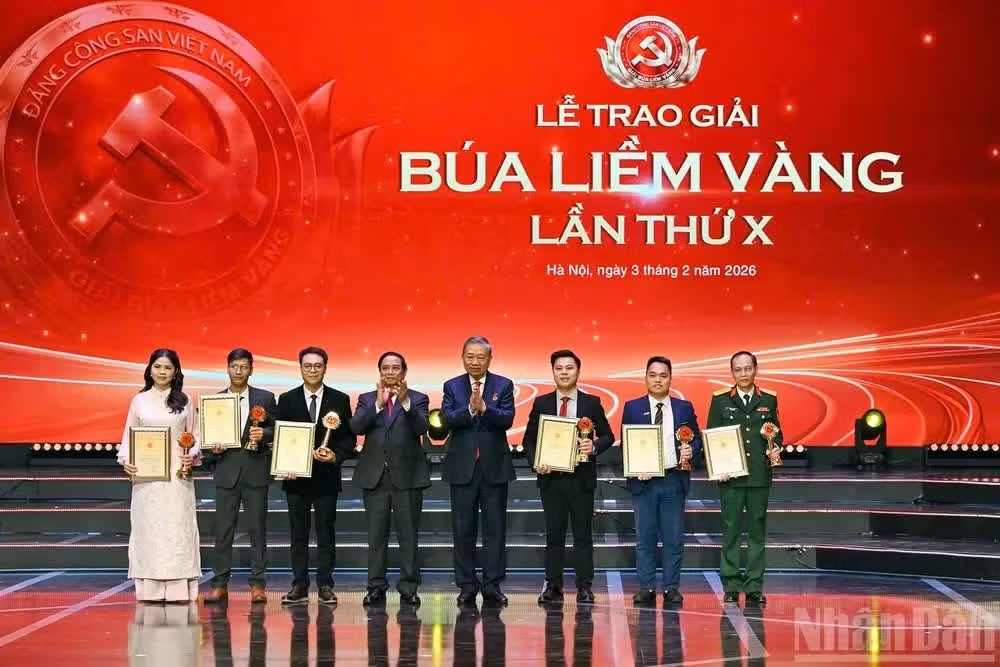
Over the past ten editions, the National Press Awards on Party Building—the Golden Hammer and Sickle Awards—have become an important platform for identifying, promoting and replicating innovative models and effective practices in renewing the Party's leadership methods across all sectors and levels. The awards have also helped reaffirm the importance of Party building while fostering confidence and optimism among officials, Party members and the people.
Every entry submitted to the awards, if firmly grounded in realities at the grassroots level and faithfully reflecting both the achievements and the challenges encountered in renewing the Party's leadership methods, will make a meaningful contribution to translating the Party's resolutions into practice, fully in line with the objectives and requirements set out in the plan for the 11th Golden Hammer and Sickle Awards.
However, renewing the Party’s leadership and governance methods cannot rely solely on policies issued by the Party Central Committee or encouragement from the press. It must first begin with the exemplary responsibility of each cadre and Party member, particularly heads of Party committees and administrations at all levels.
A new leadership method can only truly take root in practice when each cadre and Party member proactively changes their working mindset, embraces the use of technology and is willing to take personal responsibility, rather than avoiding responsibility or passing the buck as was the case with old working practices.
Renewing the Party’s leadership and governance methods is a continuous, never-ending process that requires consensus and unity from the central to grassroots levels. The spirit of the third Plenum of the 14th Party Central Committee made it clear that unity in policy must immediately translate into unity in action – meaning that every decision, however sound, is only meaningful when it is concretised through substantive changes at each Party committee, agency and organisation, and by every cadre and Party member.
As the country prepares the foundations and springboard for its rise in the new era, every step taken today to renew the Party’s leadership methods – from streamlining the apparatus, reforming personnel work, accelerating digital transformation, and completing institutions for the implementation of the Party Charter and issuing new regulations on what Party members must not do, to unified governance of development space, building Party culture, and building a disciplined, safe, civilised, harmonious and developing society – constitutes a building block towards a truly clean, strong and comprehensively capable ruling Party, capable of leading the country towards prosperity, civilisation and happiness, while firmly strengthening the trust of cadres, Party members and the people in the Party’s leadership.

![[Infographic] Key points from General Secretary and President To Lam’s opening remarks at the 14th PCC’S 4th plenum](https://en-cdn.nhandan.vn/images/j0QNt7m_5iy1OXpnUKiwG61aYhTv_B140GWhfriF26JwZbNNJ8LWetfvXUhz4Az6/1-8220.jpg.avif)