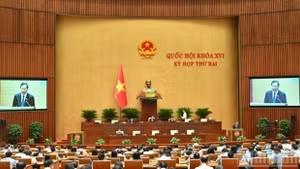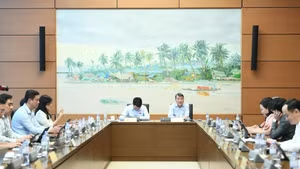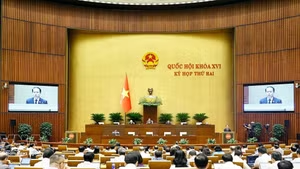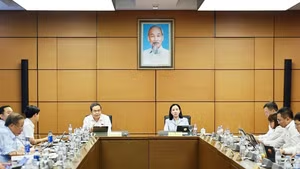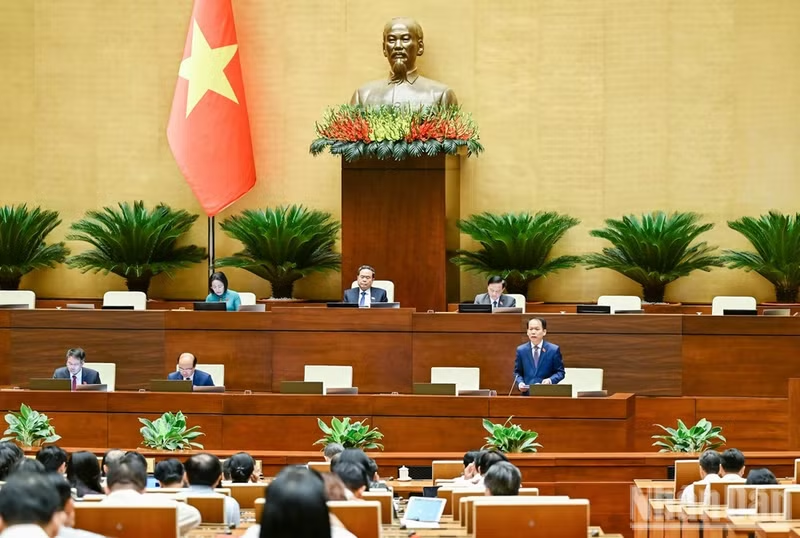
They said this will provide a robust and flexible legal framework for developing modern, smart, green and sustainable Vietnamese cities with stronger international competitiveness.
Greater powers to unlock development potential
Most deputies welcomed the draft law’s reform-oriented approach and a number of breakthrough policies, including greater decentralisation in organisational arrangements, staffing management and policy implementation.
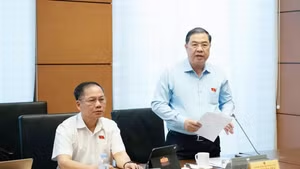
Discussing greater autonomy for special urban administrations, deputy Nguyen Ngoc Son of Hai Phong city proposed that the law clearly regulate the solicitation and handling of opinions from the Government or Prime Minister on matters involving national and inter-regional planning and infrastructure before a city approves its plans.
He also called for clearer rules on the scope of regulations that a municipal People’s Committee can temporarily suspend. Where such measures differ from laws or resolutions of the National Assembly, they must follow mechanisms specifically authorised by the legislature, avoiding a “grey area” between technological experimentation and legal policy pilots.
Deputy Trinh Xuan An of Dong Nai also stressed that comprehensive decentralisation must go hand in hand with power controls and a stronger role for People’s Councils. He said the authority and responsibility of leaders must be tied to oversight, openness and transparency.
According to An, the draft law assigns more than 150 powers to People’s Councils, giving them considerable room to decide local policies. Decentralisation, he said, should not merely mean transferring powers from central authorities to municipal People’s Committees and their chairpersons. People’s Councils must fully exercise their role as elected institutions responsible for policymaking and overseeing local administrations.
An proposed three levels of oversight: before decisions are made, during implementation, and through post-implementation evaluation and accountability. He also called for stronger capacity among People’s Council committees and full-time deputies, alongside clearer boundaries between powers that may depart from general laws and the corresponding oversight mechanisms.
Stronger decentralisation, tighter oversight
Deputy Nguyen Dai Thang of Hung Yen urged the drafting body to clarify the financial responsibility of leaders and the oversight roles of the National Assembly, Government and People’s Councils. He also proposed specific criteria and conditions for other cities to apply the mechanisms under the law, preventing “ask-give” mechanisms or premature application.
Thang supported greater autonomy in staffing and recruitment policies, particularly in human resources management. He proposed stipulating that funding for such policies must come from local budgets, without using central budget funds or altering general policies applicable to civil servants and public employees.
Regarding controlled pilot mechanisms, Thang called for clearer rules governing their relationship with sector-specific laws, particularly those on land, monetary policy, planning and investment.
On stalled projects, Son proposed that when a stalled project resumes, authorities fully review land-related financial obligations and those arising from project adjustments, ensuring that the State suffers no revenue losses while avoiding the re-establishment of obligations already lawfully fulfilled.
Projects involving large or complex land values, public assets or financial obligations should also undergo inter-agency appraisal before decisions are made. Son suggested considering a deadline of December 31, 2026, arguing that extending the mechanism for up to 10 years could weaken its urgency and encourage a wait-and-see mentality.