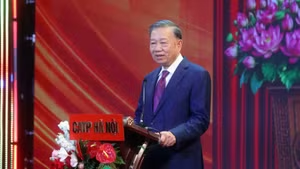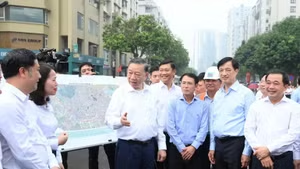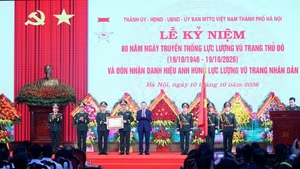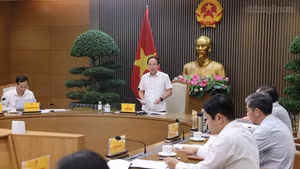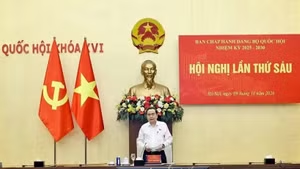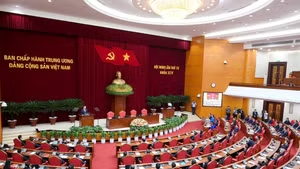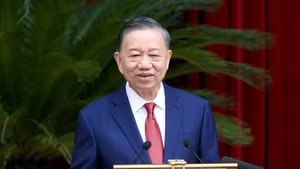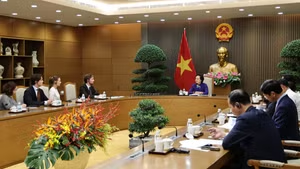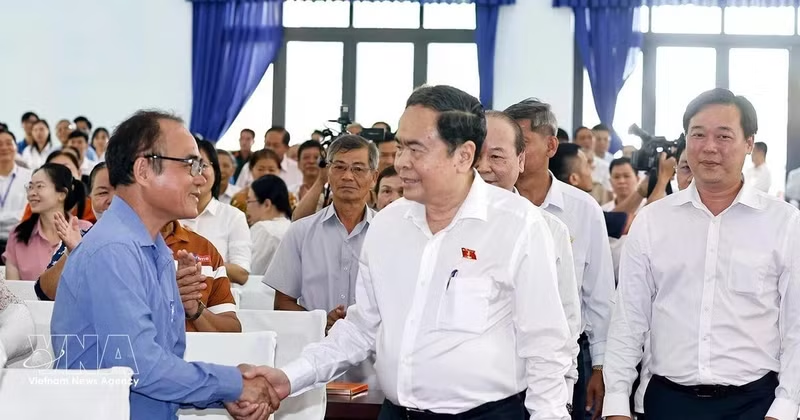
The NA Chairman and four other candidates standing for election to the 16th legislature in constituency No. 12 met voters in An Nhon Tay, Thai My, Nhuan Duc, Tan An Hoi and Cu Chi communes and Division 9.
In his action programme, the top legislator outlined four key priorities: removing institutional bottlenecks, promoting a knowledge-based economy, listening to and addressing voters’ concerns, especially in his constituency, and building a streamlined, effective administrative apparatus.
He noted that the Party and State had issued a range of major policies to spur national development. Ho Chi Minh City, in particular, has benefited from several NA resolutions piloting special mechanisms and policies with stronger decentralisation to enable it to play its role as the country’s economic locomotive.
During the 14th legislature, the National Assembly adopted Resolution 54 on piloting specific mechanisms and policies for the city’s development, granting it greater autonomy and resource mobilisation capacity.
In the 15th legislature, Resolution 98/2023/QH15 and, most recently, Resolution 260/2025/QH15 were issued, providing even stronger decentralisation. Resolution 260 supplements the legal framework for the city to pilot a free trade zone, enhance autonomy in investment, budget, land management, and expand mechanisms to attract strategic investors, particularly in infrastructure, high technology and innovation.
The city is also permitted to pilot new urban governance models, transit-oriented development, and accelerate digital transformation, science and technology and the commercialisation of research outcomes.
Despite these opportunities, Chairman Man said both the country and the city continued to face challenges.
He pledged to work with the Politburo and the Secretariat of the Party Central Committee, the National Assembly, the Government and the city's authorities to remove institutional obstacles, reform lawmaking and enforcement and ensure effective implementation of the city’s special mechanisms.
Priority areas include planning, investment, land management, environmental protection, regional transport connectivity, digital infrastructure and science and technology.
The NA Chairman emphasised fostering a knowledge-based economy driven by productivity, science, technology and innovation, establishing mechanisms to attract and retain talents and training high-quality human resources to enhance the city’s global competitiveness. He said the foremost duty of a NA deputy is to listen to and convey the aspirations of the people, adding that he will focus on pressing issues such as flooding, environmental pollution, traffic congestion, public security, social housing, hospitals and schools.
The NA Chairman also said the city needs more favourable mechanisms to build factories, warehouses and auxiliary facilities serving agriculture.
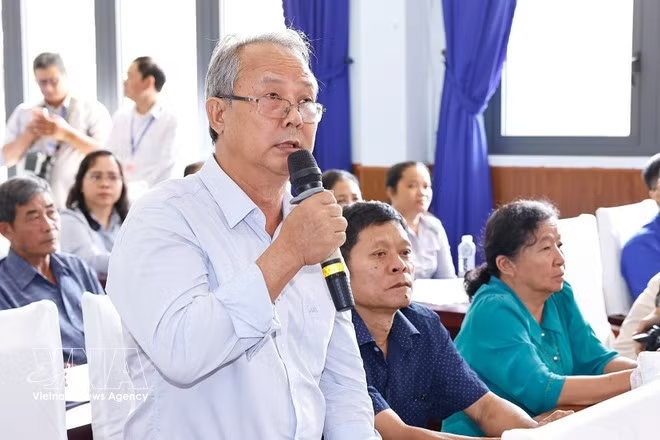
To develop more special mechanisms for the city, he said the legislative body will continue refining policies on finance and transparent investment, stressing that planning must be implemented effectively.
He also committed to helping build a lean, efficient and effective city administration, fostering a spirit of initiative and accountability and strengthening unity among the people.
At a thematic voter meeting with farmers from 11 communes in Ho Chi Minh City on the afternoon of the same day, NA Chairman Man underscored that, looking back on 40 years of Doi Moi (Renewal), agriculture, farmers and rural areas have played an especially important role as a pillar of the economy. The sector has maintained political stability, ensuring social order and safety, controlling inflation, and helping Viet Nam affirm its agricultural brand in the international arena.
He noted that the country is entering a “green era” – an era of innovation, data and knowledge – in which farmers are expected not only to excel in production but also to master technologies, take command of markets, and shape their own future.
He stressed that it is important not only to promulgate policies, but to ensure that they are implemented and translated into practice, with a focus on developing high-tech and urban agriculture, providing preferential credit, agricultural insurance and stable market outlets, maintaining consistent land-use planning to build public confidence, enhancing vocational training and job transition, and strengthening social security.
In the current context, greater emphasis must be placed on deep processing and high technology, with increased investment in advanced solutions, including post-harvest technologies, preservation techniques, cold storage systems and irradiation, to extend storage and transport time.
At the same time, digital transformation and traceability are crucial, as international markets are becoming increasingly stringent and demand greater transparency, particularly in the EU, Japan and the US.
Accordingly, planting areas should be digitalised, with synchronised establishment of planting area codes and packing facility codes to ensure quality control from farm to table, he added.