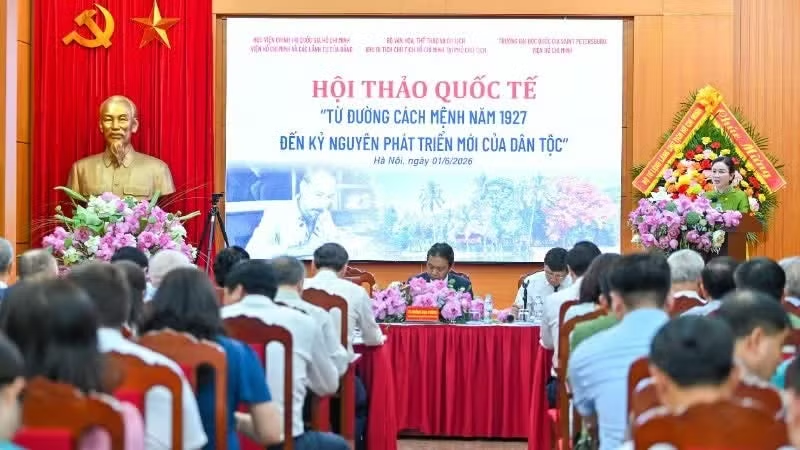
In her opening remarks, Le Thi Phuong, Director of the Ho Chi Minh Relic Site at the Presidential Palace, affirmed that The Revolutionary Path marked a new stage in Nguyen Ai Quoc’s theoretical thinking and laid the ideological foundations for the establishment of the Communist Party of Viet Nam (CPV) in 1930.
Phuong emphasised that from The Revolutionary Path to the strategic vision set out by the CPV at its 14th National Congress, there runs a rich and dynamic stream of theory and practice, reflecting the process of creatively applying and developing Marxism-Leninism in Viet Nam’s specific conditions.
Featuring more than 30 presentations, the seminar highlighted President Ho Chi Minh’s immense role in laying the foundations and providing strategic guidance for the nation’s development through The Revolutionary Path.
The guidance offered by Nguyen Ai Quoc in the work not only possesses great historical significance but also profound contemporary relevance to the cause of national construction and development, demonstrating the enduring value and vitality of Ho Chi Minh Thought.
In this new era, as the country faces the imperative of achieving stronger growth, enhancing strategic autonomy and keeping pace with global development trends, Ho Chi Minh Thought has become an even more important source of spiritual strength, an intellectual foundation, and a guide for action.
Presenting his paper at the seminar, Prof, Dr Le Van Loi, President of the Viet Nam Academy of Social Sciences, observed that a century after its publication, The Revolutionary Path continues to demonstrate its lasting value as a theoretical work and a document of strategic significance for the development of the Vietnamese revolution.
The work profoundly reflects Nguyen Ai Quoc’s theoretical thinking and strategic vision in identifying the correct path to national liberation for the Vietnamese people, while affirming a fundamental truth: for a revolution to succeed, it must be guided by a scientific, progressive, and revolutionary theory.
That same day, on the sidelines of the seminar, the Ho Chi Minh Relic Site at the Presidential Palace launched the bilingual Vietnamese-Russian book “Nguyen Ai Quoc-Ho Chi Minh and Russia”.
The book contains more than 200 documents, photographs, manuscripts, artefacts, as well as stories, memoirs, and heartfelt reflections by Russian friends and people expressing their affection and admiration for him.
On the occasion, an exhibition was held featuring 115 archival photographs that vividly recreate President Ho Chi Minh’s domestic and foreign affairs activities, as well as moments from his daily life within the Presidential Palace complex, where he lived and worked during the final 15 years of his life (1954-1969).