The southern province of An Giang has achieved a number of encouraging initial results in streamlining its administrative apparatus after one year of implementing the two-tier local government model.
However, practical implementation has also placed considerable pressure on the grassroots political system, requiring coordinated adjustments from the central authorities.
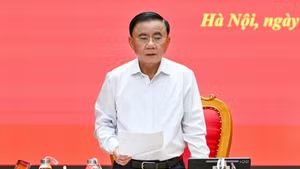
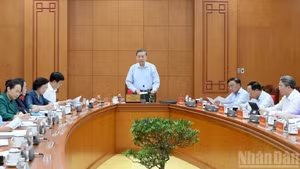
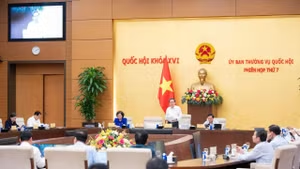
This assessment was made at a review conference on the new model held on June 1 with the participation of An Giang’s provincial leaders and representatives from 102 communes, wards, and special zones.
According to provincial leaders, the two-tier model has begun to demonstrate its effectiveness through greater decentralisation and delegation of authority to the grassroots level in areas such as administrative procedures, human resources, and finance.
Notably, responsibility for budget expenditures and management in sectors including education, irrigation, and environmental protection has been transferred directly to commune-level authorities, enabling local administrations to operate with greater initiative and flexibility.
Alongside the advantages of a streamlined structure and the reduction of intermediary administrative layers, An Giang is facing serious overload at the commune level.
As the model is entirely new, the number of units directly under provincial management has increased from 26 to 102, raising concerns that investment resources may be spread too thinly.
At the same time, while the volume of work transferred to the grassroots level has risen sharply, commune-level administrations are short of personnel due to the streamlining process.
In addition, information technology infrastructure remains uneven, data systems occasionally experience errors and overloads, and the intensive reporting regime has created further pressure.
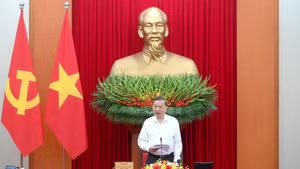
In his concluding remarks, Nguyen Tien Hai, Secretary of the An Giang Provincial Party Committee, affirmed that the implementation of the two-tier local government model is an apt strategic policy aimed at streamlining the administrative apparatus and enhancing the effectiveness of state governance.
Regarding tasks in the coming period, he called on authorities and sectors at all levels to focus on implementing breakthrough solutions, including strengthening inspection and supervision in order to promptly address emerging difficulties and obstacles.
He also urged continued efforts to expand decentralisation and delegation of authority in tandem with resource allocation, based on the principle of clear responsibilities, clear tasks, clear accountability, clear authority, clear timelines, and clear outcomes.
Other priorities include promoting greater autonomy in public service delivery, swiftly dealing with redundant office facilities, and accelerating the digitisation of archival records.
At the same time, with the aim of achieving double-digit economic growth, the province will work to remove institutional, land-use, and public investment bottlenecks, while focusing on the development of border trade, tourism, and high-tech agriculture.