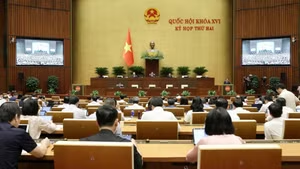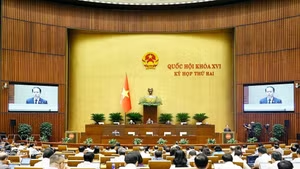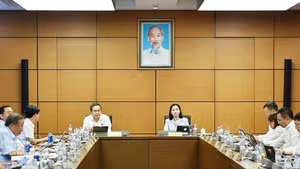
Most importantly, one year of implementation has demonstrated that this is not only a sound policy, but also a model that has been implemented correctly, swiftly, and sustainably.
A decisive shift from administrative management to public service delivery
Following rounds of administrative boundary reorganisation, the two-tier local government model has become a focal point in Viet Nam’s efforts to reform the state administrative apparatus. This is not merely a mechanical restructuring, but an attempt to dismantle rigid institutional barriers.
Behind this streamlining, however, lies the challenge of transforming governance thinking: shifting from an administrative management mindset to a service-oriented approach, while enhancing transparency and strengthening accountability at both the individual and institutional levels.
A rapid assessment on the effectiveness of public service delivery since the implementation of the two-tier local government model was jointly conducted by the Ho Chi Minh National Academy of Politics and the Mekong Development Research Institute (MDRI). Presenting the findings, Dr Phung Duc Tung, Director of MDRI, noted that citizens had positively assessed the two-tier local government system and supported the streamlining of local government structures through the removal of the intermediary district level.
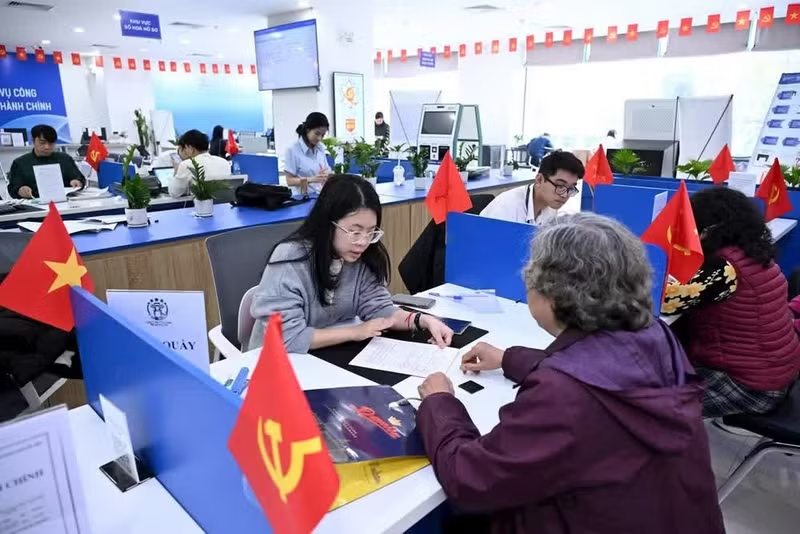
However, direct interaction between citizens and commune-level authorities, as well as village and neighbourhood heads, remained limited in the early stages of the transition. The proportion of people contacting commune or ward officials and village/neighbourhood heads was low, at 8.63% and 16.84% respectively.
Satisfaction with administrative procedures at the commune level reached 4.1 points on a five-point scale. The survey also showed that nearly one in five respondents still rated their interactions with local authorities as unsatisfactory.
Meanwhile, from July 1, 2025, the 63 provincial and municipal public service portals ceased operation, with the National Public Service Portal becoming the sole “electronic one-stop shop”. However, the proportion of users satisfied with online public administrative services on the portal remained modest at 87%, while 27% of citizens reported difficulties using the portal and 34% raised concerns about personal data security.
According to Dr Phung Duc Tung, an issue of particular concern is the finding that nearly 3% of citizens still have to rely on intermediary “brokers” to complete administrative procedures, while nearly 4% still have to pay unofficial fees to have their applications processed.
Notably, among those applying for land-use rights certificates, the proportion needing to use intermediaries reached 12%, almost 10 percentage points higher than the average for other administrative procedures.
Dr Phung Duc Tung noted that the past period had witnessed major transformations across the entire local government system. These initial findings provide important practical evidence for authorities at all levels to reflect on and act upon, making timely and adaptive adjustments in order to build a local governance system that is effective, efficient, inclusive, and citizen-centred.

Ensuring governance capacity and strengthening public trust
Assessing the two-tier local government model after one year of implementation, Assoc Prof, Dr Nguyen Manh Hung, Vice President of the Ho Chi Minh National Academy of Politics and Vice Chairman of the Central Theoretical Council, stated that the local government apparatus had initially operated stably, with citizens supporting the policy, trusting the system, and expecting a more modern, seamless, transparent, and accountable administration.
However, according to Assoc Prof, Dr Nguyen Manh Hung, the transition process still presents many issues that must be candidly acknowledged and promptly addressed. If the organisational structure is rearranged but procedures fail to keep pace, bottlenecks will emerge and citizens may still face delays. In many areas, grassroots officials are handling larger and more complex workloads, while working conditions remain inadequate and professional skills are still underdeveloped.
“Organisational restructuring must go hand in hand with redesigning procedures, clearly defining authority, allocating sufficient resources, and addressing barriers to digital service access, so that policies can be implemented quickly, correctly, consistently, and with tangible results. The important thing is not only to have the right policy, but also to implement it correctly, swiftly and sustainably. A good system is not one that never encounters obstacles but rather one that identifies problems early, resolves them promptly, and does not force citizens to bear the burden of inconsistency,” Dr Nguyen Manh Hung emphasised.
Sharing this view, Australian Ambassador to Viet Nam Gillian Bird remarked that Viet Nam is undergoing profound transformation. Building governance capacity at the local level plays a particularly important role in maintaining and strengthening public trust. Good governance is a central factor in enabling inclusive, effective, and sustainable development.
Reaffirming the consistent view that the policy of restructuring, merging and streamlining the local government apparatus is entirely correct, Assoc Prof, Dr Nguyen Manh Hung pointed out that practical implementation has shown this to be a process of continuous refinement. Only through implementation can shortcomings and inconsistencies be clearly identified, so that difficulties and limitations may be progressively addressed and operational mechanisms further refined.