As the country enters a new stage of development, with requirements for rapid and sustainable growth and deeper international integration, institutional reform, especially administrative procedure reform, has become even more urgent. It plays a key role in unlocking resources and creating new momentum for national development.
Speaking at the opening session of the 8th sitting of the 15th National Assembly on October 21, 2024, Party General Secretary and State President To Lam emphasised that among the three biggest bottlenecks at present — institutions, infrastructure and human resources — institutions are the bottleneck of bottlenecks.
That assessment not only reflected a strategic vision but also set out the requirement for more decisive, coordinated and substantive action in law-making, institutional improvement, administrative reform and the renewal of national governance methods.
Over the past nearly two years, that spirit has been translated into strong movements across many fields. Legal barriers, overlapping regulations and shortcomings have gradually been identified more fully. Many solutions have been implemented decisively and continuously reviewed and adjusted to match reality.
From the central to local levels, from legislative to executive agencies, the mindset of action has shifted strongly towards proactive facilitation, with the effectiveness of serving people and businesses taken as the measure of performance.
Party General Secretary and State President To Lam has repeatedly requested the National Assembly to strengthen supervision and accelerate the building and completion of the legal system, ensuring that the Party’s guidelines are quickly brought to life. This is not only a technical requirement in legislative work, but also a demand to renew governance thinking and overcome the tendency to avoid, shift responsibility or fear making mistakes in public duty performance.
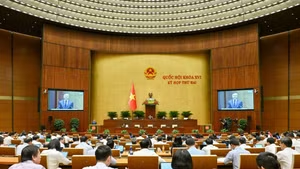
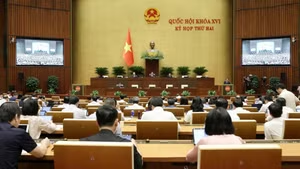
That spirit of renewal has been clearly demonstrated in the National Assembly’s legislative activities in recent times. At the opening session of the 10th sitting of the 15th National Assembly on October 20, 2025, National Assembly Chairman Tran Thanh Man affirmed that the National Assembly had strongly promoted its role in perfecting institutions and laws. The amendment and supplementation of a number of articles of the 2013 Constitution promptly institutionalised the Party’s major guidelines, especially the policy on reorganising the state apparatus towards being “streamlined, effective, efficient, close to the people, closely connected with the people and closely aligned with reality”.
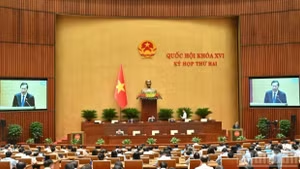
At the 10th sitting alone, the 15th National Assembly passed 51 laws and eight normative resolutions. Across the whole tenure, the National Assembly amended and supplemented a number of articles of the 2013 Constitution and passed 150 laws and 49 normative resolutions. At the very first sitting of the 16th National Assembly, it continued to pass nine laws and five normative resolutions, while deciding on many important national issues.
At the 10th sitting alone, the 15th National Assembly passed 51 laws and eight normative resolutions. Across the whole tenure, the National Assembly amended and supplemented a number of articles of the 2013 Constitution and passed 150 laws and 49 normative resolutions. At the very first sitting of the 16th National Assembly, it continued to pass nine laws and five normative resolutions, while deciding on many important national issues.
The heavy workload reflected strong political determination to complete the legal corridor for development. More importantly, it showed a shift in legislative thinking: from management to development facilitation; from the mindset of “banning what cannot be managed” to creating space for innovation; and from placing heavy emphasis on pre-inspection to strengthening post-inspection.
It can be affirmed that since the launch of the Doi Moi process in 1986, institutional reform, especially economic institutional reform, has always received special attention from the Party and State. Many mechanisms and policies have been continuously adjusted and improved to meet the requirements of development and deeper international integration.
Efforts to reform the business and investment environment, reduce unreasonable business conditions, simplify administrative procedures, and prevent and combat corruption and negative practices have brought about important changes. The achievements recorded after nearly 40 years of Doi Moi are clear evidence of the effectiveness of the process of removing institutional bottlenecks, which has been recognised and highly valued by international friends.
Entering the new tenure, the spirit of reform continues to be promoted with higher requirements, greater speed and stronger determination. At the Government’s regular meeting for April 2026 — the first meeting of the Government for the 2026-2031 tenure, held on May 4 — the focus of action was clearly defined: resolutely removing bottlenecks to promote growth and unlock resources for development.
Entering the new tenure, the spirit of reform continues to be promoted with higher requirements, greater speed and stronger determination. At the Government’s regular meeting for April 2026 — the first meeting of the Government for the 2026-2031 tenure, held on May 4 — the focus of action was clearly defined: resolutely removing bottlenecks to promote growth and unlock resources for development.
According to Deputy Minister of Justice Nguyen Thanh Tinh, in less than one month, the government, ministries and sectors launched an unprecedented large-scale administrative reform drive, with a series of plans to cut and simplify procedures and business conditions.
Nearly 50 laws are expected to be adjusted and 158 administrative procedures abolished, with the aim of sharply reducing compliance time and costs, creating a boost for the investment environment and economic development. Proposals have also been made to cut administrative procedure compliance costs by an estimated more than 23 trillion VND each year.
Under eight government resolutions, ministries and agencies have proposed and are implementing plans to cut 1,732 unnecessary business conditions, abolish 680 administrative procedures, simplify 521 administrative procedures and further reduce 18,097 working days in the settlement of administrative procedures. This brings the total time cut to 51,419 out of 97,024 days, equivalent to 52.9%, exceeding the set target.
Importantly, this reform drive is targeting the very issues that matter most to society, people and the business community. As procedures are cut in a substantive manner, the business and investment environment becomes more transparent and favourable, while social confidence is further strengthened.
The positive signals from the economy in recent times have partly shown the initial effectiveness of the process of removing institutional bottlenecks.
According to statistics from the Ministry of Finance, in the first four months of 2026, the number of newly established enterprises and those returning to operation increased by 33.9%, while total additional registered capital for the economy rose by 84.6%. On average, nearly 30,000 enterprises entered the market each month.
These are not merely growth figures. They also reflect the business community’s confidence in the investment and business environment and in the country’s development prospects. When institutions are improved and procedures streamlined, resources will be released, production capacity awakened, and new momentum created for rapid and sustainable growth.
However, removing institutional bottlenecks is a difficult, complex and long-term task. Therefore, along with institutional improvement, special importance must be attached to improving the quality of cadres and civil servants; tightening administrative discipline and order; and strengthening inspection, supervision and accountability in the performance of public duties.
The determination, persistence and consistency in the mindset of “placing people and businesses at the centre of service” are creating a new reform momentum throughout the political system. As the bottleneck of bottlenecks is gradually removed, the space for development will become broader and social resources will be unlocked more strongly, helping consolidate confidence in the country’s prospects for breakthrough development in the new stage.