Managing development through spatial planning and networks
On June 1, 2026, Minister of Construction Tran Hong Minh signed Decision No. 836/QD-BXD approving revisions to the national master plan for the urban and rural system.
The most pioneering aspect of the revised plan is its significant shift in planning philosophy — from management based solely on administrative boundaries to governance grounded in integrated spatial structures, interconnected networks, and digital data.
The revised plan is built upon a robust legal foundation, ranging from the 2025 Planning Law to National Assembly resolutions on administrative restructuring and urban classification. At its core lies a transformative approach that prioritises spatial development structures, regional connectivity, and data-driven governance over traditional administrative divisions.
The new development strategy identifies improving the quality and efficiency of urbanisation as a central task. The plan promotes advanced urban models, including green cities, smart cities, compact urban development, and innovation hubs. In particular, Transit-oriented Development (TOD) is prioritised as a key solution to address congestion and optimise land-use efficiency.
Viet Nam’s urban and rural system will be organised according to a “Poles–Regions–Corridors–Networks” structure. This framework is designed to ensure synergy between maritime inland spaces, and the national infrastructure system, while meeting environmental protection requirements and enhancing resilience to climate change.
Four major urban regions identified as growth engines
The plan designates four major urban regions that will serve as the core drivers of the national economy and generate development momentum across the country.
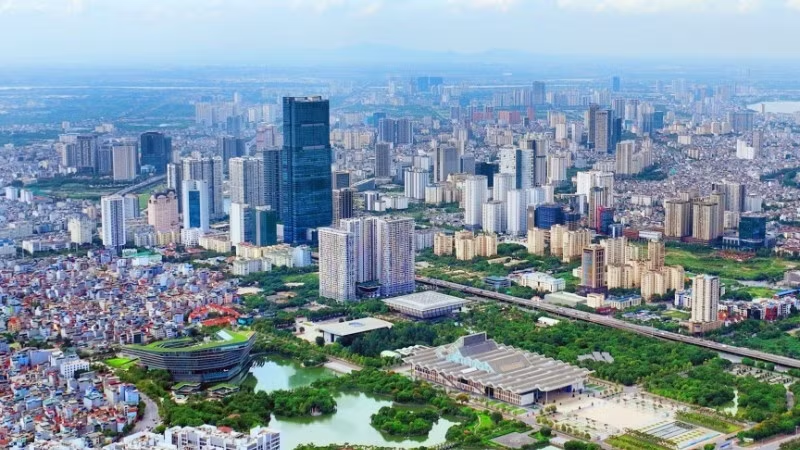
Ha Noi urban region comprises the capital city of Ha Noi and neighbouring localities in the Red River Delta and Northern Midlands and Mountainous Region, including Hai Phong, Quang Ninh, Bac Ninh, Phu Tho, Hung Yen, Ninh Binh, and Thai Nguyen. The development strategy aims to avoid excessive concentration in the urban core by promoting a cluster-based model of radial cities combined with a multi-centre, multi-polar urban structure.
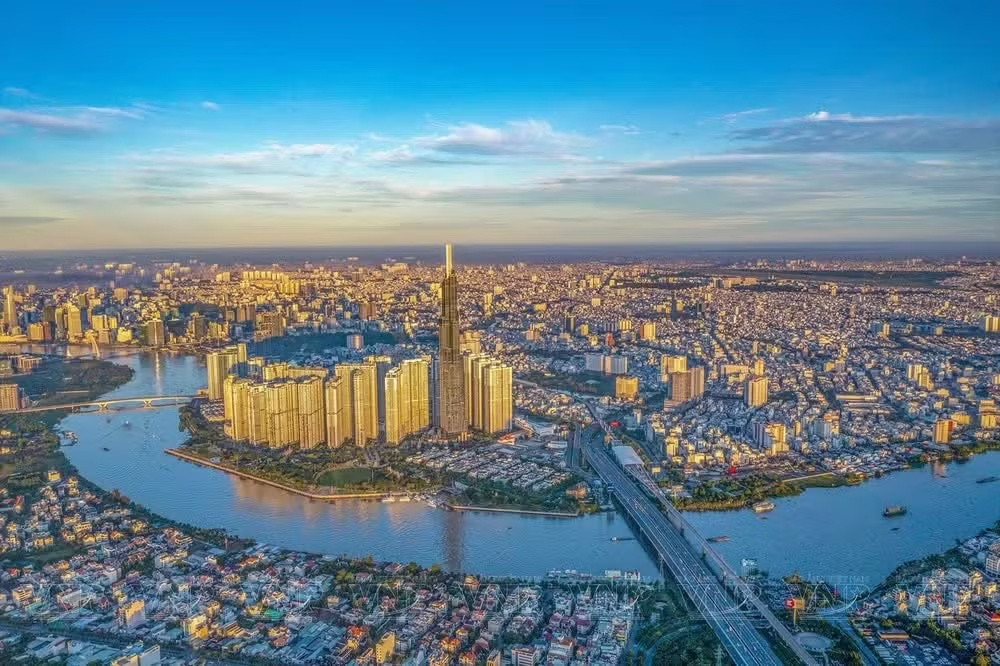
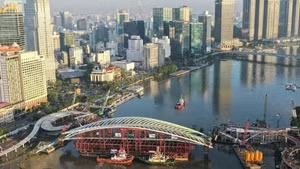
Ho Chi Minh City urban region includes Ho Chi Minh City, Dong Nai City, the provinces of the Southeast Region, and part of the Mekong Delta. The focus is on strengthening its role as an international economic, financial, and logistics centre while assigning specialised functions to satellite urban areas, particularly in seaport development and tourism, to reduce pressure on the central metropolitan area.
Da Nang–Hue urban region will serve as the principal growth driver of central Viet Nam, with a focus on the maritime economy, border-gate economic activities, and world-class heritage tourism.
As the growth pole of the Mekong Delta, Can Tho urban region will focus on modern agriculture, logistics, and river-based economic activities while maintaining a high level of resilience to rising sea levels.
Under the planning decision, each core city has been assigned a distinct mission to strengthen its position within the region and globally.
Ha Noi is envisioned as a “Civilised–Cultured–Modern” city, a global, smart, and green metropolis. It will remain Viet Nam’s leading centre for culture, education, healthcare, and finance, while further enhancing the Red River as a strategic ecological and cultural landscape corridor.
Ho Chi Minh City is expected to consolidate its leading position in Southeast Asia in terms of economic development, finance, and innovation. The long-term objective is to elevate the city to the level of major global metropolises and establish it as a key digital economy hub in Asia.
Hai Phong is planned as a modern maritime city and the principal seaport gateway for the Capital Region and the Lao Cai–Ha Noi–Quang Ninh economic corridor, with strengths in high-tech industry and international port services.
Hue and Da Nang will pursue complementary development paths. Hue will reinforce its identity as a heritage and festival city, while Da Nang will become a centre for start-ups, innovation, and international events.
Dong Nai City and Can Tho also have clearly defined roles. Dong Nai is expected to become a strategic gateway linked to Long Thanh International Airport, while Can Tho will develop as an ecological river city that embodies the cultural identity of the Mekong Delta.
National spatial framework built around economic corridors
Strategic infrastructure networks — including the North–South Expressway, the high-speed railway, and the Ho Chi Minh Road corridor — will form the backbone of future urban and economic development corridors.
The eastern North–South corridor will connect Ha Noi and Ho Chi Minh City through a chain of urban centres stretching from Lang Son to Ca Mau, supporting logistics development and the maritime economy.
The western North–South corridor will link the northern midlands, the Central Highlands, and the Mekong Delta, connecting resource-production areas and renewable energy zones.
A coastal corridor will create a continuous chain of coastal cities extending from Mong Cai to Phu Quoc, following an integrated “sea–urban–industry–tourism” development model.
East–west corridors will strengthen connections between inland regions, seaports, and international border gates, enhancing subregional cooperation within the Greater Mekong area.
The plan also establishes a network of specialised urban centres focusing on finance (Ho Chi Minh City and Da Nang), airport and logistics services (Long Thanh and Nhat Tan–Noi Bai), and knowledge-based science and technology development (Hoa Lac, Thu Duc, and Da Nang).
Modernising rural areas and strengthening urban–rural linkages

Rural areas will not stand outside the urbanisation process but will instead be integrated as an organic component of the national spatial structure. By 2030, approximately 65% of communes nationwide are expected to meet new-style rural development standards, with 10% achieving advanced modern standards.
Rural areas are envisioned as multifunctional spaces that combine residential functions with high-tech agricultural production, cultural heritage preservation, and eco-tourism development. The plan emphasises the creation of peri-urban transition zones that serve as integrated buffer areas and future development reserves.
Urban–rural connectivity will be strengthened through economic value chains, digital infrastructure systems, and the extension of services from urban centres to rural, mountainous, and border areas.
The plan also sets out a vision for a modern, synchronised technical infrastructure system that stays ahead of development needs. Priority will be given to mass-transit systems based on the TOD model in cities with populations exceeding one million, while broadband internet and next-generation mobile networks will be expanded to even the most remote villages.
In terms of resources, the Government encourages diversified investment mobilisation, stronger public-private partnerships (PPP), and more effective utilisation of land and development-space resources. Digital technologies, artificial intelligence (AI), big data, and geographic information systems (GIS) will play a pivotal role in managing and operating smart urban and rural systems.
The revised master plan also provides a clear implementation timetable. In 2026, the nationwide urban classification plan will be completed. In 2027, a national programme for urban renovation, regeneration, and development will be launched. By 2030, the overall structural framework will be completed, with the roles of major growth poles fully established.
The Revised Master Plan’s approval marks a significant turning point in creating a robust spatial foundation for the country’s future development. With a scientifically grounded development model, stronger connectivity among growth centres, and a commitment to green and smart development, Viet Nam is well positioned to build an urban-rural system that is modern, distinctive, and capable of driving the country confidently into a new era of growth.