Building national advanced healthcare capacity
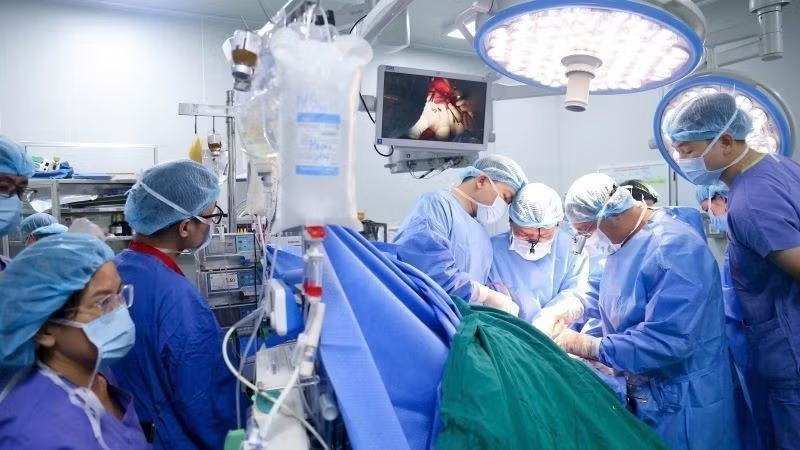
From the first kidney transplant performed in June 1992, Viet Nam has now carried out more than 10,000 organ transplants, mastering kidney, liver, heart, and lung transplantation, as well as the transplantation of several other human organs and body parts. More and more stories of organ transplantations that "extend life" continue to be recorded, including organ retrieval and transplantation coordinated for patients separated by thousands of kilometres. Viet Duc University Hospital has clearly demonstrated its position as a special-grade surgical hospital by mastering single-organ transplantation techniques while also successfully performing multi-organ and domino transplants. These milestones not only represent technological achievements but also reflect the growing organisational capacity, inter-hospital coordination, and organ transplant coordination capabilities of the country's healthcare system.
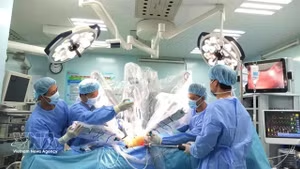
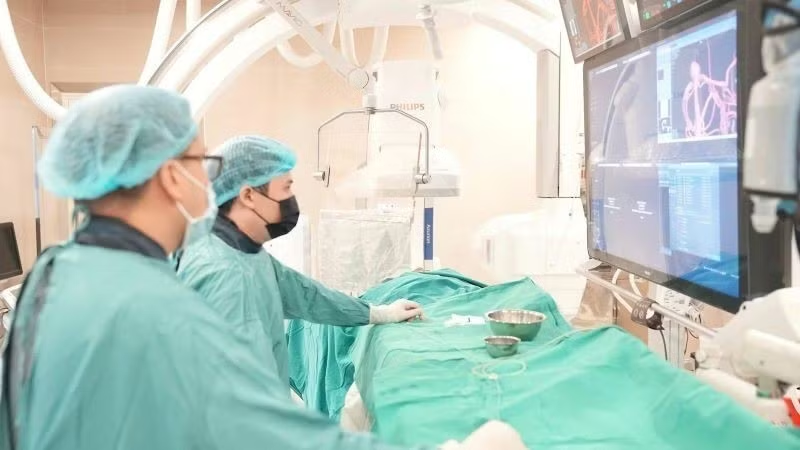
Many other advanced techniques have also been successfully implemented at hospitals nationwide, including foetal cardiac intervention, transcatheter aortic valve replacement (TAVR), robotic surgery, neurovascular intervention, advanced radiotherapy, extracorporeal circulatory support, and extracorporeal respiratory support.
Alongside mastering advanced techniques, leading medical institutions have gradually strengthened their roles in training and guiding the healthcare system. Professional direction, remote consultations, and telemedicine have created a nationwide mechanism for technology transfer. Many medical techniques that were previously available only in Ha Noi, Ho Chi Minh City, or Hue have now been introduced at provincial hospitals, including those in mountainous, border, and disadvantaged areas.
Another important achievement is that advanced healthcare is no longer confined to the public sector. Many private hospitals have made systematic investments in infrastructure, equipment, and human resources while developing highly specialised clinical departments. The participation of both public and private sectors is creating additional resources, expanding service capacity, and promoting competition in healthcare quality.
These achievements provide the foundation for Politburo Resolution No. 72-NQ/TW, which sets out the requirement to develop a modern, equitable, high-quality, efficient, and internationally integrated healthcare system, with focused investment in a number of advanced, high-quality medical centres comparable with those in the region and internationally. The adjusted Master Plan for the Healthcare Facility Network for the 2021–2030 Period, with a vision to 2050, also clearly states that the network should be organised in accordance with the country's six socio-economic regions, there will be 17 provincial general hospitals performing regional functions; each region will have at least one highly specialised tertiary hospital, and each province and centrally governed city will have at least one advanced specialised hospital.
Developing a multi-tiered system with a leading role
The new context, marked by changes in hospital governance models and professional referral systems, is creating new development directions for the entire healthcare sector as well as for individual hospitals. Based on practical experience, People's Doctor, Professor, Doctor Tran Minh Dien, Director of the National Children's Hospital, believes that the foremost priority in developing advanced medical centres is for them to become institutions that lead the healthcare system and generate value for the entire network. These specialised centres should be assigned leading roles in their respective medical fields, responsible for developing treatment guidelines, quality standards, patient safety protocols, and organising continuous training and technology transfer for hospitals within their networks and satellite systems. They must also possess the capability to provide remote consultations, deliver real-time professional support, and coordinate patient referrals appropriately across different levels of care. Advanced medical centres must serve as the nucleus of innovation, supported by strong research ecosystems and the application of precision medicine, artificial intelligence, big data, and digital transformation.
Sharing the same view, Assoc Prof, Dr Dao Xuan Co, Director of Bach Mai Hospital, stated that the development of advanced medical centres should not merely be seen as concentrating high-end medical technologies, but rather as a strategy for strengthening national healthcare capacity and creating "locomotives" to lead the entire healthcare system. An advanced medical centre should be built upon five pillars: advanced diagnosis and treatment capabilities capable of managing the most complex diseases; high-quality human resource training closely integrated with clinical practice; scientific research, innovation, and mastery of new technologies; modern hospital governance in accordance with international standards; and serving as the core of the healthcare network by developing professional guidelines and supporting capacity building for local hospitals.
According to Prof, Dr Tran Van Thuan, Deputy Minister of Health, the fundamental shift in advanced healthcare in the coming period will be moving away from investing in a limited number of specialised hospitals in individual localities towards establishing a multi-tiered advanced healthcare network with clearly defined roles, close coordination, and mutual support. National leading hospitals must focus on highly specialised techniques and complex and rare diseases, while also taking responsibility for research, specialist training, and the development of professional standards. Regional hospitals must possess sufficient capacity to manage the majority of severe diseases, thereby reducing the number of patients referred to the limited number of central hospitals. Advanced hospitals at the provincial and municipal levels must become the professional hubs of their localities, closely linked with primary healthcare facilities and first-level and basic-level hospitals.
Investment will also shift from funding individual hospitals to developing an advanced healthcare ecosystem. A truly advanced medical centre cannot be strong only in treatment; it must simultaneously possess capabilities in research, education, clinical trials, innovation, and technology transfer. Accordingly, it is necessary to promote specialised interdisciplinary research centres in gene technology, regenerative medicine, cell technology, nuclear medicine, nanotechnology, and emerging biomedical fields, while strengthening the application of artificial intelligence, big data, the Internet of Things, and digital platforms in diagnosis, treatment, and healthcare system management.
Another important shift concerns the underlying philosophy. Instead of "transferring patients to higher-level hospitals", the focus will be on "transferring knowledge and capabilities to lower-level facilities." Leading medical centres must not only receive critically ill patients but also take responsibility for building professional networks, training medical teams, transferring technologies, conducting remote consultations, and providing regular support to lower-level healthcare facilities.
The Ministry of Health is currently studying several new development models, including advanced medical complexes, centres of excellence, and collaborative clusters linking hospitals, universities, research institutes, and enterprises. An advanced medical complex should not simply be a concentration of hospitals within the same area; it must achieve genuine integration among treatment, education, research, technology transfer, pilot production, and the development of the biomedical industry. Likewise, a centre of excellence should not merely be an honorary title, it should be recognised on the basis of established standards, treatment outcomes, scientific capacity, workforce quality, international integration, and its ability to lead the healthcare system.