A race against time
For most people, the remains of martyrs are only seen at memorial services or repatriation ceremonies. But for staff at the Centre for DNA Identification under the Institute of Biology (Viet Nam Academy of Science and Technology), the journey begins much earlier: tracing every detail in archived records, every memory of veterans, and every clue from local residents to locate the place where a soldier fell.
Since the launch of the 500-day campaign to recover and identify fallen soldiers, vehicles from the Centre have continuously departed from Ha Noi to locations across the country — from Tra Linh in Cao Bang Province, Giong Rieng in An Giang Province to Nga Bay in Can Tho City, and beyond.
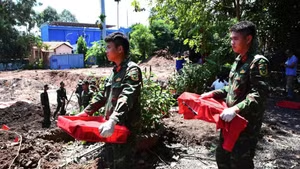
With more than 24 years dedicated to DNA identification, examiner Vu Anh Tuan has lost count of the cemeteries and recovery sites he has visited nationwide. Before working in the laboratory, much of his time was spent in the field: at cemeteries, trekking through forests, climbing mountains, or crawling into cold, deep caves — places where every inch of soil might still hold traces of a soldier.
On one trip, the vehicle had to stop at the foot of a mountain, forcing the team to carry equipment on foot for hours. In some places, samples were taken as floodwaters had only just receded. In others, a whole day’s work yielded only a few fragments of bone worn down by time. Each terrain posed a different challenge, but all demanded absolute care.
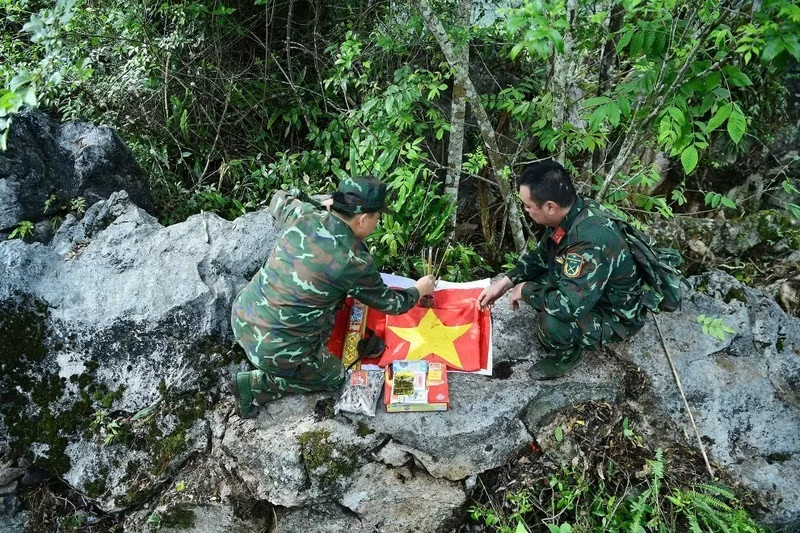
Tuan recalls the harsh impact of time on every sample. “In areas such as Giong Rieng, martyrs’ graves are often flooded for around six months of the year, so the remains are very badly decomposed. Some samples, once brought up from the ground, if not preserved properly, become mouldy within just one or two days, and the DNA data can be lost completely,” he said.
Time has not only eroded the remains after more than half a century underground. For those working in identification, the race begins the moment a sample is unearthed. In Viet Nam’s hot, humid climate, mould can invade within days and destroy genetic material. That is why each field trip is both a search and a race against time to preserve the final traces of the deceased.
Some samples contain only short DNA fragments. Yet for examiners, that is still enough to hold hope. Every step — cleaning, packing, sealing, transport — must strictly follow procedure to preserve as much genetic material as possible after decades underground.
To outsiders, fragments may look like indistinct pieces of bone. To DNA specialists, they remain precious clues. As long as one genetic fragment survives, the hope of identification is not lost.
To outsiders, fragments may look like indistinct pieces of bone. To DNA specialists, they remain precious clues. As long as one genetic fragment survives, the hope of identification is not lost.
What weighs most heavily is the knowledge that behind every unidentified set of remains is a family that has waited for more than half a century — a mother who never stopped waiting, a sibling now grey-haired, or children who know their father only through a faded photograph.
Some samples, once returned to the laboratory, prove unsuitable for DNA extraction. Each time that happens, specialists feel troubled, knowing another search has stopped just short of closure. But they never allow themselves to rush. “No matter how many samples there are, we are not permitted to skip any stage in the approved procedure. We cannot trade accuracy for speed,” Tuan said.
Decoding what time left behind
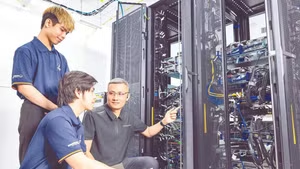
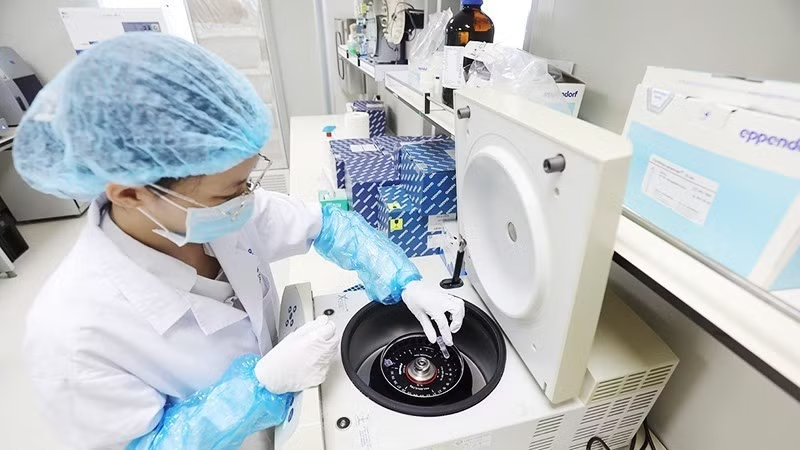
The remains collected in the field do not go straight to a conclusion. They begin a new journey, quieter but no less demanding, behind the doors of the Centre’s laboratory. If the fieldwork is a race against time, then inside the lab that race continues through patience, precision and perseverance, with staff spending long hours facing bone fragments kept underground for decades.
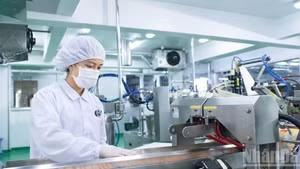
In the sterile room, technicians carry out each step slowly and with millimetre-level precision. Every action must strictly comply with procedure, because even the smallest mistake could erase the final chance to identify a soldier.
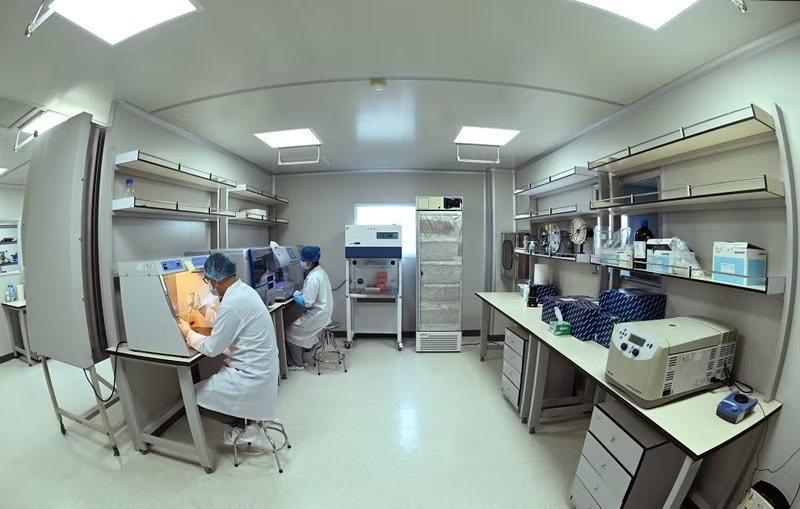
Technician Le Thi Dung has grown used to that rhythm. On her worktable, samples marked with codes pass through a series of stages: cleaning to remove contamination, DNA extraction, quantification, preparation of sequencing libraries, operation of next-generation sequencing (NGS) systems, then data analysis and comparison. For heavily decomposed remains, the process can take weeks, requiring not only technical mastery but also near-absolute patience.
After decades underground, most DNA has been severely damaged by climate, groundwater, microorganisms and natural decomposition. Some samples may look intact, yet the genetic material inside is almost gone. Conversely, tiny bone fragments can still preserve valuable signals. That is why no sample is ever dismissed as hopeless. As long as there is even the smallest possibility, it is pursued.
Dung revealed that the hardest part is not the technical steps, which have become routine, but the pressure of persevering with every sample. Some yield data within days, others require repeated processing. Sometimes chemicals must be changed, procedures adjusted, results reassessed, and the process restarted.
For DNA specialists, the greatest happiness is not decoding a sample, but informing a family that their loved one is no longer a “martyr of unknown identity”. At that moment, fragile DNA fragments preserved for decades complete their mission: bringing the soldier back to his name, his homeland and his family’s embrace.
As the mother of two young children, Dung is used to coming home late and spending weekends in the laboratory with colleagues, processing the growing number of samples during the campaign.
Her family has never complained, understanding that her work is not just science. “This is an act of gratitude, a responsibility of today’s generation towards those who sacrificed for the independence and freedom of the Fatherland. Every time I think of that, I feel I need to try a little harder,” she said.
What she keeps in mind is that behind every code on the computer screen is a person and a family that has waited for decades. Each failed analysis is not just a missed experiment, but another missed chance to bring a soldier home.
Sometimes, the room falls silent as the software begins to return results. There are no loud cheers, only quiet looks exchanged, and someone softly says: “We made it.” Those words close out weeks, sometimes months, of painstaking labour. Yet even then, the work is not finished. The genetic signals must still undergo analysis, comparison with relatives’ data and strict verification before a final conclusion is reached.
For DNA specialists, the greatest happiness is not decoding a sample, but informing a family that their loved one is no longer a “martyr of unknown identity”. At that moment, fragile DNA fragments preserved for decades complete their mission: bringing the soldier back to his name, his homeland and his family’s embrace.