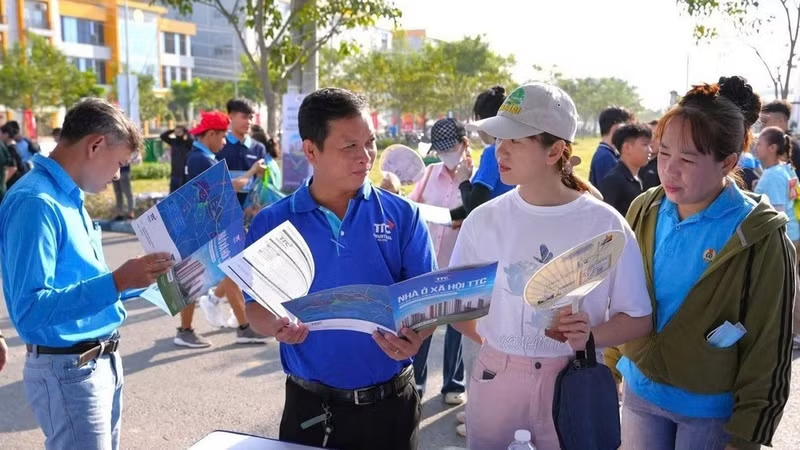
The aim is to meet urgent social welfare needs, enhance competitiveness, attract investment and secure the workforce required to support industrialisation.
Joining forces to provide housing for workers
According to Tay Ninh authorities, the province is home to more than 36,000 businesses operating in industrial parks and industrial clusters, employing over 400,000 workers. Under the provincial master plan to 2030, Tay Ninh will develop 208 industrial parks and clusters covering more than 37,500 hectares, with the workforce expected to increase to around 600,000.
To retain the workforce needed for industrialisation, the province has earmarked 73 sites covering more than 570 hectares for social housing and rental housing projects.
By the end of the second quarter of 2026, Tay Ninh had completed 19 social housing and workers’ housing projects covering more than 35.3 hectares, providing 6,207 apartments. Of these, 2,714 apartments in 11 projects have been allocated for rental, helping to meet workers’ immediate accommodation needs.
In addition to completed projects, the province has approved investment in 33 further developments covering nearly 162 hectares and providing around 41,470 apartments.
Notably, seven projects comprising almost 14,000 apartments have been approved and assigned to developers under special mechanisms to accelerate implementation.
During the first six months of the year, Tay Ninh commenced construction on eight projects covering nearly 49 hectares, comprising 7,628 apartments, with approximately 5,597 units expected to be completed by the end of the year. In the remaining months of 2026, the province aims to break ground on another 20 projects providing more than 20,700 apartments while completing investment approval procedures for a further 11 projects with a combined capacity of nearly 39,600 apartments.
One of the flagship developments is a project by Thanh Thanh Cong Industrial Park Joint Stock Company.
After more than 18 years of developing its industrial park, the company has built a comprehensive technical infrastructure system, including roads, electricity, water supply and drainage, green spaces and facilities supporting production.
Building on this foundation, the Thanh Thanh Cong Social Housing Project is planned to comprise four 14-storey apartment blocks totalling 1,130 apartments.
Dang Van Thanh, Chairman of Thanh Thanh Cong Group, said investing in social housing is not only a corporate responsibility towards workers but also a collaborative effort between the authorities and the business community as part of a long-term development strategy.
He added that stable housing enables businesses to retain their workforce, improve productivity and lay a solid foundation for private-sector development alongside sustainable growth
![[Video] 866 social housing projects under way nationwide](https://en-cdn.nhandan.vn/images/0747_ciVMvQhL5NgCvqCayXGotHM6o53R39KEsk0GUqpZJAOuW3_ib4SRgpGkRu7/nhaxh.jpg.avif)
Bottlenecks yet to be addressed
Despite these achievements, the development of social housing in Tay Ninh continues to face considerable challenges arising from market realities and workers’ actual needs.
The government has assigned Tay Ninh a target of building 80,240 social housing units during the 2025-2030 period. However, implementation has shown that demand for social housing in some areas has not grown as projected.
This is largely because investment attraction in certain industrial parks has been slower than expected, occupancy rates have fallen short of targets and worker numbers have not increased in line with development forecasts.
Many workers and low-income earners have also been unable to accumulate sufficient savings to purchase homes, even with access to preferential credit programmes.
The situation is particularly evident at the Tan Ninh Ward Social Housing Apartment Project (Phase 1), which comprises 824 apartments. Although the project became eligible for sale in June 2025, only 137 units have been sold to date, representing a take-up rate of just 16.62%.
Similarly, a social housing project developed by Prodezi Long An, comprising 400 apartments in Luong Hoa Commune, has seen only 13 apartments sold, although it became eligible for sale in November 2025.
These figures highlight the gap between demand for social housing and workers’ purchasing power and living preferences.
Nguyen Thanh Phuong, a worker from Can Tho who has been working at an industrial park in Tay Ninh for the past decade, said: “My family wants to buy a social housing unit but with a monthly income of just over 10 million VND, balancing the living expenses of a three-member family makes buying a home extremely difficult.”
In practice, rental accommodation remains the preferred option for migrant workers and low-income earners who have yet to build up financial reserves.
Statistics show that Tay Ninh currently has around 6,549 privately developed rental compounds providing 95,443 rooms, primarily serving workers and low-income residents.
Beyond demand-related issues, social housing projects also face obstacles linked to investment procedures, site clearance and the provision of synchronised infrastructure.
Rising construction material prices, increasing machinery and labour costs, together with the challenges facing the property market, have also significantly affected project progress and placed additional pressure on investors.
The province’s plan to develop 100 industrial parks and 108 industrial clusters will not only create new momentum for economic growth but also require comprehensive preparation to ensure rapid and sustainable development.
Experience has shown that industrial development can only be sustainable when accompanied by improved living conditions for workers.
Social housing planning must therefore be integrated into the overall planning of industrial parks, transport networks, technical infrastructure and social infrastructure to ensure coordinated, connected and long-term development.
Allocating suitable land in locations convenient for workers’ commuting and daily lives will not only improve the effectiveness of housing projects but also promote more efficient land use, avoiding scattered investment that is disconnected from actual demand.
Removing institutional and policy bottlenecks, unlocking investment resources and creating a transparent, stable and business-friendly investment environment remain pressing priorities to translate the Party’s guidelines and the State’s policies on social housing development into reality.