A shift in mindset
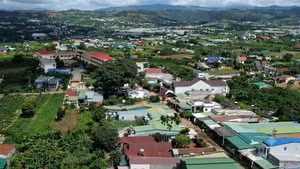
Compared with major urban centres across the country, Dong Hoi Ward has relatively few high-rise apartment buildings. This is largely because of its abundant urban land and relatively small population, meaning that most residents have traditionally preferred to buy land and build their own homes.
In addition, the coastal urban area has not attracted large numbers of workers, as it lacks major factories and industrial facilities, resulting in limited demand for apartment living or high-rise rental accommodation.
Since July 2025, however, following the merger of Quang Tri and Quang Binh into the new Quang Tri Province, which has expanded development space and a larger economic scale, demand for apartment housing has gradually increased. As a result, a series of social housing projects have been approved and are being implemented at a relatively rapid pace.
According to the Quang Tri Department of Construction, the province currently has 13 social housing projects comprising 6,524 units. By the end of June, three projects had been completed, delivering 574 apartments. Four projects, providing 1,869 apartments, are under construction, while the remaining six projects, totalling 5,229 units, have received investment approval and are scheduled to break ground in the final months of 2026.
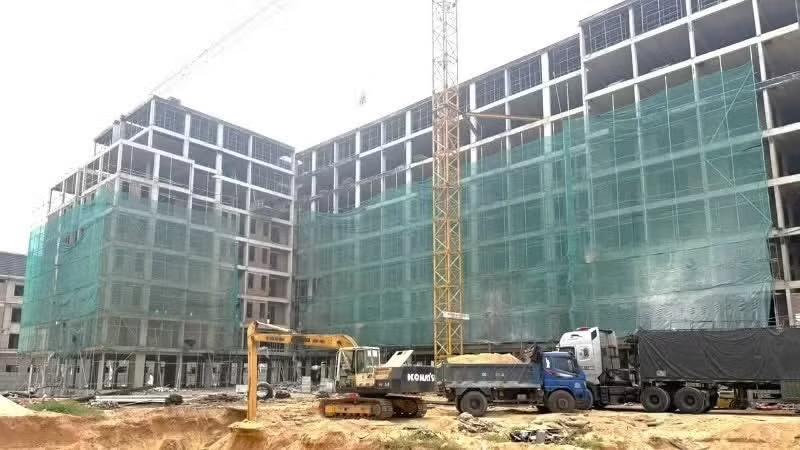
Bao Ninh Peninsula in Dong Hoi Ward has become the province's most dynamic area for resort property, high-end apartment developments and social housing. The Bao Ninh 2 social housing project, which broke ground on July 9, 2025, has completed Tower T1, with the developer now authorised to begin selling its first 120 apartments.
Contractors are concentrating manpower on Towers T2 and T3 to ensure they are completed and handed over to residents by the end of this year. Meanwhile, the Bao Ninh 1 social housing project is also nearing completion and has met the conditions required to begin property sales.
Also in central Dong Hoi Ward, construction of a social housing project on Le Loi Street, comprising 560 apartments, began in December 2025. Work is currently being carried out around the clock, helping to significantly accelerate its progress.
The Department of Construction has authorised the developer to begin sales procedures, with apartment prices ranging from 680 million VND (25,900 USD) to 1.4 billion VND (53,300 USD), depending on floor area. Buyers are required to provide a minimum 30% deposit, while the remaining 70% may be financed through preferential government-backed loans available from commercial banks under the government’s social housing support policy.
Nguyen Sang, a public employee working in Dong Hoi Ward, said that after exploring various options, he decided to purchase a social housing apartment in Bao Ninh. Having registered early with the developer, he was able to secure a reasonable price while also obtaining his preferred apartment size and floor level.
Pham Thi Dieu, a resident of Le Thuy Commune, said that after her son gained admission to the province’s specialised high school in Dong Hoi Ward, the family decided to purchase a social housing apartment, which would provide him with convenient accommodation during his studies while also serving as a family residence in the future.
Her experience reflects a gradual shift in the traditional housing preferences of Quang Tri residents. Instead of buying plots of land to build houses for their children, many parents are now opting to purchase social housing, avoiding the complexities of searching for land and completing property transactions.
Prioritising social housing projects
In January 2026, the Government issued a resolution assigning social housing development targets to localities for the 2026-2030 period. In response, the Quang Tri People’s Committee directed the Department of Construction, the Department of Finance and relevant agencies and local authorities to continue implementing measures to fulfil the targets assigned by the Government.
Deputy Director of the Department of Construction Van Duc Loi said that to ensure projects remain on schedule, the department is coordinating with relevant agencies and local authorities to expedite design appraisals and construction permits while accelerating land clearance, compensation procedures and land handover for social housing developments.
These projects are also being prioritised under the administrative “green lane” mechanism, with a commitment to reduce processing time for project appraisal, approval, land allocation, construction permits and other related administrative procedures by at least 50%.
The Department of Construction has also instructed developers to strictly comply with all legal procedures governing social housing sales. Project information must be publicly disclosed at least 30 days before applications from prospective buyers are accepted.
In late May, the Quang Tri People's Council adopted a resolution revising the 2021-2030 housing development programme to better meet residents' housing needs, promote urbanisation and strengthen social welfare.
Under the revised programme, Quang Tri aims to develop approximately 178,401 housing units by 2030. Average living space is expected to increase to 35.3 square metres per person across the province, including 37.5 square metres in urban areas and 33.9 square metres in rural areas. Minimum housing space is targeted at 12 square metres per person.
The province also plans to develop more than 24,600 homes for industrial workers, low-income earners, members of the armed forces and other eligible policy beneficiaries.
According to Quang Tri Chairman Nguyen Dang Quang, the revised housing development programme marks a significant step forward, given that only 574 social housing units were completed across the province during the 2021-2025 period, far below the original target.
Quang Tri plans to mobilise more than 235 trillion VND (8.95 billion USD) for housing development. Of this, approximately 894 billion VND (34 million USD) will come from the state budget to support housing construction for people with meritorious service to the revolution, poor and near-poor households.
Most of the remaining investment is expected to come from the private sector, as the province encourages businesses to invest in commercial housing, social housing and technical infrastructure projects. At the same time, the province has earmarked 3,628 hectares of land for housing development projects during the 2021-2030 period.
According to Quang Tri Vice Chairman Phan Phong Phu, implementing the social housing development programme will enable low-income, disadvantaged and vulnerable groups to purchase homes at affordable prices that match their incomes, thereby promoting social equity and strengthening social security.