As artificial intelligence (AI) transforms the way people learn, work, and create, the education sector faces a pressing need for radical innovation. The goal is not merely to equip students with AI usage skills but, more importantly, to foster the ability to master technology, think critically, and innovate — qualities that will be essential for future generations of citizens.
Education: The frontline of the AI race
In less than three years, AI has moved from research laboratories into classrooms across many nations.
With the Republic of Korea investing hundreds of millions of dollars to roll out AI-integrated textbooks, China establishing a roadmap to introduce AI into schools by 2030, and Japan prioritising digital infrastructure upgrades before widespread AI adoption in education, it is evident that the technological race has effectively become a competition for human capital.
In this context, education is no longer merely trailing behind AI development; it has become the decisive factor in each nation's future competitiveness.
The AI wave is fundamentally reshaping how people learn, work, and create. To prepare for this shift, many countries have chosen to invest in education at an early stage.
The RoK has decided to invest approximately 850 million USD to implement a nationwide system of AI-integrated textbooks, aiming to personalise the learning experience for every student.
China is also accelerating its efforts, with at least 11 regions — including Beijing, Shanghai, and Guangdong — issuing specific policies to integrate AI into classrooms by 2030.
Meanwhile, Japan has adopted a more cautious approach, focusing on perfecting digital infrastructure and ensuring every student has a learning device before rolling out AI platforms on a large scale.
Although these three nations employ different approaches, they share a common perspective: AI is not viewed merely as a new technology, but as a fundamental competency for future citizens.
Consequently, investing in AI is seen primarily as an investment in education, as the quality of the workforce will determine national competitiveness for decades to come.
From strategic policy to the imperative of educational reform
Viet Nam is also addressing this trend through long-term strategic directives.
Resolution No. 57-NQ/TW of the Political Bureau identified science, technology, innovation, and digital transformation as key strategic breakthroughs that drive national development.
Subsequently, Resolution No. 71-NQ/TW on education and training reform emphasises the need to cultivate a workforce possessing digital literacy, innovative capabilities, and the ability to master technology.
While Resolution 57 established science and technology as the country’s new engine for development, Resolution 71 has addressed the need to prepare the people who will drive that very engine.
The innovation lies not in simply adding AI-related knowledge to the curriculum but in a fundamental shift in educational mindset: moving from knowledge transmission to competency development, and from learning for the sake of knowing to learning how to master technology, solve problems, and engage in lifelong learning.
Furthermore, the Law on Artificial Intelligence (No. 134/2025/QH15), effective from March 1, 2026, has established a legal foundation for the safe, transparent, and responsible development and application of AI.
This increasingly comprehensive legal framework creates conditions for educational institutions to proactively innovate their teaching methods, management practices, and workforce training to align with new development requirements.
Notably, in his concluding remarks at the July 30 meeting of the Central Steering Committee for the implementation of the Political Bureau’s Resolution No. 57-NQ/TW, General Secretary and President To Lam emphasised the fundamental shift from simple labour to creative labour, linked to enhancing the quality of the national workforce.
He identified this as a major objective and a crucial benchmark for implementing Resolution No. 57-NQ/TW in the new era.
General Secretary and President To Lam’s conclusion clearly states: “We must gradually transition from a development model primarily reliant on simple labour, processing, assembly, and the exploitation of existing advantages to one driven by science, technology, innovation, digital transformation, and high-quality human resources. In this new model, farmers master modern agricultural technologies; workers master advanced technologies and equipment; entrepreneurs pioneer innovation; and officials shift from a mindset of mere administration to one of fostering development. Creative labour must become the nation’s most vital resource in the future.”
Therefore, given the increasingly pervasive presence of artificial intelligence in learning, work, and daily life, the goal of education cannot stop at simply equipping learners with the skills to use AI tools.
The core objective is to cultivate technological mastery, critical thinking, creativity, and a lifelong learning mindset, enabling individuals to generate new value rather than merely absorbing existing knowledge.
Learners are already ahead; education must guide them in the right direction
A notable reality is that AI has permeated the learning habits of Vietnamese people much faster than anticipated.
Research conducted by Microsoft in collaboration with the AI Economics Institute reveals that the adoption rate of generative AI in Viet Nam stands at 23.5%, surpassing the global average of 16.3%.
This figure reflects the rapid adaptability of Vietnamese people to new technologies and highlights AI's emergence as a familiar tool for study and work among students.
However, a matter of concern is that this adoption process remains largely spontaneous.
While learners utilise AI to search for information, summarise documents, solve problems, or brainstorm ideas, they often lack the necessary skills to verify information, assess the reliability of data sources, or recognise the limitations of AI-generated responses.
This presents a thought-provoking issue: while learners have taken the lead in using AI, the education system must take the lead in guiding how it is used.
Consequently, the question is no longer whether AI should be used in education but rather how AI can help learners develop their thinking processes instead of replacing them.
In an era where AI can provide information almost instantaneously, the human advantage no longer lies in the ability to memorise more than a computer.
A learner’s core value lies in the ability to ask questions, think critically, verify facts, synthesise information, and make decisions. These are precisely the competencies that education must prioritise developing in this new era.
A practical model: critical thinking and technological mastery
Real-world examples from pioneering educational institutions offer valuable insights into this challenge. A prime example is the model of controlled AI application currently being implemented across the FPT Schools system.
Rather than treating AI merely as a tool for completing assignments or looking up answers, the school is integrating it into the teaching and learning process as a partner that fosters critical thinking.
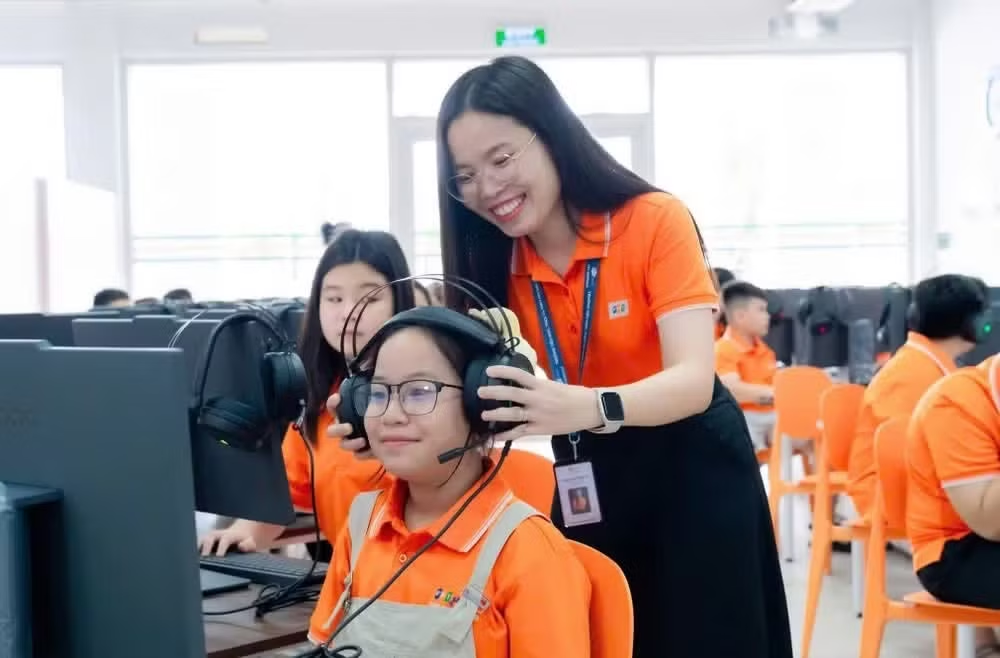
In this model, students do not passively receive information from AI. Instead, they hone their ability to frame issues, formulate critical questions, and cross-reference AI-generated results with authoritative data sources and reliable scientific literature.
Technology serves as a facilitating assistant, while the capacity for analysis, verification, and final decision-making rests entirely with the learner’s own intellect.
A clear illustration of this methodology is the project titled “From ‘AI Answers’ to ‘Student Critique’: A Teaching Model for Social Studies in the Age of Artificial Intelligence,” developed by Trinh Thi Truc Ly and her colleagues at FPT School Soc Trang.
When presented with an AI-generated essay — fluent in structure yet lacking genuine experience and empathy — the teachers guided students to distinguish between machine-generated knowledge and human values.
Students learned to challenge AI’s responses and identify gaps, enriching the content with their own insights and emotions.
This systematic approach not only mitigates the risks of technology misuse but, more importantly, transforms AI into a tool for cultivating scientific rigor, critical thinking, and a spirit of “authentic learning and practice” among K-12 students.
Thus, investing in education during the AI era is not merely about preparing the workforce for today; it is about building national competitiveness and driving the country's sustainable development for decades to come.
Ultimately, the race to develop human capital in the AI era serves as a comprehensive test of the education system’s vision and capacity for action.
Driven by the sound strategic direction of Party resolutions, an increasingly robust legal framework, and the continuous guidance of Party and State leaders — particularly General Secretary and President To Lam — alongside proactive and practical educational models,
Viet Nam is well-positioned to cultivate a young generation equipped with the intellect, mettle, and capability to master science and technology, ready to make substantive contributions to the nation’s prosperous development.