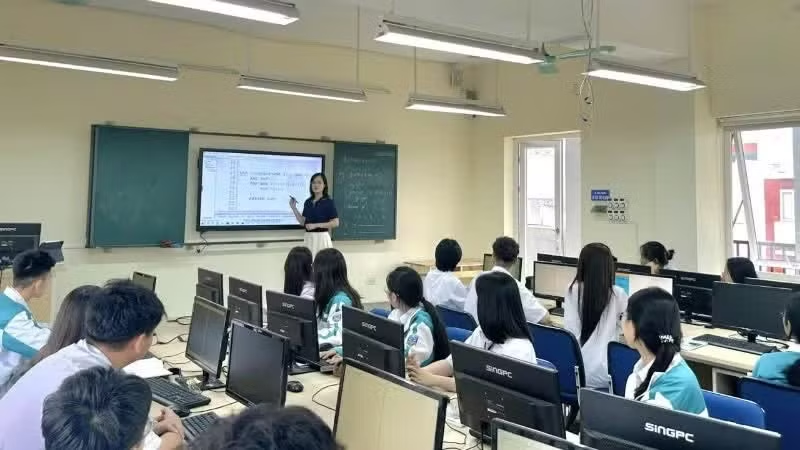
In 2024, the ministry issued initial guidance on teaching and learning artificial intelligence in schools, providing a basis for local authorities and educational institutions to approach content related to this new technology.
On that basis, the Viet Nam National Institute of Educational Sciences, with support from the United Nations Children’s Fund (UNICEF), proactively studied, adjusted and adapted the artificial intelligence competency framework for students and teachers proposed by UNESCO in order to ensure its suitability to domestic curricula, teaching staff and the local educational environment.
In 2025, the Ministry of Education and Training directed the development of a content framework for AI education in general schools and issued guidance for piloting this framework in the second semester of the 2025-2026 academic year. At the same time, a set of guidance materials for teachers was compiled, and training was organised in two phases: the first for 17 localities and the second for the remaining ones.
Prof. Dr. Le Anh Vinh, Director General of the Viet Nam National Institute of Educational Sciences, said many localities had proactively registered to take part in the pilot programme in a very positive spirit. Ho Chi Minh City, for example, issued guidance for large-scale pilot implementation, encouraging schools to choose suitable approaches such as integrating AI content into subjects, organising thematic learning sessions, or running clubs and supplementary activities for students.
Alongside this, the Viet Nam National Institute of Educational Sciences carried out a pilot programme at the Experimental Primary, Secondary and High School in Ha Noi during the 2025-2026 academic year. Initial evaluation results showed that both students and teachers responded positively, and implementation did not encounter any major difficulties.
In terms of facilities, schools that already have the conditions to teach Informatics and Technology are not expected to face many difficulties in introducing these contents. As for teachers, professional development and experience-sharing remain necessary to help them better understand both the content and methods of implementation. However, once they recognise the significance and importance of AI education, teachers can take the initiative in delivering it.
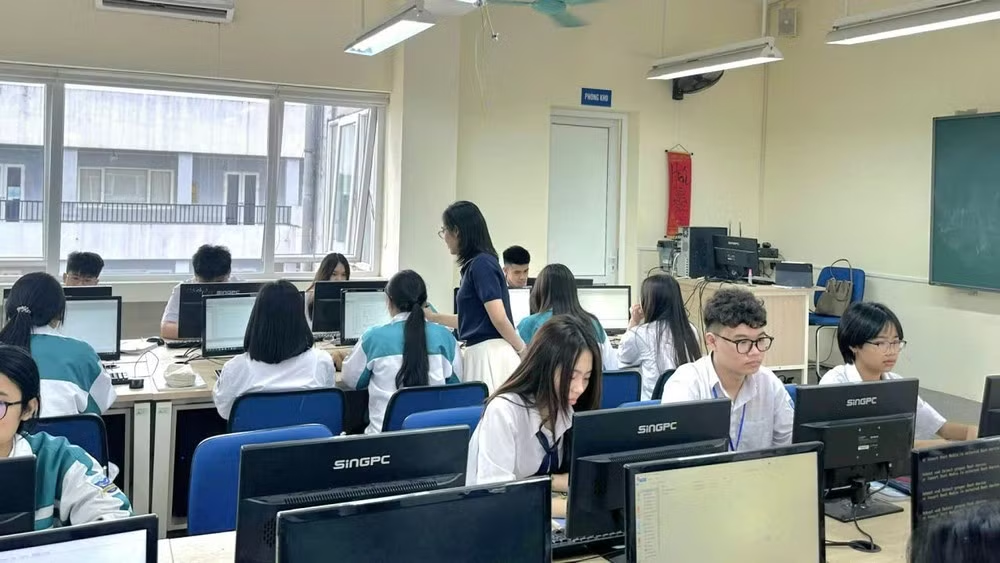
From the 2025-2026 academic year, the Department of Education and Training of Ninh Binh Province issued a pilot plan for AI education content in educational institutions, and organised many teacher training sessions on the application of AI in teaching.
At Bien Hoa High School for the Gifted, observations show that AI education activities have helped students develop learning capacity, thinking skills and hands-on experience, while also shaping plans for implementation in the time ahead.
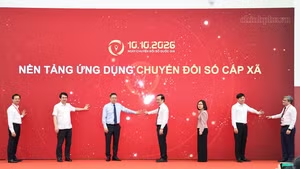
According to Nguyen Thi Bich Hang, Principal of Bien Hoa High School for the Gifted, the school has recently conducted training on the application of artificial intelligence in teaching. It has organised professional development courses on AI application for school leaders and teachers, launched activities in response to National Digital Transformation Day, held thematic training on developing the flipped-classroom model in the context of digital transformation and AI application, and used the LCMS i-School platform for revision and assessment in preparation for the 2026 secondary school graduation examination.
Following the direction and guidance of the Ninh Binh Province Department of Education and Training, the school has integrated AI content into subjects and educational activities within the general education curriculum.
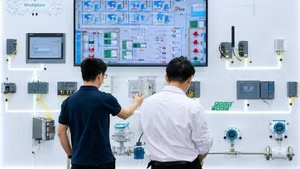
In particular, for Informatics, beyond the existing curriculum content, the school has also been required to strengthen several topics on AI application in education in line with practical conditions, including the use of AI in STEM education. As a result, both teachers and students have begun to familiarise themselves with these tools and form new learning methods.
The school has also used artificial intelligence to support teachers in lesson design, question bank development and the analysis of learning outcomes, thereby reducing the volume of manual work. At present, most teachers and students use free online applications such as ChatGPT and Gemini. As a result, lessons have become more visual and engaging, increasing students’ interaction with learning content.
Students can study flexibly anytime and anywhere, while also developing technological skills, logical thinking and problem-solving abilities.
Alongside these results, school leaders have also pointed out a number of difficulties and limitations that will need to be addressed in the time ahead. Specifically, AI education content in general schools is still mainly integrated into Informatics or STEM activities, with no official and unified curriculum in place.
The school lacks teachers with deep expertise in artificial intelligence instruction, while many others are still only at the stage of familiarising themselves with the subject through self-study and have yet to gain sufficient experience to design programmes or guide students in in-depth research.
In addition, students’ ability to use AI tools in learning remains uneven. Some are still unsure how to make effective use of the technology, while others risk becoming passive or overly dependent on it. Some students may also develop a habit of simply “asking the machine and taking the answer” without understanding the underlying issues.
Notably, content generated by artificial intelligence is not always accurate. It may be misleading or fall short of proper standards, and it also carries risks of personal data leakage.