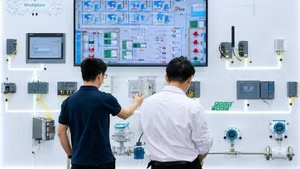
Artificial intelligence (AI), semiconductors, 5G-6G networks, robotics and automation, blockchain, cyber security, biotechnology and medicine, and new materials were once considered “luxuries” for developing countries. The identification of strategic technologies shows a major shift in thinking, from accessing technology to mastering it. Viet Nam is determined to catch up and move forward alongside others, ensuring it is not left behind in the global flow of the science and technology revolution.
From outsourcing to innovation
In the initial phase, six key technologies have been prioritised for early implementation, including a large Vietnamese language model, 5G network equipment, AI cameras, autonomous robots, blockchain-based traceability and unmanned aerial vehicles. These are all foundational fields with strong spillover potential and, in particular, are closely linked to the practical needs of the economy.
Hoang Anh Tu, Deputy Director of the Department of Science, Engineering and Technology under the Ministry of Science and Technology, affirmed: “Once Vietnamese enterprises master foundational technologies, they can participate more deeply in global value chains instead of stopping at the outsourcing stage.”
The state’s policy has quickly created a spillover effect in the business community. The list of strategic technologies serves both as a policy orientation and as a clear market signal, helping enterprises confidently make long-term investments.
At many technology enterprises, research and development activities are taking place in a vibrant atmosphere. Microchip assembly lines, sensor systems and intelligent control platforms are gradually being localised. This is particularly important amid fluctuations in global supply chains, which require a higher level of self-reliance.
Immediately after securing a contract worth millions of US dollars to manufacture unmanned aerial vehicles (UAVs) with a partner from the Republic of Korea, CT Group has been accelerating the development of a range of other technology products based on its mastery of core technologies.
Tran Kim Chung, Chairman of CT Group, shared: “When the state clearly identifies strategic technologies, enterprises have a foundation to invest systematically in R&D. This marks a shift from short-term thinking to mastering core technologies.”
In the health sector, AI is opening up new directions. AI platforms supporting diagnostic imaging and hospital management have initially proved effective in shortening processing time, reducing costs and improving accuracy.
Dang Thi Anh Tuyet, founder of an AI enterprise in the health sector, said that in the past, enterprises struggled to find a development direction for technology. With the orientation of strategic technologies, the development of products suited to domestic demand, aimed at replacing products that previously depended entirely on external sources, has seen fundamental changes.
“Technology enterprises have been shown the paths they should take, where they know where they are heading and receive support and encouragement to develop,” Tuyet said.
Tran Kim Chung noted that with clearer attention and orientation in the development of strategic technologies, groups such as CT Group would be given added momentum.
Removing bottlenecks in human resources and institutions
Technology cannot develop without people. High-quality human resources are becoming the biggest bottleneck in the process of implementing strategic technologies.
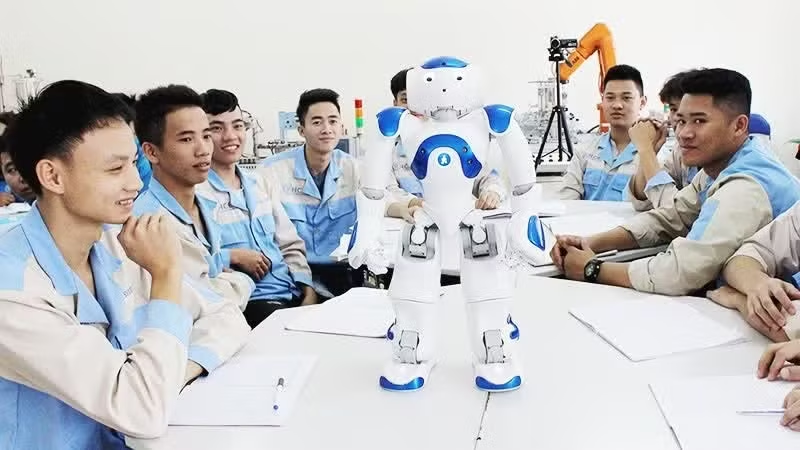
At universities, this transformation has begun to become clearly visible. Many laboratories for robotics, automation, intelligent transport, sensors and related fields have received strong investment. Students not only study theory but also directly participate in research projects and connect with enterprises.
Associate Professor Dr Ngo Van Minh, Head of the Innovation and Technology Transfer Department at the University of Transport and Communications, said: “Training must be linked to the needs of strategic technologies. Students need early access to AI and automatic control so they can work immediately after graduation.”
Dr Tran Tien Cong, Deputy Head of the Faculty of Artificial Intelligence at the Posts and Telecommunications Institute of Technology, emphasised another perspective: “It is necessary to introduce training programmes that meet international standards and take part in global competitions to raise the level of Vietnamese human resources.”
However, reality shows that the gap between training and market demand remains wide. Many enterprises have to retrain their staff, wasting both time and costs. Building a close coordination mechanism among universities, enterprises and research institutes is an urgent requirement.
One notable point is the strong shift in the state’s management mindset. Instead of supporting inputs, policies are moving towards support based on outputs, meaning that support is linked to specific products and commercialisation capacity.
The government has set ambitious targets: by 2027, Viet Nam is expected to master at least 20 strategic technology products and raise the contribution of these sectors to 15-20% of GDP. At the same time, the digital economy is expected to account for about 30% of GDP in the coming years.
Recent figures show positive signals, with the number of digital technology enterprises rising sharply, technology product exports reaching hundreds of billions of US dollars, and e-commerce growing rapidly. However, deeper analysis shows that most of the value still comes from the foreign direct investment sector. This places an urgent demand on improving the capacity of domestic enterprises.
The Prime Minister has clearly directed that resources be prioritised for strategic technologies, that the share of the State budget allocated to this field be increased, and that controlled risks in research and development be accepted. In addition, the Government leader has approved the establishment of a working group on strategic technology development, headed by Deputy Prime Minister Ho Quoc Dung, demonstrating the government’s strong determination.
We see the biggest change in the government’s new mindset: moving from working for others to taking ownership, and from application to innovation. This is the decisive factor in forming technology enterprises with global competitiveness.
Tran Kim Chung, Chairman of CT Group
Assessing the policy of building lists of strategic technologies and strategic technology products, Do Tien Thinh, Deputy Director of the National Innovation Centre (NIC), said it is necessary to clarify outputs, specific roadmaps and financial resources.
“We have set very high targets, which must be accompanied by feasible roadmaps that can attract the participation of enterprises, especially large technology enterprises and groups in a leading role. Only then can we create an ecosystem that includes start-ups and human resources for strategic technologies,” Thinh said.
Hoang Anh Tu said the Ministry of Science and Technology is currently developing a national project on strategic technology and industry development through 2030. The project will clearly identify strategic industries connected with strategic technologies, linked to policies on institutions, infrastructure and human resources. The ministry will propose breakthrough policies in research, development and market creation for strategic industries, strategic technologies, and strategic industrial and technology products. It will also approve projects on infrastructure for key research centres and laboratories, expected to focus on seven to ten laboratories located at institutes, universities and enterprises, with the aim of shared use, public-private cooperation, and allowing all parties to access and use them.
Along with infrastructure, science and technology institutions will continue to be strongly improved. As requested by the Prime Minister, a series of pending tasks must be resolved decisively; guiding documents for the Law on Digital Transformation and the Law on Artificial Intelligence must be accelerated; and the list of strategic technologies must be completed in connection with the country’s major challenges.
Under this new approach, policies must go hand in hand with specific products, clear roadmaps and measurable results. If this can be achieved, strategic technologies will not stop at orientations but will become real capabilities of the economy.