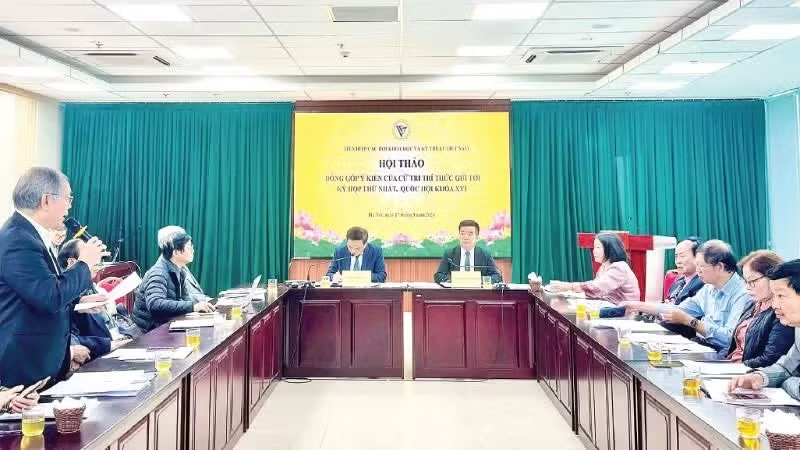
Alongside the achievements, intellectual voters have also candidly pointed out shortcomings and bottlenecks, thereby proposing policy improvements to unlock resources for rapid and sustainable development.
In the new stage of development, as demands for growth quality and competitiveness continue to rise, Viet Nam needs closer alignment between policy directions and practical realities. In that process, the scientific intellectual community plays a pivotal role, not only in research, but also in contributing ideas, offering criticism and making dedicated proposals that help improve policy and promote innovation.
In their contributions to the first session of the 16th National Assembly, scientific intellectuals affirmed that the Party and State’s policy of identifying science, technology and innovation as important drivers of growth is gradually being translated into practice. The policy system continues to be improved; research and application activities have seen many positive changes; and the innovation ecosystem has taken shape and continued to develop.
However, based on practical implementation, the intellectual community has also expressed concerns over a number of issues that need to be resolved soon, including the fact that investment in science and technology remains low compared with development requirements, while mechanisms for mobilising social resources remain ineffective. Many businesses, especially small and medium-sized enterprises, have yet to give sufficient attention to technological innovation; links between research and production, business and daily life remain weak; many research results are slow to be commercialised; and domestic research and development capacity remains limited, with continued dependence on imported technologies.
According to Tran Duc Lai, Chairman of the Radio-Electronics Association of Viet Nam, the digital gap between urban and rural areas, and between developed areas and remote, border and island areas, remains significant, with many places still lacking fibre-optic infrastructure and mobile coverage. More notably, risks related to cyber insecurity, online fraud and personal data leaks are eroding public trust in the digital environment, while the legal framework and enforcement capacity for data protection and cybersecurity still contain many gaps. Without breakthroughs in institutions and resources, the risk of falling further behind in technology is real.
There also remains a shortage of high-quality human resources in science and technology, especially in core and emerging fields such as artificial intelligence, semiconductors, biotechnology, new materials and digital technology. In some places, mechanisms for rewarding, attracting and employing talent in science and technology are still not attractive enough, leading to brain drain or to the underuse of the intellectual community’s full potential.
Nguyen Van Ve from the Viet Nam Water and Environment Association
Sharing the same view, Nguyen Van Ve from the Viet Nam Water and Environment Association said that there also remains a shortage of high-quality human resources in science and technology, especially in core and emerging fields such as artificial intelligence, semiconductors, biotechnology, new materials and digital technology. In some places, mechanisms for rewarding, attracting and employing talent in science and technology are still not attractive enough, leading to brain drain or to the underuse of the intellectual community’s full potential.
These shortcomings require continued institutional improvement, the unlocking of resources and the creation of conditions for intellectuals to fully play their role and contribute more effectively to the country’s development.
Reality shows that Viet Nam is facing the need to transform its growth model towards one based on science, technology and innovation. Developing a knowledge-based economy is not only a requirement of international integration, but also an important path for enhancing national competitiveness.
According to Nguyen Thi Hoang Yen, Chief of Office of the Viet Nam Association of Psychological and Educational Sciences, scientific intellectuals are an important national resource. For this resource to be fully utilised, it is necessary to build an open and dynamic innovation ecosystem in which science and technology organisations are granted greater autonomy, scientists are encouraged to innovate and provide policy criticism, and research results are effectively connected with development practice.
Le Thi Khanh Van, Vice President of the Viet Nam Association for Scientific and Technological Information, proposed that greater attention should be paid to improving policies in order to better tap specific resources in science and technology. This includes support mechanisms and enabling conditions for women, who account for a large share of the research workforce, so that they can contribute with peace of mind and overcome interruptions linked to family responsibilities. At the same time, there should be appropriate policies to continue making effective use of retired scientists with rich experience and high professional expertise.
Greater attention should be paid to improving policies in order to better tap specific resources in science and technology. This includes support mechanisms and enabling conditions for women, who account for a large share of the research workforce, so that they can contribute with peace of mind and overcome interruptions linked to family responsibilities. At the same time, there should be appropriate policies to continue making effective use of retired scientists with rich experience and high professional expertise.
Le Thi Khanh Van, Vice President of the Viet Nam Association for Scientific and Technological Information
In the context of the strong growth of the digital economy, Viet Nam’s firm choice of a development path based on science, technology and innovation has affirmed a sound vision consistent with the trend of the times. To realise this orientation, experts and scientific intellectuals also believe that investment mechanisms and policies need to be improved in a comprehensive and open manner, with knowledge-based development placed at the centre.
This includes increasing spending on research and development; reforming the management and use of funding in a more flexible direction with fewer procedures; and encouraging businesses to invest in research and technology transfer. Greater attention should also be given to strengthening links among institutes, universities, businesses and the market; accelerating the commercialisation of research results; and developing the innovation ecosystem.
At the same time, effective mechanisms are needed to attract and make full use of intellectuals and scientists, creating a favourable environment for them to maximise their creative potential, thereby enhancing national competitiveness and promoting socio-economic development. Difficulties and bottlenecks must be removed, institutions promptly improved, and tangible changes created so that science, technology, innovation and the digital economy truly become the main drivers of the new growth model, contributing to the country’s rapid and sustainable development.