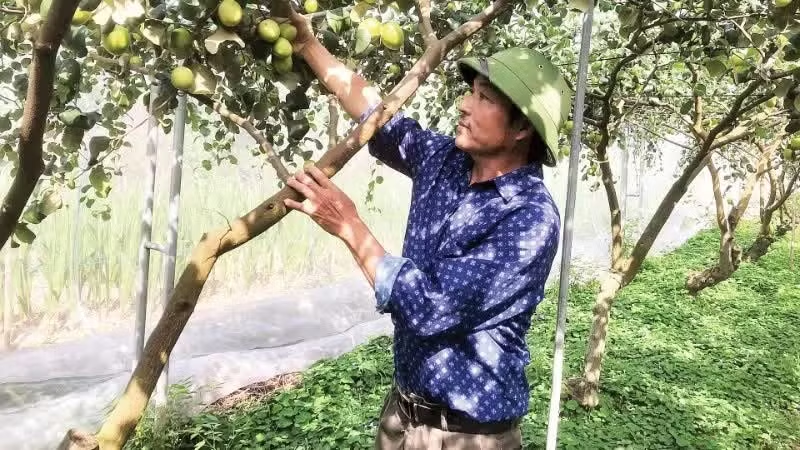
Many years ago, the 2-hectare apple orchard of Tran Dinh Hanh’s family in Ly Nhan commune (Ninh Binh province) was cultivated using traditional methods, resulting in low efficiency and even losses of up to 80% in some years due to insect damage. Since 2025, his family has received support from the National Agricultural Extension Centre under the Ministry of Agriculture and Environment to transfer the technical process for growing the Da Mat 06 apple variety according to VietGAP standards, combined with a trellis system and insect-proof netting covering 4,000m². After a period of production, the orchard yields high productivity, good quality, attractive appearance, and significantly higher income than before.
Hanh said: “Since we started growing apples in greenhouses, the spoilage rate has decreased, the quality is good, and food safety is ensured. In fact, growing apples in greenhouses and producing according to VietGAP standards has reduced the number of pesticide sprays from 18-20 times per crop, saving 5-7 million VND per crop, reducing the spoilage rate to 5%, and increasing yield by 30-40%. Furthermore, the netting system helps to limit more than 95% of harmful insects, creating a favourable environment for the trees and fruit. According to statistics, in the 2025 apple crop, my family harvested 13 tonnes of fruit, and after deducting expenses, the profit reached approximately 300 million VND.”
In Phu Tho province, for many years, the application of science and technology in production has been creating momentum to promote agricultural development, producing high-quality products and increasing people’s income. To date, the province has 648 key crop production areas covering 79,000 hectares, with over 7,600 hectares granted planting area codes. In addition, 3,900 hectares are VietGAP certified, 153 hectares are GlobalGAP certified, and 108 hectares are organically grown…
Vu Van Luyen from Chan Mong commune said: “Currently, my family has over 2 hectares with 473 Đoan Hung pomelo trees. To achieve effective production, my family follows the procedures of pruning, applying organic fertilizer, and using biological pesticides to control pests and diseases according to the guidance of agricultural extension officers. Although this production method has higher costs, the results are better, yielding about 400 million VND per crop, and the pomelos are safe and of high quality for consumers.”
In recent times, ministries, departments, localities, and the people have been paying attention to the application of science and technology in production. Many businesses have invested in building large-scale, concentrated raw material areas, introducing new varieties into production, applying new techniques, and utilising modern technology in processing and preservation to increase export value.
In recent times, ministries, departments, localities, and the people have been paying attention to the application of science and technology in production. Many businesses have invested in building large-scale, concentrated raw material areas, introducing new varieties into production, applying new techniques, and applying modern technology associated with processing and preservation to increase export value. Many new, widely adaptable plant and animal varieties have been introduced into production, contributing to improving productivity and product quality. For example, rice currently has more than 80% high-quality varieties, helping to increase export value. The application of science and technology has yielded good results, increasing value by about 30-35% compared to traditional production.
Deputy Director of Science, Technology and Environment under the Ministry of Agriculture and Environment Nguyen Quang Tin
Many new, widely adaptable plant and animal varieties have been introduced into production, contributing to improved productivity and product quality. For example, over 80% of rice is now high-quality variety, increasing export value. The application of science and technology has yielded positive results, increasing value by approximately 30-35% compared to traditional production methods.
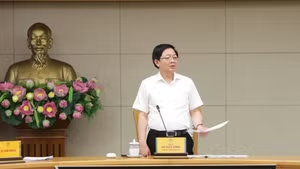
According to Deputy Director of Science, Technology and Environment under the Ministry of Agriculture and Environment Nguyen Quang Tin: in recent times, ministries, departments, localities, and the people have been paying attention to the application of science and technology in production. Many businesses have invested in building large-scale, concentrated raw material areas, introducing new varieties into production, applying new techniques, and applying modern technology associated with processing and preservation to increase export value.
Many new, widely adaptable plant and animal varieties have been introduced into production, contributing to improving productivity and product quality. For example, rice currently has more than 80% high-quality varieties, helping to increase export value. The application of science and technology has yielded good results, increasing value by about 30-35% compared to traditional production, he added.
Currently, science and technology are applied in all stages of agricultural production, from plant and animal breeding to cultivation techniques, fertilizers, harvesting, processing, and preservation, helping to increase product value. However, the application of science and technology in production still faces many “barriers” due to limited and unstable product markets; limited access to technology among farmers in some areas; and inconsistent transfer of technological advancements at the grassroots level.
In addition, investing in high-tech agriculture requires significant funding for infrastructure and equipment, making it difficult for farmers to afford. The application of science and technology in production remains low. For example, organic farming in Viet Nam, despite achieving positive results, only covers 174,000 hectares, accounting for approximately 1.4% of the total agricultural land area.
To overcome these difficulties, many managers and experts believe that in the coming time, ministries, sectors, and localities need to continue implementing programs, plans, schemes, and projects on the development of agriculture applying science and technology; disseminate information and raise awareness about the role of science and technology in agricultural production; proactively research and select new plant and animal varieties with high productivity and quality for production; build large-scale, concentrated production areas, creating conditions for the application of technology to increase value; continue to attract businesses to invest in high-tech agriculture with production linkages to help farmers sell their products and increase income; and develop infrastructure to form high-tech agricultural zones.