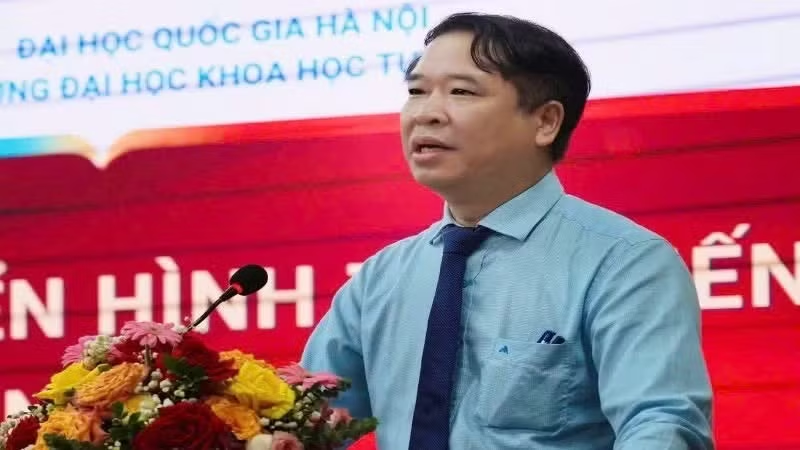
Regarding this issue, Professor Dr Le Thanh Son, Rector of the University of Science under Viet Nam National University, Ha Noi, shared his views on solutions to attract and retain outstanding students pursuing fundamental scientific fields in the new context.
Q: The Government has recently issued Decree No. 179/2026/ND-CP regulating scholarship policies for students in basic sciences, key engineering fields and strategic technologies. The decree will take effect on July 15, 2026, and apply to students enrolled from 2025 onwards; scholarships will be granted from September 1, 2026. In your view, what does this scholarship policy mean for attracting and training human resources for Viet Nam’s basic sciences and strategic technology sectors?
A: I believe this is a very important and strategic policy for higher education and the development of high-quality human resources in Viet Nam. The introduction of scholarships for basic sciences, key engineering fields and strategic technologies reflects the State’s strong priority for science, technology and innovation.
This policy will help attract outstanding students to science, technology, engineering and mathematics, especially fundamental fields such as Mathematics, Physics, Chemistry, materials science, AI, semiconductors, biotechnology and robotics — sectors that are in urgent need of high-quality human resources for national development.
The decree taking effect on July 15, 2026, with scholarships to be granted from September 2026, will create a positive impact right in the enrolment season, helping increase the appeal of science and engineering disciplines, which often require long and demanding training.
In my view, the policy will bring about many positive effects. It will expand learning opportunities for excellent students from disadvantaged backgrounds; create motivation for study, research and academic competition; contribute to training human resources for national strategic technologies; and affirm science and technology as a driving force for national development in the new stage.
However, for the policy to be truly effective, it is necessary to ensure sufficiently attractive scholarship levels and a transparent selection process, while also linking the policy with the research environment, businesses and post-graduation employment opportunities.
Overall, this is a step in the right direction. If implemented effectively from September 2026, it will create positive changes in science and technology training in Viet Nam in the years ahead.
In my opinion, at undergraduate level, financial support of 3.7-5.5 million VND per month can help students significantly reduce financial pressure, especially expenses for study, learning materials, dormitories and basic living costs. For master’s students and doctoral candidates, support of up to about 8.4 million VND per month is quite meaningful, as many learners need to devote most of their time to research and participation in research groups at universities and institutes.
Q: Many argue that to attract and retain outstanding students in basic sciences, scholarships need to be accompanied by comprehensive policies, including a strong learning and research environment, support for scientific research, business linkages and expanded career opportunities after graduation. What is your view on this issue?
A: That is correct. To truly create strong appeal and retain outstanding students, especially in basic sciences or specialised research fields, scholarships for STEM students should be seen as an initial foundation. In reality, living costs in major cities are rising, while postgraduate students also need additional funding for research, scientific publications, foreign language learning and international integration.
The value of a scholarship does not lie only in its financial amount. It also needs to be connected with a comprehensive support ecosystem, including a strong research environment, opportunities to join research projects, international exchanges, support for scientific publication, business linkages and employment opportunities after graduation.
When these factors are combined, scholarships will be able to effectively encourage learning, attract and nurture talent over the long term. If this scholarship policy is implemented in a stable and long-term manner, I believe it will have a very positive impact on both the quality of student intake and the career orientation of students in basic sciences and key engineering and technology fields.
In addition, to develop human resources for natural sciences in a sustainable manner, beyond scholarships for students in basic sciences and STEM fields, I believe the state and universities should also strengthen communication about the role and career opportunities of basic sciences. At the same time, there should be good salary and remuneration policies, as well as expanded job opportunities for basic science personnel.
When society properly recognises the value of fundamental disciplines and career opportunities are expanded for those pursuing basic sciences, this will become a strong message about the country’s strategy for developing science and technology human resources.
Q: How will the University of Science, Viet Nam National University, Hanoi, implement this scholarship policy for new students?
A: As a leading university in basic sciences, the university is ready to implement this policy in a transparent and effective manner for new students from this academic year. Of course, implementation will still have to await official guidance from the Ministry of Education and Training and relevant agencies.
Among the 15 groups of disciplines covered by the Government’s policy, the University of Science offers most of the core traditional and spearhead disciplines, including Mathematics, Statistics, Computer Science, Information Technology, Biology, Applied Biology, Physical Sciences (including Physics, Chemistry and materials science), and Earth Sciences. New students in these disciplines will be directly eligible for consideration and support in accordance with regulations.
In addition, master’s students and doctoral candidates will also be considered in accordance with the spirit of Decree 179.
Alongside the STEM scholarship policy package, outstanding students of the University of Science will also have opportunities to receive academic encouragement scholarships and scholarship packages from major corporate partners. In particular, they will be prioritised for elite training pathways, participating in scientific research at key laboratories from their first year and being directly connected with professors and leading experts for guidance.
The university is committed to creating a high-level academic environment so that new students passionate about basic sciences and STEM can not only study with peace of mind, but also maximise their abilities and become strategic human resources serving national development.
Reporter: Thank you very much.