The foundation of core technologies
The history of scientific and technological development demonstrates that every breakthrough technology stems from the long-term accumulation of fundamental knowledge in disciplines such as mathematics, physics, chemistry, mechanics, biology, and data science.
Viet Nam's own experience provides compelling evidence of the value of basic science. In agriculture, research in genetics, plant physiology, crop breeding, soil science, and hydrology in the Mekong Delta has contributed to the development of high-quality rice varieties such as ST24 and ST25, while strengthening the sector's resilience to climate change. According to experts, investment in basic science not only generates new knowledge but also enhances national competitiveness.
In recent years, Viet Nam has continued to make encouraging progress in basic research. Increasing numbers of studies have been published in leading international journals, while research groups in mathematics, advanced materials, and biotechnology have gradually established their international standing. The mastery of artificial intelligence, semiconductors, advanced materials, and biotechnology is ultimately dependant on the building of a strong foundation in basic science.
As artificial intelligence and the knowledge economy continue to advance, the strategic importance of basic science is becoming even more evident. AI relies on data, but data only creates value when it is transformed into knowledge through scientific research. Investing in basic science is therefore also an investment in the nation's knowledge infrastructure, highly skilled workforce and core technologies. Professor Nguyen Dinh Duc, Director of the Laboratory of Advanced Materials and Structures and former Chairman of the University Council of the VNU University of Engineering and Technology, said that elevating basic science to the same level as other drivers of growth marks Viet Nam's transition towards a development model based on knowledge, innovation, and technological self-reliance.
This vision is reflected in Resolution No. 57-NQ/TW and the Law on Science, Technology and Innovation 2025, both of which call for strengthening basic research, expanding research autonomy, adopting ex-post evaluation mechanisms, and accepting scientific risk.
At a working session with the Standing Board of the Central Steering Committee for Science and Technology Development, Innovation and Digital Transformation on basic scientific research, Party General Secretary and State President To Lam reaffirmed that basic science forms the nation's intellectual foundation. It underpins the development of core technologies, elite human resources, strategic forecasting, evidence-based policymaking, and long-term national self-reliance. He also pointed to several longstanding bottlenecks, including insufficient investment; fragmented research lacking alignment with national development strategies; administrative management practices; and shortages of centres of excellence, modern laboratories, data infrastructure, and the next generation of scientific experts. These challenges, he stressed, must be addressed without delay.
Building research ecosystem for new era
If basic science is to become the true foundation of core technologies, increasing investment alone will not be sufficient. More importantly, the governance and organisation of scientific research must be fundamentally reformed.
While research inherently involves experimentation, adaptation, and uncertainty, management practices in many institutions remain heavily focused on prior approval procedures and administrative compliance. Professor Hoang Van Cuong, former Vice-Rector of the National Economics University, observed that many existing regulations continue to place excessive emphasis on adherence to initial research proposals. When researchers need to adjust methodologies or materials in response to actual scientific findings, they are often required to complete additional administrative procedures, discouraging creativity and reducing their willingness to take scientific risks.
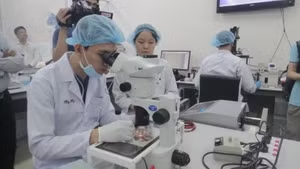
This challenge became particularly evident during the outbreak of African swine fever, when scientists at the Viet Nam National University of Agriculture had to investigate an entirely new disease. Although many experiments did not produce immediate results, research costs continued to accumulate throughout the process.
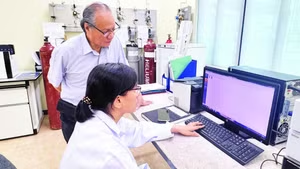
Alongside reforms to management mechanisms, long-term investment is equally critical for developing strong scientific schools of thought. Many fundamental research projects and core technology programmes require decades to mature, yet public funding mechanisms continue to be constrained by annual budget cycles. Professor Nguyen Dinh Duc argued that basic research cannot flourish through short-term investment or term-based planning. Instead, research teams need stable, long-term funding that enables them to pursue ambitious scientific challenges.
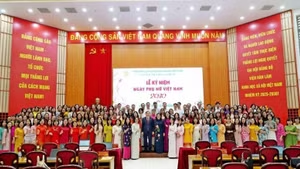
Under Decision No. 2555/QD-BKHCN issued by the Ministry of Science and Technology, the Programme for Excellence in Basic Research in Natural Sciences (PEBR) 2026–2035 shifts from funding individual projects to supporting long-term research groups. The programme also grants greater research autonomy, accepts scientific risk, and evaluates performance primarily on the quality of research outputs.
Professor Phung Ho Hai, former Director of the Institute of Mathematics, said that the most important factor in basic research is identifying the right people, accurately assessing their capabilities, and placing sufficient trust in them to innovate. A professional academic environment, stable resources, and effective talent development policies are essential for building strong research groups and influential scientific schools. Several research institutions in Viet Nam have already begun adopting this approach.
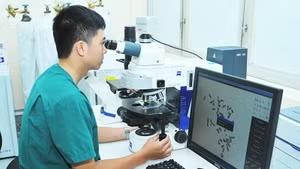
Viet Nam National University Ho Chi Minh City is implementing its Basic Science Development Programme 2025–2030, focusing on establishing strong research groups, centres of excellence, and modern research infrastructure. At the same time, the National Foundation for Science and Technology Development (NAFOSTED) is preparing to launch the Viet Nam Research Excellence Fellowship (VREF) programme to nurture outstanding early-career researchers.
In the AI era, data has become a part of the strategic infrastructure for science and technology. Viet Nam therefore needs to develop large-scale data platforms while establishing effective mechanisms for data sharing to support research. From the business perspective, Nguyen Thi Tuyet Nhung, Chief Executive Officer of KCI Credit Information Joint Stock Company, noted that the country still lacks high-quality foundational datasets that are maintained over the long term. Existing data remains fragmented, with limited interoperability between the public and private sectors. She argued that alongside improving the legal framework, Viet Nam should establish trusted mechanisms for data connectivity and sharing to build the knowledge infrastructure needed for research and innovation.
In parallel with targeted investment in modern laboratories and strategically important scientific fields, stronger collaboration among government agencies, universities, research institutes, and businesses is needed to ensure that scientific research addresses the country's major development challenges.
Nguyen Phuong Tuan, Vice-Chairman of the National Assembly's Committee for Science, Technology and the Environment, likewise emphasised that basic science should be regarded as a long-term national strategy rather than merely the responsibility of the science and technology sector. In the global race for technological leadership, a nation's competitive advantage increasingly depends on its capacity to generate new knowledge. Institutional reform, sustained investment and the development of a deep, resilient research ecosystem will enable basic science to fulfil its proper role as the driving force behind core technologies, innovation, and national self-reliance.