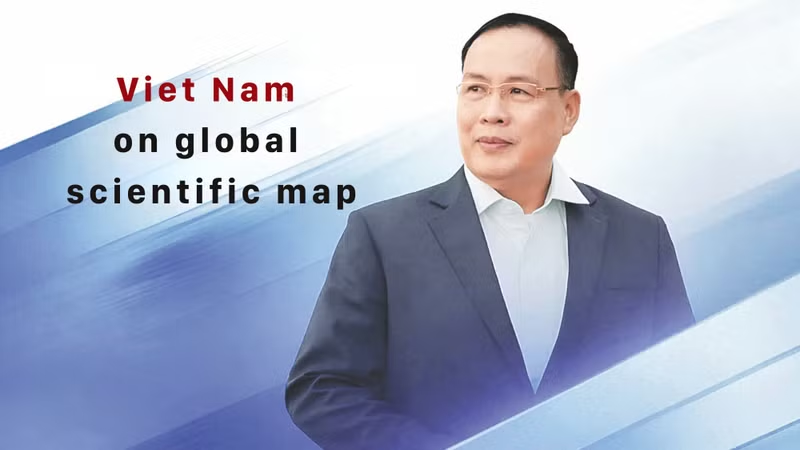
He has published hundreds of research works in prestigious international journals indexed in the ISI database, making an important contribution to bringing Viet Nam’s Mechanics and Advanced Materials disciplines to a proud presence on the global scientific map.
A historic dialogue after nearly 30 years away from his “second home”
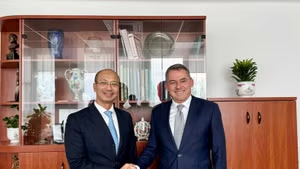
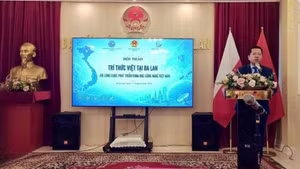
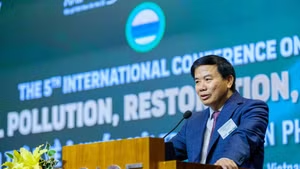
In June 2024, within the framework of the State visit to Viet Nam by President of the Russian Federation Vladimir Putin, a meeting was held at the Ha Noi Opera House between the President and Vietnamese alumni who had graduated from universities in the former Soviet Union and Russia. Professor, Doctor of Science Nguyen Dinh Duc was honored to be invited to deliver the first speech and to engage in direct dialogue with the President.
Professor Nguyen Dinh Duc expressed his sincere and profound emotions about his youth, recalling memories of beautiful Russia and the kind and benevolent Russian people. He highly appreciated the Russia–Viet Nam relationship in education. The Russian Federation has played and continues to play a very important role in training high-quality human resources for Viet Nam, especially in key fields such as engineering and technology.
For seven consecutive years (2019–2025), Professor Nguyen Dinh Duc has continuously been ranked among the top 10,000 most influential scientists in the world; among the top 100 leading scientists; and in 2025 rose to 51st in the world in the field of engineering and technology. He is also the author of 400 scientific works, including more than 250 articles published in prestigious ISI-indexed journals.
President Putin smiled while listening to him speak, thanked him for his kind words about Russia, and expressed his impression at the success of a Vietnamese scientist. At the same time, he highly appreciated Professor Nguyen Dinh Duc for having absorbed the knowledge acquired in Russia and devoted it to serving his country and nation.
Having been educated and matured within Russian science, in leading scientific environments such as Lomonosov Moscow State University (MGU) and the Russian Academy of Sciences, under the guidance of outstanding Russian professors, all these factors formed the scientific foundation that enabled Professor Nguyen Dinh Duc to gradually conquer the heights of science and bring his name, and that of Vietnamese science, into integration with international science.
The Vanin - Nguyen Dinh Duc nonlinear formula and world-renowned super heat-resistant 3D and 4D materials
After graduating from university, Professor Nguyen Dinh Duc went to Russia and continued as a postgraduate researcher at MGU, working with scientists including Nobel and Fields Prize laureates. Under the dedicated supervision of his great mentor, Professor, Academician Pobedrya B.E., he successfully defended his PhD dissertation in Mathematical Physics in 1991.
After establishing a foundation in basic science, he decided to shift to applied research and successfully defended his Doctor of Science dissertation at the Russian Academy of Sciences in 1997, at the age of 34, under the scientific supervision of Professor Vanin G.A. The nonlinear formula determining the elastic moduli of particle-reinforced composite materials, taking into account interactions among components - distinct from previous linear results - became widely known under the name Vanin Nguyen Dinh Duc.
His research on ideal super-strong 3D and 4D material structures has been widely published in leading scientific journals, providing the scientific basis for design and fabrication, and contributing to the development of ultra-mechanically strong and ultra-heat-resistant new materials applied in industry, aerospace, and global defense and security.
The discovery of 3D and 4D structures by Professor Nguyen Dinh Duc answered questions that many physicists and materials technologists at the time had been unable to resolve in order to enhance the mechanical properties of composite materials. To date, most rocket engine nozzles worldwide use these 3D and 4D composite materials, significantly contributing to extending missile ranges from 5,000 km to approximately 10,000 km today. With these outstanding research results, he was elected an Academician of the Russian Academy of Natural Sciences in 1999 at the age of 36.
After successfully defending his Doctor of Science dissertation in the Russian Federation, despite receiving many job offers from countries around the world with special incentives, out of love for his homeland Viet Nam, he decided to return to build the country’s scientific foundation and serve the nation.
Registering Viet Nam in the international scientific community
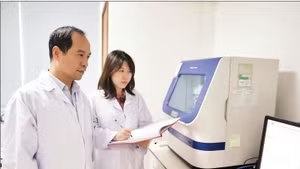
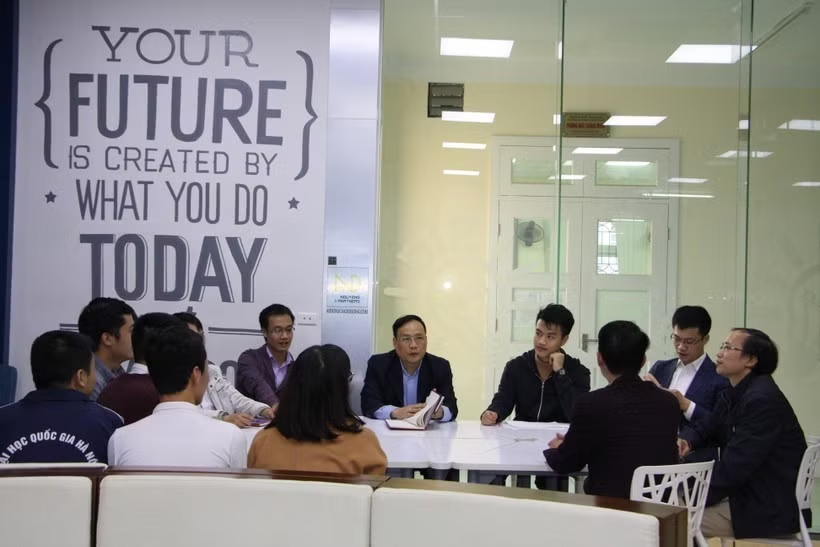
He recounted that on the first day he brought his family back to Viet Nam, he worked at Viet Nam National University, Ha Noi with a starting salary of 314,000 VND per month (equivalent to 30 USD at that time). However, he quickly overcame initial difficulties, laid the foundation and built a research group from 2005, and established the Laboratory of Advanced Materials and Structures in 2015, attracting outstanding students to join.
The research and contributions of Professor Nguyen Dinh Duc and generations of his students at various domestic universities over more than 30 years have created a Vietnamese school of advanced three-phase composites, recognized and highly evaluated by the international scientific community. To date, the group has made remarkable progress, publishing more than 400 scientific papers, about 250 in ISI-indexed international journals, including many in the top 1–5% worldwide, all 100% “made in Viet Nam.”

Professor Nguyen Dinh Duc is a teacher who inspires scientific research across many generations of students. Under his dedicated guidance, many young scientists have matured, won prestigious scholarships, and begun to establish their reputations abroad.
“Those who come to me have very different starting points. Most come from difficult circumstances, many from mountainous, remote, and disadvantaged areas, but all are instilled with confidence, aspiration, and passion for research so that they can rise by their own abilities and gradually conquer the heights of science,” he shared.
Professor Nguyen Dinh Duc is also known as a university administrator with sharp vision. Having served as Head of the Science and Technology Department, Head of the Training Department at Viet Nam National University, Hanoi, Vice Rector, and then Chairman of the University Council of the University of Engineering and Technology, he has always reflected deeply on university autonomy and innovation.
From his research group, in 2018, the Department of Civil and Transportation Engineering was established and in 2022 became a Faculty, with him serving directly as Dean. Currently, the Faculty enrolls more than 400 students each year and has completed its training levels with the goal of training high-tech human resources in construction and transportation, focusing on new technologies, sustainability, and smart development.
“Those who come to me have very different starting points. Most come from difficult circumstances, many from mountainous, remote, and disadvantaged areas, but all are instilled with confidence, aspiration, and passion for research so that they can rise by their own abilities and gradually conquer the heights of science.”
Professor, Doctor of Science Nguyen Dinh Duc
He also proposed and founded the Civil Engineering program at the Viet Nam - Japan University in 2016, the Automation and Informatics program at the International School, Viet Nam National University, Hanoi in 2020, and most recently, in 2025, he supported Hung Vuong University Ho Chi Minh City in establishing the Institute of Advanced Science and Technology and Artificial Intelligence (AI). These are all key and strategic disciplines for the country.
His story of achieving recognition in Russia, of his dialogue with President Putin, and of his reflections while steering high-level science to help the country develop strategic technologies, partly sketches the portrait of a scientist who is contributing to placing Viet Nam on the global scientific map.