Bottlenecks in human resources and institutional mechanisms
Concluding a meeting on basic scientific research held on May 25, 2026, General Secretary and State President To Lam emphasised the need to build a strong foundation in basic science that can generate new knowledge and underpin strategic technologies, innovation, and national self-reliance. To achieve this goal, alongside appropriate mechanisms and investment resources, cultivating a cadre of scientists capable of pursuing long-term research directions is critical. However, this remains a major bottleneck for many scientific organisations today.
At the Viet Nam Academy of Science and Technology, years of workforce streamlining policies have hindered research units from recruiting young personnel, particularly in cutting-edge scientific fields that demand top talent.
Sharing his views on the issue, Professor Dr Chu Hoang Ha, Vice President of the Viet Nam Academy of Science and Technology, noted that basic research requires long-term training, the accumulation of knowledge over many years, and a modern research environment for scientists to develop professionally. In reality, the Academy’s research workforce remains sparse in many fundamental scientific disciplines, particularly in emerging, highly interdisciplinary fields and those related to core technologies. Across several specialised areas, the number of experts truly capable of mastering advanced technologies remains limited.
The erosion of basic research capacity is also evident at the Agricultural Genetics Institute — one of Viet Nam’s leading research institutions in agricultural science under the Viet Nam Academy of Agricultural Sciences. According to Professor Dr Pham Xuan Hoi, former Director of the Agricultural Genetics Institute, this loss is particularly concerning as it affects highly capable researchers who are formally trained and capable of providing scientific leadership.
Meanwhile, many talented and dedicated young people are reluctant to pursue careers at research institutes, as they have access to alternative career paths offering better income and greater opportunities for professional advancement.
Meanwhile, many talented and dedicated young people are reluctant to pursue careers at research institutes, as they have access to alternative career paths offering better income and greater opportunities for professional advancement. This trend is partly driven by financial autonomy mechanisms, that have reduced budget allocations for salaries and scientific research activities. In such circumstances, scientists increasingly seek research projects funded by programmes, investment funds, foreign organisations, and businesses. However, this often diverts them from their areas of expertise, diluting the depth and specialisation of their research.
Discussing the agricultural research system, Professor Dr Nguyen Hong Son, Director General of the Viet Nam Academy of Agricultural Sciences, noted that the academy’s network of 19 affiliated research institutes employed around 2,900 staff in 2020, compared to just over 2,000 today. The shortage of salary funding — estimated at nearly 40% — has directly affected the morale and commitment of research personnel.
Requirements for financial autonomy and the implementation of short-term commissioned scientific tasks have placed considerable pressure on researchers to produce immediately applicable outcomes. Consequently, they have fewer opportunities to pursue in-depth studies of core technologies and techniques. Simultaneously, there is a growing shortage of leading experts in individual fields, while specialised researchers are becoming increasingly scarce. Those leaving the system are often highly capable, foreign-trained staff members who struggle to adapt to the current mechanisms and subsequently transition to the private sector.
According to Professor Son, researchers contribute to the country regardless of where they work. However, if public research institutes are unable to retain formally trained scientific personnel, their capacity to conduct basic research, tackle complex scientific problems, and undertake studies serving the public interest will inevitably decline.
Professor Dr Le Huy Ham, Head of the National Biotechnology Programme, emphasised that rebuilding a scientific workforce is a multi-year endeavour. With well-trained young researchers are increasingly unwilling to work in public research institutes, and experienced scientists capable of connecting research with practical needs and proposing solutions to real-world problems are leaving these institutions, restoring the talent pipeline will require substantial time and effort.
Removing barriers to developing the research workforce
In this context, many experts argue that comprehensive policies and determined action are necessary to achieve meaningful progress in attracting scientific talent and meeting new development requirements.
Salary policies must ensure a decent standard of living, while funding allocation and disbursement mechanisms should enable scientists to focus on research. Greater autonomy should also be granted to the heads of research institutions. Simultaneously, transparent evaluation systems based on research outputs and accountability mechanisms for research groups and institutes must be established. The autonomy framework applied to basic research organisations must also be adjusted. Tying research institute operations to revenue-generation requirements has created significant difficulties in maintaining activities and making investments commensurate with the role of fundamental research.
Another solution is the introduction of long-term support policies for talented young scientists, doctoral candidates, early-career PhD holders, and promising research groups working in fundamental scientific disciplines.
In addition, research environments must be compelling enough to encourage young people to pursue long-term scientific careers.
Another important solution is to establish long-term support policies for talented young researchers, doctoral students, early-career PhD graduates, and promising research teams in fundamental scientific fields.
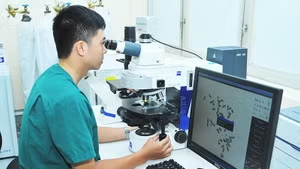
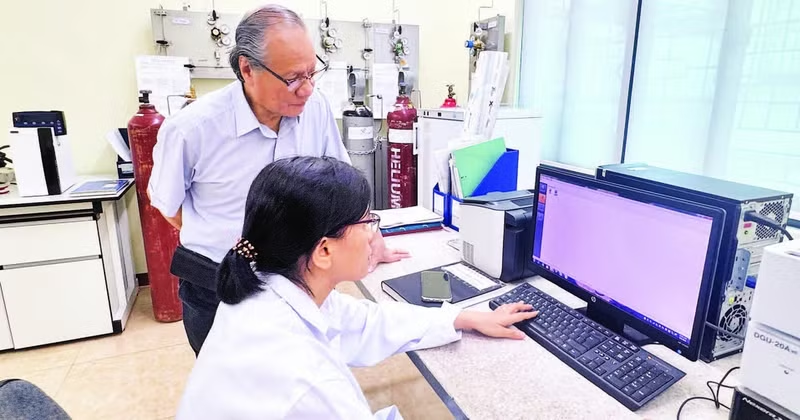
According to Professor Dr Chu Hoang Ha, the most common model of scientific workforce development worldwide is a pyramid structure within research groups. At the top are professors and experienced scientists who provide strategic direction and leadership. Beneath them are PhD holders, doctoral candidates, and young researchers who execute the practical work. Young researchers undertake the majority of experiments, data analysis, and implementation of scientific ideas. In experimental disciplines in particular, they are responsible for operating equipment, conducting research, and accumulating experience that enables them to develop professionally over time. Consequently, the sustainable development of science depends heavily on mechanisms that can attract, retain, and nurture talented young researchers.
Viet Nam must also attract overseas Vietnamese scientists to participate in key national research programmes. This highly skilled talent pool has been trained in advanced scientific environments and can help strengthen domestic research capacity while narrowing knowledge gaps within Vietnamese scientific institutions.
Attracting these experts requires more than competitive remuneration packages. It also requires creating opportunities for them to contribute to solving major national challenges, participate meaningfully in strategic planning, help design research programmes, and play an active role in training the next generation of scientists.