This shift not only increases the pace of technological innovation but, more importantly, fundamentally changes the role of science and technology in development strategies and in ensuring national autonomy.
In many developed countries, although models differ, they are all based on a common principle: developing strategic technologies through a systemic approach, with clear role allocation and close coordination among the State, enterprises, research institutes, and universities. The State plays a facilitating, orienting, and investing role in high-risk, long-term stages; enterprises are the central actors in commercialization and scaling up; research institutes and universities serve as the foundation in knowledge, core technologies, and high-quality human resource training.
Viet Nam is at the early stage of building capacity to master strategic technologies. Total expenditure on research and development (R&D) currently accounts for only about 0.5 to 0.6% of GDP, significantly lower than in many other countries. According to data from the Ministry of Science and Technology, the state budget remains the main source of investment, accounting for more than 75% of total spending on basic research, while enterprises, the private sector, and public–private partnerships contribute about 20 to 25%. This structure shows that market-driven motivation for research and development of strategic technologies is not yet strong enough to promote long-term programs.
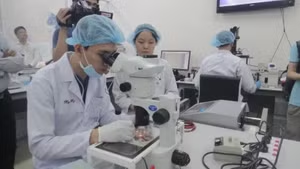
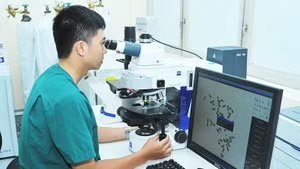
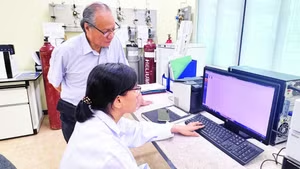
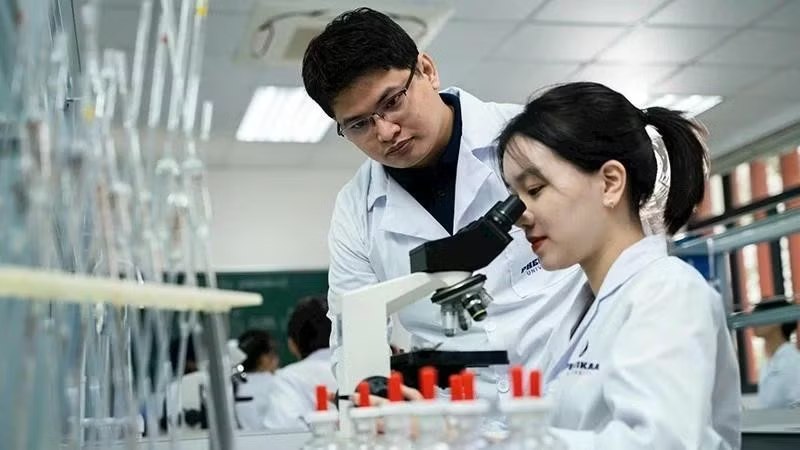
Viet Nam has also formed a network of research institutes, universities, and laboratories in many key fields, accumulating foundational research capacity, applied research capability, and human resource training, especially in information technology, automation, materials, biology, and high-tech agriculture. However, the capacity to master core technologies remains limited. Research activities mainly focus on improvement, adaptation, and application of technologies rather than creating source technologies capable of leading value chains.
In 2024, out of a total of 4,430 patents granted, only 308 were awarded to Vietnamese individuals or entities. Most domestic patents originate from the public research sector and tend to serve the completion of science and technology tasks, while foreign patents concentrate on foundational technologies with strong commercialization potential and global competitiveness.
According to experts, Viet Nam needs to shift from organization by units and sectors to organization by strategic technology chains, ensuring continuous linkage from foundational research, application-oriented research, and technology development to testing, commercialization, and scaling up, in order to enhance investment efficiency.
Along with this is the establishment of intersectoral coordination mechanisms, linking science and technology policies with industrial, investment, education, and market development policies, while creating conditions for substantive participation of enterprises. The roles of stakeholders must be “properly aligned”: enterprises play the central role in commercialization and scaling up; the State focuses on institutional facilitation, orientation, and investment in high-risk, long-term stages; research institutes and universities concentrate on foundational research, core technologies, testing, and training high-quality human resources.
The research and training network needs to be reorganized toward forming capability clusters and centers of excellence in strategic technology fields to create leading nuclei. The research and training system must be more closely connected with enterprises and the market through task design originating from practical demands, with enterprise participation from the outset and mechanisms for co-investment and sharing of research and testing infrastructure.