New financial mechanisms for scientists
The 2025 Law on Science, Technology and Innovation and Decree No. 263/2025/ND-CP, which provides detailed regulations and guidance on the implementation of the law, mark a major policy turning point for the scientific workforce.
Under the new framework, the abolition of the “salary cap” means that the income of civil servants and employees at public science and technology organisations is no longer constrained by limits such as two or three times the state pay scale. Public science and technology organisations are granted autonomy and held accountable for using revenue from the state budget, labour costs derived from science, technology, and innovation activities, and other lawful sources to pay salaries and incomes.
Remuneration is now determined based on job positions, assigned tasks and work performance, ensuring income is commensurate with workload, quality, and effectiveness, rather than being calculated according to fixed grades and ranks as before. In addition, income derived from the commercialisation of scientific research results, technological development, and innovation activities is to be distributed transparently to civil servants and employees in accordance with agreed arrangements.
Further important incentives include the exemption from personal income tax for scientists participating in technology transfer activities, as well as exemptions from import tax on equipment directly used for research.
With financial barriers removed, science and technology organisations can compete more effectively to attract overseas Vietnamese and foreign experts. The new mechanism allows the offering of attractive remuneration “packages”, including salary, housing, and working conditions, sufficient to persuade renowned scientists to work in Viet Nam.
The Ministry of Science and Technology believes that these new mechanisms for attracting foreign science, technology, and innovation personnel will enable Viet Nam to integrate more deeply into global value chains and research networks, address strategic national challenges, and contribute to stronger national development during the country’s current phase of advancement.
The “return” of talented individuals is expected to bring with it knowledge, experience, innovative thinking and international networks, directly enhancing domestic research and technological development capacity. Talent is also a core factor enabling Viet Nam to master core technologies, achieve greater autonomy in producing high-tech products, reduce reliance on foreign sources and enhance its standing on the global technology map.
Empowering organisations to strengthen the science system
While policies targeting scientists create incentives at the individual level, changes in mechanisms for science and technology organisations generate momentum across the research system. For the first time, public research institutes and centres have been granted comprehensive autonomy in organisational structure, human resources, finance, and the implementation of scientific tasks, with an especially significant breakthrough in recruitment autonomy.
Decree No. 263/2025/ND-CP authorises public science and technology organisations to decide on the recruitment, management, and utilisation of civil servants and employees in accordance with regulations, provided they have dedicated departments or personnel responsible for organisational and staffing affairs. This new provision enables public science and technology organisations to proactively remove long-standing bottlenecks in recruitment, management, and human resource utilisation.
According to Associate Professor Phan Tien Dung, Head of the Department of Technology Application and Deployment at the Viet Nam Academy of Science and Technology, recruitment previously had to be submitted to supervisory authorities, resulting in prolonged procedures and missed opportunities to attract high-quality talent. Personnel management under the Law on Civil Servants and Public Employees made it extremely difficult for science and technology organisations to dismiss, recruit, or appoint staff flexibly. Now, research institutes can proactively recruit the right people at the right time with the right expertise — a decisive factor in fast-developing fields such as artificial intelligence, biotechnology and new materials.
Decree No. 263/2025/ND-CP grants public science and technology organisations the authority to decide on recruitment, management and utilisation of civil servants and employees in accordance with regulations, provided they have dedicated organisational and personnel units.
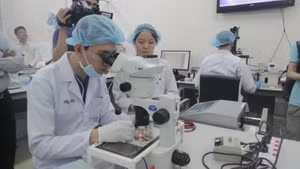
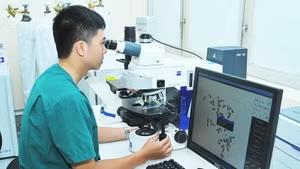
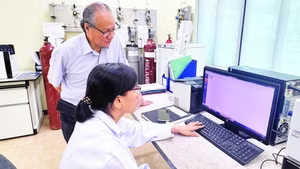
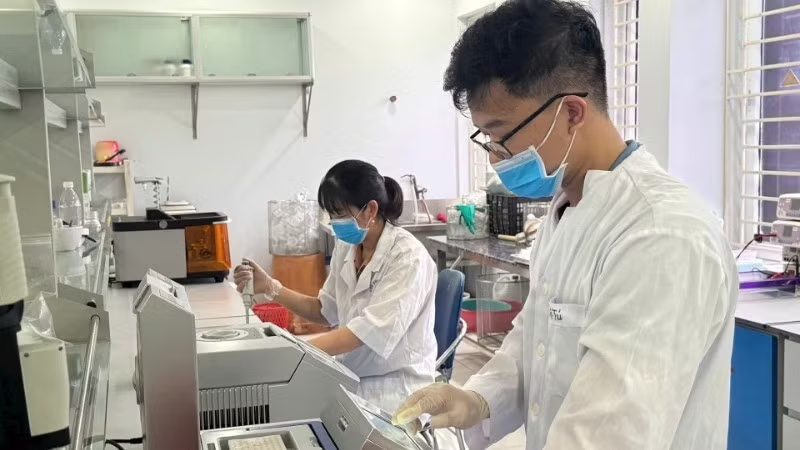
Financial autonomy has also been expanded, allowing science and technology organisations to determine expenditure levels for scientific and technological tasks, manage recurrent and investment spending independently, and proactively mobilise lawful revenue sources to sustain research activities. This is a critical condition enabling research institutes to invest boldly in laboratories, procure equipment, and pursue new research directions that carry higher risks but deliver strategic value.
The Law on Science, Technology and Innovation and its guiding decree permit science and technology organisations to establish enterprises or contribute capital to businesses to commercialise research outputs. This provision creates a direct bridge between laboratories and the market, enabling research results to be rapidly transformed into products with economic value. Profits generated not only increase scientists’ incomes but also provide financial resources for reinvestment in research activities. This is a model that has been successfully adopted in many countries with advanced scientific systems. However, greater autonomy must be accompanied by requirements for financial transparency, output-based performance evaluation and standardised governance processes.
The new mechanism also allows public science and technology organisations to recruit overseas Vietnamese and foreign experts to hold leadership and management positions, thereby facilitating access to modern operational models in line with international practices. When a scientific organisation is capable of attracting, managing, and operating according to international standards, its level of integration and competitiveness is significantly enhanced.
According to scientists, the new policies form a coherent system in which individuals are provided with incentives, organisations are granted authority, and the overall system is ensured connectivity and integration. As science and technology organisations grow stronger from within, they will become core drivers of innovation, contributing to the resolution of strategic national challenges and enhancing the position of Viet Nam’s science and technology sector.