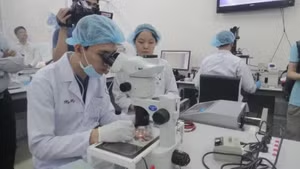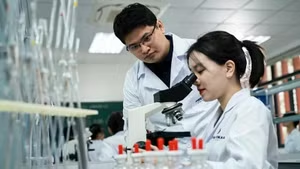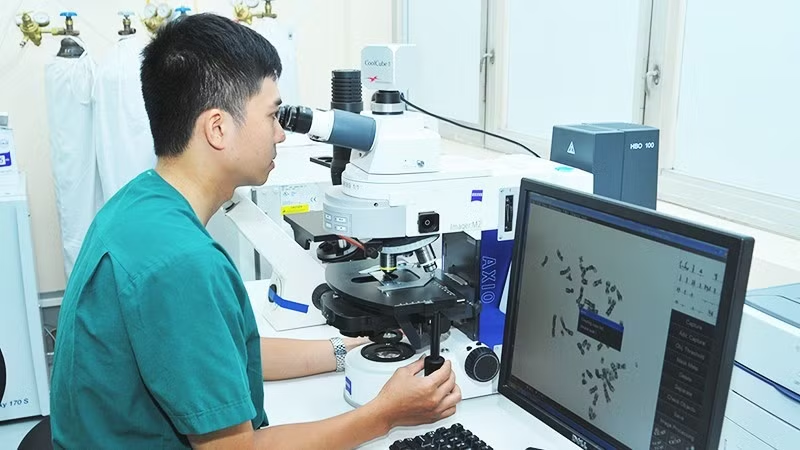
After more than two decades of investment in developing the national key laboratory system, the gap between research and commercialisation remains considerable. Scientists must often conduct research while simultaneously seeking resources to sustain laboratory operations.
Long-standing bottlenecks
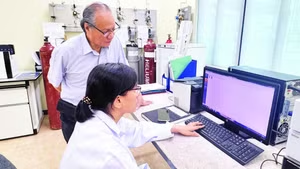
At the Key Laboratory for Petrochemical and Refinery Technologies, scientists have successfully developed a range of additives that help reduce energy consumption and emissions during the use of solid and gaseous fuels. These products offer significant practical value.
Behind that success, however, lies a journey that took seven years. During that period, researchers had to overcome numerous obstacles related to institutional mechanisms, financing, and operational management.
Professor Dr Nguyen Thi Thu Ha, representing the Key Laboratory for Petrochemical and Refinery Technologies, said that laboratories currently operate under a financial autonomy mechanism and receive virtually no regular budget support for operating expenses or salaries. All science and technology projects must compete through bidding processes in order to secure funding.
Consequently, scietntists must perform multiple roles simultaneously: conducting fundamental research, carrying out applied research, publishing internationally, and seeking research projects and funding opportunities. “The burden placed on scientists is extremely heavy,” Professor Ha noted.
The experience of the Key Laboratory for Petrochemical and Refinery Technologies reflects a broader reality: success is possible, but transforming laboratory achievements into marketable products requires tremendous effort.
After more than 20 years of operation, several shortcomings have become increasingly apparent. The first is the ageing of research infrastructure. Most equipment was purchased between 2000 and 2010, while the lifecycle of modern technologies today is typically only three to seven years.
According to a report by the Ministry of Science and Technology, average annual operating funding stands at just over 1 billion VND per laboratory, an amount largely sufficient only to cover electricity, water, and consumable materials.
Many laboratories also lack genuine autonomy. A significant number operate as dependent units within universities or research institutes and do not possess full legal status to make independent decisions regarding personnel, finance, or development strategies. As a result, resources are fragmented and utilisation efficiency falls short of the potential created by the original investment. Meanwhile, the commercialisation of research outcomes continues to face numerous barriers, hindering market access for scientific products.
More than just facilities for research equipment
Amid increasingly intense technological competition, many experts believe it is time to rethink the role of national key laboratories.
According to specialists, a modern laboratory should serve as a hub where knowledge, high-quality human resources, scientific data, and collaboration among government agencies, research institutes, universities, and businesses converge.
Professor Dr Nguyen Van Noi, former Rector of the University of Science under Viet Nam National University, Ha Noi, argued that the most important task is to transform laboratories into centres that attract cooperation among the State, scientists, and enterprises.
In his view, the objective should go beyond producing “Made in Viet Nam” products and instead focus on developing technologies that are genuinely “Created in Viet Nam” through Vietnamese innovation and intellectual capacity.
This perspective aligns with development trends in countries at the forefront of science and technology. In the US, the Republic of Korea (RoK), Japan and Germany, leading laboratories often function as the core of innovation ecosystems. Businesses participate from the stage of identifying research needs and share both resources and risks with scientific teams throughout the development process.
Recognising current limitations, the Ministry of Science and Technology is drafting a scheme to develop a system of national key research centres, testing facilities, and laboratories dedicated to strategic technologies.
The most notable aspect of the new approach is a shift in mindset. Rather than focusing solely on investing in individual laboratories, Viet Nam intends to build an integrated national research infrastructure system. Under this model, laboratories will no longer operate independently but will form part of a broader ecosystem comprising research centres, scientific databases, high-performance computing infrastructure, shared equipment platforms, and networks of experts.
According to the Ministry’s proposal, investment resources will be concentrated on strategic technology sectors such as artificial intelligence, big data, the semiconductor industry, biotechnology, biomedical sciences, advanced materials, and new energy technologies. Around 60%–70% of resources during the initial phase are expected to be allocated to these fields.
Importantly, the laboratory system will operate under an open-access mechanism, enabling universities, research institutes, businesses, and local authorities to access and utilise research infrastructure.
Hoang Anh Tu, Deputy Director of the Department of Science, Engineering, and Technology, noted that ministries and sectors are coordinating efforts to identify shared-use laboratories, establish investment criteria, and allocate medium- and long-term resources to ensure coherence and maximise the effectiveness of the national key laboratory system.
Viet Nam currently has 16 national key laboratories operating in priority fields including biotechnology, information technology, materials science, mechanical engineering, automation, petrochemicals, and energy. Total investment in the entire system amounts to approximately 967 billion VND, averaging less than 60 billion VND per laboratory. This funding falls significantly below investment levels in many countries with advanced science and technology sectors.