For Viet Nam — which is entering a new stage of development requiring rapid, sustainable growth and higher-quality human resources — grasping and developing the knowledge economy has become an urgent task in today’s digital era.
Intellectuals represent the nation’s intellect
Since the late 20th century, the world has undergone a profound transition from an industrial economy to a knowledge economy, characterised by the thorough exploitation and promotion of human intellectual potential, particularly knowledge in science and technology, to serve the goal of the national development. In a knowledge economy, human resources, especially the scientific and technological intellectual workforce, play a decisive role in the development of each country.
Throughout the history of our nation, intellectuals have always been an important creative force, making great contributions to the national development. The Vietnamese people have long upheld a tradition of respecting, honouring and taking pride in the intellectuals, affirming that intellectuals represent the nation’s intellect, as reflected in the saying that “Virtuous and talented people are the vital essence of the nation.”
Continuing this tradition, throughout the process of leading the revolution, the Party has always affirmed the important position and increasingly significant role of intellectuals in the cause of national construction and defence.
At every stage of the revolution, the Party has introduced appropriate and timely policies and decisions to gather, unite, build, and develop the intellectual workforce, thereby strongly promoting their role and motivating their dedication and creativity. Particularly since the initiation and deepening of the renewal cause, the Party and state have introduced specific policies that create favourable conditions for intellectuals to develop and contribute in all areas of social life. Resolutions, policies, and guidelines related to education, training, science, and technology have provided impetus for creativity and dedication of Viet Nam’s intellectuals.

According to Professor and Academician Chau Van Minh, Secretary of the Party Committee of the Viet Nam Union of Science and Technology Associations and former President of the Viet Nam Academy of Science and Technology, the aspiration for the nation to rise strongly in the new era represents the crystallisation of the intellect, will and confidence of the entire Party, people, and armed forces.
That aspiration has been translated into clear, synchronised and breakthrough policy “pillars”, notably a system of important resolutions of the Politburo that reflect strong reform thinking and long-term vision.
Resolution No. 68-NQ/TW on private economic development affirms the role of the private economy as an important driver of the socialist-oriented market economy. Resolution No. 66-NQ/TW on reforming law-making and law enforcement lays the foundation for improving institutions and ensuring a transparent and stable legal environment for development. Specifically, Resolution No. 57-NQ/TW, on breakthroughs in science and technology development, innovation, and national digital transformation, marks a fundamental shift in leadership thinking from considering science and technology as supportive sectors to identifying them as the central drivers of rapid and sustainable growth, affirming the highest political determination of the Party and state to realise strategic goals. This is a clear message of unity between vision and action and between policy formulation and implementation.
That spirit of urgency was quickly reflected at the legislative level. Soon after Resolution No. 57-NQ/TW was issued, the National Assembly adopted Resolution No. 193/2025/QH15, which piloted several special mechanisms and policies to create breakthroughs in science and technology development, innovation, and national digital transformation. The resolution opens an important legal corridor to unlock resources; remove bottlenecks in finance, investment, and mechanisms for the use and reward of human resources; and create favourable conditions for testing new models in a more flexible institutional environment.
However, even the most appropriate policies can only truly take effect when implemented by a capable and dedicated workforce. In this process, intellectuals, scientists, technology experts and innovative entrepreneurs are the key force, acting both as creators of new knowledge and as bridges connecting knowledge with production, business activities, and national governance.
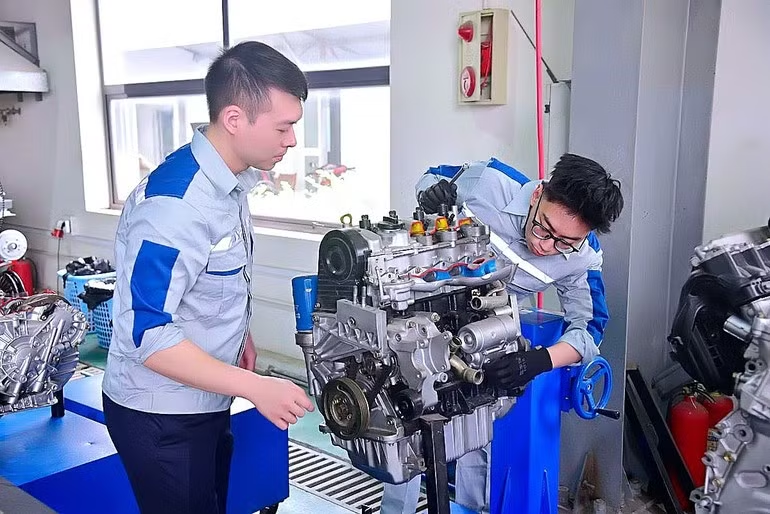
Therefore, along with institutional improvement, it is necessary to build mechanisms for attracting and utilising talent, creating favourable research environments, ensuring autonomy, encouraging bold initiatives, and accepting risks in innovation. From aspiration to action, from resolutions to concrete mechanisms, an ecosystem based on knowledge, technology, and innovation is gradually taking shape. This will serve as the foundation for Viet Nam to make breakthroughs, improve productivity and growth quality, and gradually affirm its position in global value chains.
It can be affirmed that over time the Vietnamese intellectual workforce has developed rapidly in both quantity and quality. From only a few hundred engineers and doctors after gaining the national independence, the country now has millions of people with university and postgraduate qualifications, including nearly 7,000 professors and associate professors working at higher education institutions.
However, the restructuring of Viet Nam’s economy remains slow and has yet to develop in depth. The technological level and overall development of the economy remain relatively low. The contribution of science and technology to economic growth is still modest, resulting in growth quality that is not high or sustainable. Therefore, it is necessary to proactively prepare human resources, strengthen information and telecommunications infrastructure, and continue building and improving the legal framework to promote socio-economic development.
Implementing synchronous and effective solutions
According to Professor Chau Van Minh, the Party and state recognise that the path ahead requires faster progress, higher quality, and stronger political determination than in previous periods, with the goal of transforming Viet Nam into a developed, high-income country by 2045, with an equitable, democratic, and civilised society, realising the aspiration long cherished by President Ho Chi Minh.
Moving from middle-income to high-income status is a challenging journey. The world development experience shows that many countries have fallen into the “middle-income trap” and struggled to break through. For Viet Nam, the inevitable path is to rely on science, technology, innovation, and digital transformation as the central drivers of growth.
Resolution No. 57-NQ/TW of the Politburo clearly identifies that breakthroughs in science, technology, innovation, and national digital transformation are the most important, serving as the main driving force to promote the rapid development of modern productive forces, improve production relations, innovate national governance methods, and strengthen self-reliance capacity and autonomy of the country.
The history of Viet Nam’s revolution demonstrates that each step forward of the nation has been associated with the development of science and technology and the pioneering role of intellectuals. In the new era, this tradition must be promoted even more strongly so that intellectuals truly become the decisive resource to help the country make breakthroughs.
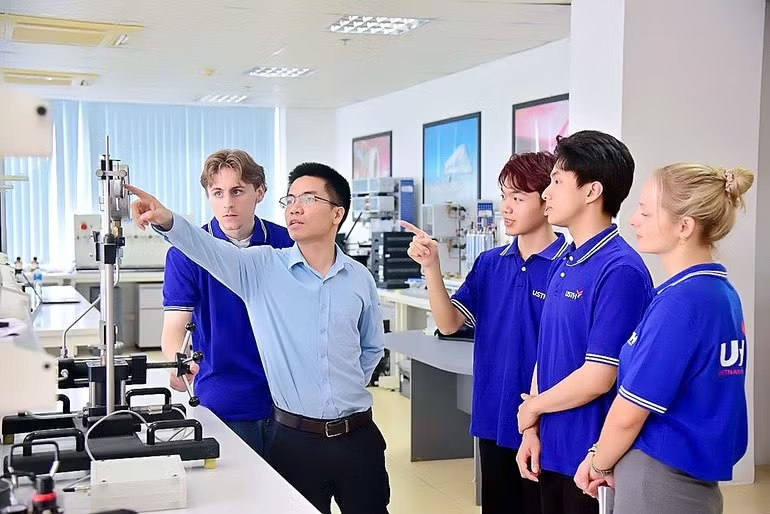
Therefore, developing a knowledge economy requires an intellectual workforce that is both large in number and high in quality, together with appropriate mechanisms to help them to fully realise their potential and contribute to the national development. On the one hand, intellectuals should be encouraged and supported to uphold their patriotic tradition and devote themselves wholeheartedly to the nation and the people, using their knowledge, talent, and strength — together with the people and under the leadership of the Party — to help the country develop and stand shoulder to shoulder with the world’s powers. On the other hand, some synchronised solutions should be implemented.
These include reforming mechanisms and policies for science and technology development, improving the legal system in line with socio-economic development requirements; encouraging enterprises to innovate technologies, strengthening competitiveness, and creating a fair competitive environment. Support should be enhanced for innovation and research and development of businesses, while building comprehensive mechanisms and policies that stimulate dynamism and efficiency in scientific and technological activities of every organisations and individuals; greater linkage should be created between research, training, and production; and effective mechanisms should be built to support the commercialisation of researched products and technological development results to meet demands of socio-economic sectors.
The state should increase investment in scientific research, technological development, and the application of modern technologies, striving by 2030 for Viet Nam to become a developing country with modern industry and upper-middle-income status. The overall objective is to improve people’s living standards, place Viet Nam among the top 30 economies in the world with per capita GDP of about 8,500 USD, develop the digital economy, and firmly safeguard national sovereignty.
It is also necessary to enhance the quality of basic research in both natural and social sciences, prioritising key research areas and concentrating investment to reach international standards. Basic research should be regarded as the foundation for the development of national scientific and technological research and development capacity and as the basic infrastructure of the country’s science and technology. At the same time, it should promote applied research to serve socio-economic development, efficiently and sustainably exploit natural resources, and strengthen international cooperation in science and technology activities.
Continued innovation of management and financial mechanisms in science and technology will create incentives for the scientific and technological intellectual workforce to uphold their creativity. The state will focus on building development funds and major science and technology programmes, identifying and commissioning the implementation of key national science and technology tasks, and concentrating resources on solving crucial science and technology tasks.
The education system must be developed and modernised at all levels with the long-term goal of training high-quality human resources, contributing to improving public knowledge, nurturing talent, and shaping the character of Vietnamese people. Strong investment in education and training is necessary so that, together with science and technology, it truly becomes a top national policy of the country.
Appropriate policies should also be implemented to reward, respect, and utilise intellectuals, including special mechanisms to attract talent and prevent brain drain.
Building a strong intellectual workforce is a top national policy and a responsibility of the entire political system and society in order to create a solid foundation for the country to enter a new era of development.
The 14th National Party Congress identified the intellectuals as a particularly important resource, playing a decisive role in the success of the cause of the industrialisation, modernisation, and deep international integration. The consistent viewpoint is to build a community of intellectuals with firm political courage, profound knowledge, and a strong spirit of service to the nation and the people — truly becoming the pioneering force in innovation, knowledge economy development, national defence and security, and enhancement of the country’s position.
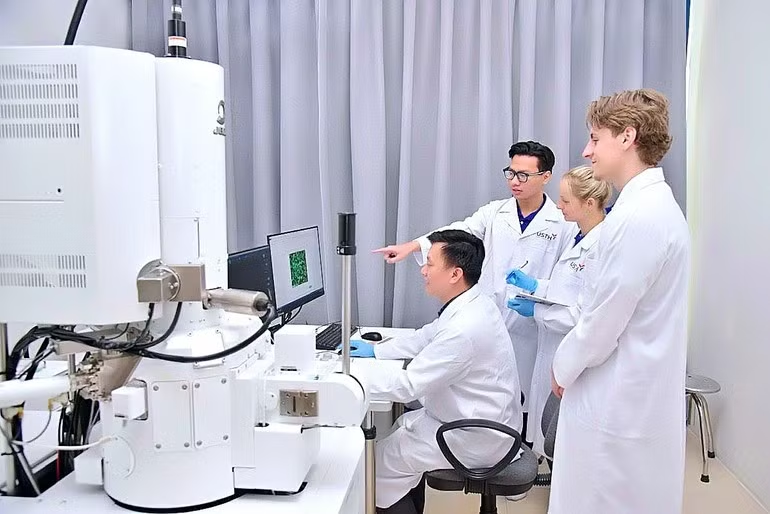
Under the decisive and synchronous leadership of the Politburo and the Secretariat, particularly under the direction of General Secretary To Lam, guidelines, policies, and mechanisms to identify, attract, utilise, and reward talent are gradually being improved. This opens broader opportunities and a more transparent legal framework for intellectuals to research, innovate, and contribute. Along with mobilising resources, it is also essential to build a healthy academic environment that upholds freedom of creativity combined with social responsibility, honours substantive contributions, and uses effectiveness and value of contribution as key evaluation criteria.
It is time for Vietnamese intellectuals to continue affirming their courage, aspiration, and stature, bringing Vietnamese intellect to the regional and global stage and contributing to the realisation of the strategic goals set by the 14th National Party Congress. We believe that in the new era, when knowledge, science, technology, and innovation become the primary drivers of growth, intellectuals will serve as the core force helping the country make breakthroughs, achieve rapid and sustainable development, and gradually realise the aspiration of building a strong and prosperous Viet Nam.