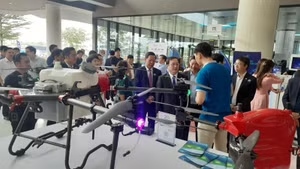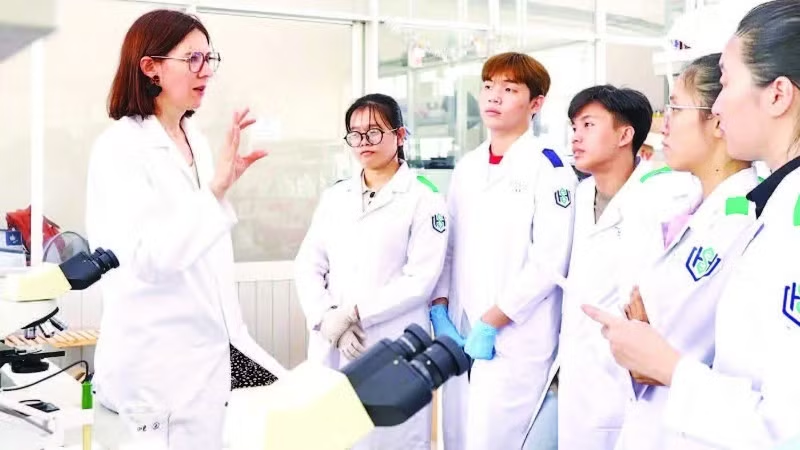
However, for this resource to be fully effective, the challenge lies not only in policy but also in the capacity to connect and operate the innovation ecosystem.
When innovation becomes growth driver
In recent years, Viet Nam has gradually improved its policy framework on science, technology and innovation, laying the foundation for the formation of a national innovation system. A notable milestone is the Law on Science, Technology and Innovation No.93/2025/QH15, which for the first time incorporates the concept of “innovation” into the legal system and places it on par with science and technology. In parallel, the 2025 State Budget Law expands spending for science, technology, innovation and digital transformation, providing a basis for prioritising resources for research, development and technological application.
According to Pham Hong Quat, Director General of the National Innovation Centre under the Ministry of Science and Technology, Viet Nam’s innovation startup ecosystem currently comprises around 4,000 startups, more than 200 venture capital funds, over 200 startup support organisations and approximately 100 startup and innovation centres, gradually forming a network to support research and technology commercialisation.
Nguyen Mai Duong, Director General of the Innovation Agency under the Ministry of Science and Technology, noted: “The innovation ecosystem is being promoted with enterprises at its centre, encouraging businesses to invest in technology development, while establishing innovation centres and startup support centres across ministries, sectors and localities.” Alongside state budget resources, capital flows for innovative startups are also taking shape. In 2024, total venture capital investment in Vietnamese startups reached approximately 529 million USD across 112 deals.
Viet Nam’s innovation ecosystem has also recorded encouraging signals. In 2025, the country ranked 55th globally in the Global Startup Ecosystem Index. Ho Chi Minh City entered the top five startup ecosystems in Southeast Asia for the first time, while Ha Noi and Da Nang both improved their rankings.
In this context, the Government has issued Resolution No.86/NQ-CP on the national strategy for innovative startups, establishing for the first time an overarching direction for developing the innovation ecosystem at the national level. According to Quat, by 2030, Viet Nam aims to have around 10,000 innovative startups, attract 1.5 billion USD in venture capital investment, and rank among the top 40 countries in the Global Innovation Index (GII) and the top 45 global startup ecosystems according to StartupBlink.
To further promote innovation in enterprises, on March 17, 2026, the Government issued Decree No. 77/2026/ND-CP to improve the operational mechanism of the National Technology Innovation Fund (NATIF). Under this decree, the fund finances and supports science, technology and innovation tasks through various instruments such as interest rate subsidies, technology vouchers and national science and technology programmes. Notably, its management mechanism has shifted from “pre-audit” to “post-audit”, encouraging enterprises to invest more boldly in technological innovation.
The challenge of connecting the innovation ecosystem
Although policy frameworks and supporting institutions for innovation are gradually taking shape, many experts believe that the greatest current challenge remains the ability to connect stakeholders within the ecosystem. A national innovation system can only operate effectively when its three pillars are closely linked: research institutes and universities generate knowledge and technology; enterprises commercialise and bring technologies to market; and the State plays a facilitating role in institution-building and implementation.
Under Decree No.268/2025/ND-CP, innovation centres can be organised under various models, including research and development centres, startup support centres or science and technology organisations. However, in practice, many research outcomes have yet to be commercialised or transferred into production, indicating that the gap between research and the market remains significant.
Experts note that while Viet Nam’s network of innovation centres is expanding rapidly and has begun to form a nationwide support system, many centres remain small in scale, operate in a fragmented manner, and lack strong linkages among ecosystem actors. A major gap lies in the absence of effective coordination mechanisms to connect resources and promote technology commercialisation. In this context, the National Innovation Centre (NIC) is expected to play a pivotal role in connecting the ecosystem, supporting technology enterprises and fostering international technology cooperation.
Some emerging models have begun to demonstrate new approaches to linking ecosystem stakeholders. For instance, the Innovation Centre at Viet Nam National University, Ho Chi Minh City has been developed as a deep-tech complex connecting research groups with enterprises, promoting technology transfer and fostering spin-off companies. The centre also participates in advising on development projects for Ho Chi Minh City and implements collaborative initiatives in fields such as semiconductors, artificial intelligence and creative industries.
Associate Professor Dr Lam Quang Vinh, Head of the Science and Technology Department at Viet Nam National University, Ho Chi Minh City, stressed the need to establish and effectively operate linkage mechanisms within the innovation ecosystem, particularly the “triple helix” model involving the State, universities and enterprises. Building cooperation frameworks and benefit-sharing mechanisms in applied research, while removing institutional barriers, would help unlock resources and promote innovation.
Linking scientific research with market demand from the outset would help shorten the gap between laboratory and production, facilitating the formation of technology-based spin-off enterprises. In addition, developing networks of innovation centres, investment funds and intermediary institutions is considered crucial for connecting technology supply and demand and promoting the commercialisation of research outcomes.
In the context of increasingly fierce technological competition, innovation is not only a driver of development but also a decisive factor in determining each nation’s position. While policy frameworks and supporting institutions are gradually being refined, the key challenge now is how to bridge the gap from ideas to market and from research to application, so that innovation can truly become a driving force of economic growth.
According to the orientation for developing the innovation ecosystem, Viet Nam will establish a network of startup support centres and innovation centres in six major cities, develop at least 300 innovation spaces and clusters, and build five Deeptech Hubs at universities and research institutes to promote core technology research and technology commercialisation.