Excess offices, shortage of personnel
After nine months of implementation, the two-tier local government model has shown many positive results: a leaner apparatus, fewer intermediary layers, closer government-to-people relations and faster policy responses.
However, as many deputies pointed out during discussions, this organisational revolution has also created inevitable consequences that need to be addressed. In that context, selecting public assets — specifically “office headquarters in the context of implementing the two-tier local government model” — as a theme for supreme oversight was both a timely and well-targeted decision. Timely, because it touches upon a sensitive area prone to losses, waste and localised interests. Well-targeted, because it is directly linked to a large-scale administrative restructuring process, where every change on paper leads to concrete practical implications: which offices will continue to be used, which will be abandoned, which assets will be repurposed, and who will bear responsibility?
Yet selecting the “right and relevant” topic is only the beginning. More importantly, how should oversight be conducted so that it not only reflects reality, but also resolves existing and even accumulating bottlenecks?
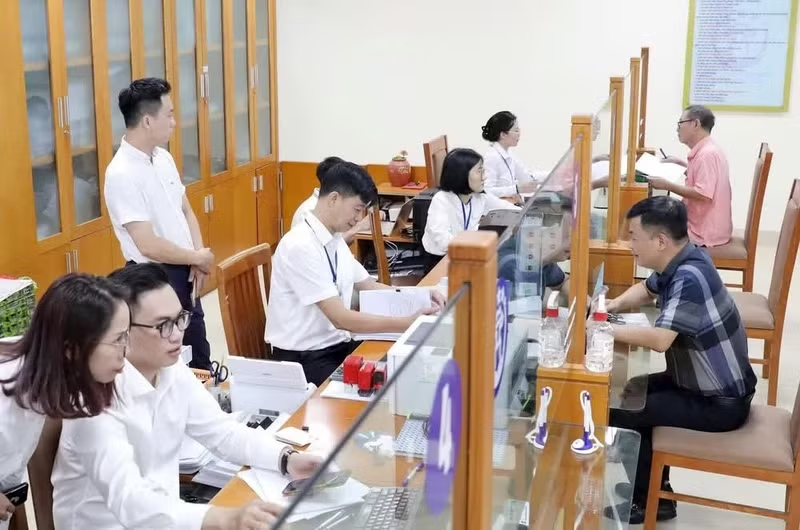
Representing a widely shared view, deputy Tran Thi Hoa Ry from Ca Mau Province analysed that when intermediary levels are removed, the workload does not disappear; instead, it is shifted entirely to the grassroots level. The paradox is that office headquarters may become redundant after mergers, while human resources and on-site decision-making mechanisms are in severe shortage. “Many responsibilities have been transferred to the grassroots level, but final decision-making authority still remains with higher levels. This means the two-tier model can sometimes become merely symbolic, slowing the resolution of people’s concerns,” she frankly commented.
Before this issue was debated at the National Assembly, records from group discussions among deputies had already highlighted that the lack of streamlined procedures and technological tools had left commune-level officials “overwhelmed” by reports and administrative procedures. The pressure has become even greater because the capabilities of many officials remain far below practical requirements — they are expected not only to handle administrative work, but also perform governance functions. When facing complex issues related to investment, planning or digital transformation, many officials feel uncertain and reluctant to act for fear of making mistakes and lacking protection mechanisms.
Towards comprehensive and objective oversight
To ensure that oversight activities concerning public office assets in particular, and the implementation of the two-tier local government model and other pressing practical issues in general, achieve substantive results, a series of transformative solutions regarding both oversight objectives and methods have already been proposed at the very first session of the 16th National Assembly.
Deputy Le Minh Nam from Can Tho City expressed strong support for the overarching principle of “constructive oversight”, as emphasised in the report by the NA's Committee for People's Aspirations and Supervision. Rather than merely “finding faults for punishment”, oversight should focus on sharing, accompanying and seeking solutions that pave the way forward. The highest objective is to comprehensively assess reality in order to design better policies and unlock resources currently “frozen”.
Regarding oversight methods, deputy Be Trung Anh from Dak Lak Province referred to the requirement for “oversight based on real and real-time data”, remarking that: “The Government operates on data, so the National Assembly cannot conduct oversight based on memory.” He stressed the need to build a synchronised digital platform connected to national databases so that deputies can access, compare and detect bottlenecks as soon as they emerge or show signs of emerging. This would enable the National Assembly to keep pace with the Government’s governance speed, instead of relying primarily on periodic reports containing largely qualitative figures.
Although not a new topic, mobilising expert knowledge and ensuring deputies’ independence in conducting oversight were also identified as crucial factors for specialised oversight activities. Deputy Dang Thi My Huong from Khanh Hoa Province proposed establishing clear mechanisms to involve scientists and experts in oversight delegations. At the same time, each National Assembly deputy should enhance their independence by developing their own oversight plans based on their professional expertise and constituencies, rather than relying entirely on the common programmes of delegations or committees.
Finally, in order to address one of voters’ longstanding concerns that many post-oversight recommendations “remain only on paper”, many deputies put forward strong proposals regarding post-oversight mechanisms. National Assembly bodies and delegations should conduct follow-up oversight on the implementation of previous recommendations to ensure the strict enforcement of the law. The results of implementing oversight recommendations should also be made public so that citizens and voters can monitor and evaluate them, thereby creating positive accountability pressure on those subject to oversight.
The first session of the 16th National Assembly has concluded, opening a packed and challenging agenda for the new term. The efforts of the Ethnic Council, National Assembly committees, delegations and individual deputies, together with close coordination and a spirit of “understanding and sharing” between oversight bodies and those being overseen, will serve as the “golden key” to turning parliamentary recommendations into tangible positive changes.
The post-oversight mechanism must be regarded as the “breakthrough stage”. Accordingly, there should be clear regulations on responsibilities and sanctions for agencies and individuals — especially leaders — who delay or fail to fully implement oversight conclusions.

![[Infographic] Key points from General Secretary and President To Lam’s opening remarks at the 14th PCC’S 4th plenum](https://en-cdn.nhandan.vn/images/j0QNt7m_5iy1OXpnUKiwG61aYhTv_B140GWhfriF26JwZbNNJ8LWetfvXUhz4Az6/1-8220.jpg.avif)