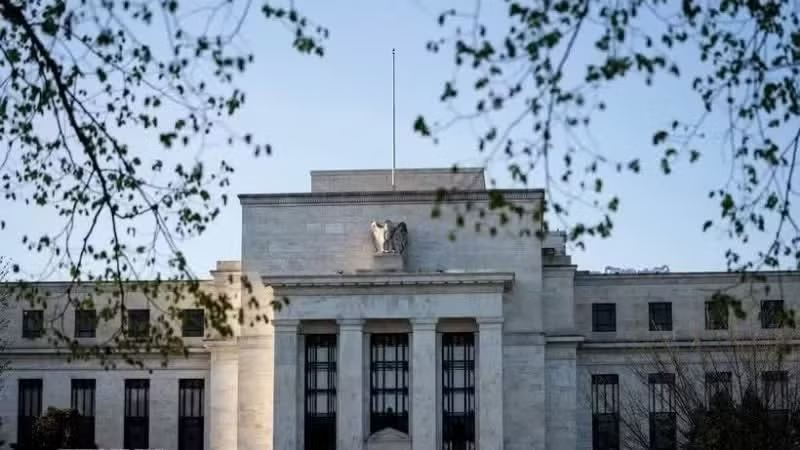
The Federal Open Market Committee's vote proved less contentious than many had anticipated, with members voting 9-3 in favour of keeping rates on hold.
The decision has been welcomed by the business community at a time of heightened market uncertainty, driven by soaring energy and food prices, as well as concerns over massive investment in artificial intelligence.
Fed Chairman Kevin Warsh said maintaining the benchmark interest rate at 3.5-3.75% was appropriate given the current state of the US economy.
However, Warsh acknowledged that significant risks remain, stemming primarily from the fallout of the conflict with Iran and continued volatility in energy prices.
Even so, the new Fed chairman struck an optimistic note, describing the outlook for the US economy as relatively positive.
According to the latest figures released by the US Department of Commerce, the world’s largest economy expanded by 1.5% in the second quarter, slowing from 2.1% in the first quarter.
The Personal Consumption Expenditures (PCE) price index, the Fed's preferred measure of inflation, fell by 0.1% in June, bringing the annual inflation rate to 3.7%.
Core PCE inflation, which excludes food and energy prices, rose by 0.1% in June, reaching 3.3% compared with the same period in 2025.
Three policymakers voted against keeping interest rates unchanged.
All three were presidents of regional Federal Reserve Banks: Beth Hammack of Cleveland, Neel Kashkari of Minneapolis and Lorie Logan of Dallas.
These officials have consistently argued in favour of raising interest rates to curb inflation, which has hovered between 3.5% and 3.7%, well above the Fed’s 2% target.
Even so, current inflation remains far below the peak of 9.1% recorded in mid-2022.
Analysts believe the voting outcome highlights increasingly visible divisions within the Fed over whether the US central bank has been too slow in responding to inflationary pressures.
The Fed has long relied on interest rate increases as one of its most effective tools for containing inflation.
With inflation remaining elevated for several years, many policymakers have called for raising interest rates to cool price growth.
Consumers and small businesses, however, argue that current interest rates are already placing a heavy burden on borrowers through higher debt-servicing costs.
As a result, demand for goods typically purchased on credit, such as cars and industrial equipment, has weakened considerably.
One of the strongest impacts of high inflation has been the sharp rise in food prices across the US in recent years.
This has forced many American households to change their spending habits by hunting for discounts, cutting back on non-essential purchases, eating out less frequently and turning to food assistance programmes.
US government figures show that the cost of groceries has risen by around 33% since the beginning of 2019, marking the steepest increase in several decades.
With the rising cost of living continuing to squeeze household budgets, American consumers are increasingly taking advantage of promotional offers, comparing prices across retailers and shopping more carefully for food.
The Fed’s decision to keep interest rates unchanged has therefore been viewed as a well-balanced approach.
Investors have welcomed the fact that the central bank has refrained from raising rates to combat inflation, while also resisting the temptation to cut rates in an effort to stimulate economic growth and reduce borrowing costs.
Many economists are even optimistic that inflation in the US may already have peaked, leaving the Fed with little justification for taking the risk of raising interest rates.