Amid profound changes in the world order, BRICS is strengthening coordination and seeking consensus to address common challenges and safeguard the interests of developing countries.
BRICS has developed from its initial grouping of Brazil, Russia, India and China. To date, the bloc has 11 members and several countries participating as partner countries.
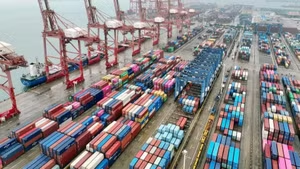
As a forum for consultation and cooperation among emerging markets and developing countries on economic, political, financial and global governance issues, BRICS has become one of the important cooperation mechanisms of the Global South, accounting for around 30% of global gross domestic product (GDP) and representing a large share of the world’s population. The bloc’s expansion has increased BRICS’ economic and diplomatic weight, strongly promoting trade exchanges through trade corridors connecting major economies.
To ensure that member countries can maximise their capacity to overcome challenges and develop, strengthened intra-bloc cooperation helps enhance resilience in responding to supply chain disruptions, climate risks and geopolitical shocks. The 18th BRICS Summit, chaired by India as BRICS Chair in 2026, takes place at an important time for the bloc. The Chair’s goal is to make BRICS more practical, comprehensive and development-oriented.
Trade is one of the key areas on the BRICS agenda. Under India’s chairmanship, the group has made progress on the BRICS Economic Partnership Strategy 2030, supporting the multilateral trading system with the World Trade Organisation (WTO) at its core, the internationalisation of micro, small and medium-sized enterprises (MSMEs), and global value chains. Another important achievement is the launch of the BRICS Global Value Chains Action Plan 2026-2030, aimed at making supply chains more sustainable and diversified, while encouraging greater market access and investment among member economies.
Recent global disruptions have shown the vulnerability of international supply chains, and the BRICS logistics supply chain cooperation framework is designed to help improve the resilience and sustainability of systems and logistics infrastructure.
BRICS is also moving towards stronger cooperation in the fast-growing digital services economy. India has placed small businesses at the centre of its economic agenda, as they are an important factor for inclusive growth. Notably, the agenda also includes the BRICS Incubation Network, which aims to connect start-up incubators and help promising companies find partners and opportunities in other BRICS economies.
Technological cooperation is considered an area with ample room for growth. India has strengths in public digital infrastructure, while China and many other BRICS members possess considerable technological capabilities. This provides a foundation for strengthening cooperation in areas such as artificial intelligence, electric vehicles and innovation.
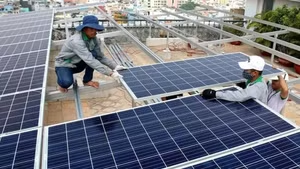
Cooperation to ensure energy security is also particularly important for BRICS, as many of its members are major energy producers and consumers, as well as economies undergoing rapid industrialisation. BRICS currently includes major energy producers such as Russia, Saudi Arabia, Iran, the United Arab Emirates (UAE) and Brazil, while also having major consumer markets such as India and China.
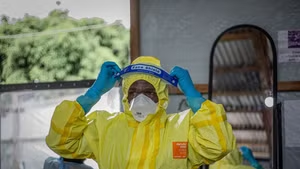
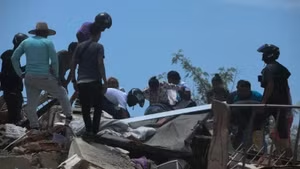
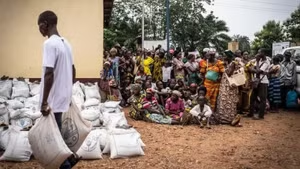
Faced with global challenges such as geopolitical conflicts, supply chain disruptions, natural disasters and epidemics, no country can withstand external shocks without a truly solid foundation of self-reliance and international cooperation. In this context, BRICS members are promoting autonomy and self-reliance, advancing sustainable trade, technology transfer and participation in the development of international standards on science and technology, in order to overcome challenges and move towards sustainable and inclusive development.