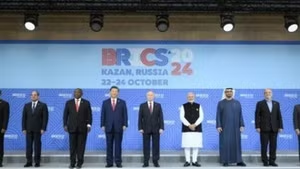
This year’s meeting was overshadowed by conflict and the energy crisis. The war involving Iran and the related fuel crisis dominated discussions throughout the conference. Participating countries, including Iran, Saudi Arabia and the United Arab Emirates, held differing positions regarding the conflict between the US and Israel with Iran that erupted in late February.
Conflicts, economic instability, together with challenges relating to trade, technology and climate, are reshaping the global landscape. Against this backdrop, expectations are growing, particularly among emerging economies and developing nations, that BRICS will play a constructive and stabilising role.
The meeting therefore provided an opportunity for member states to exchange views, promote consensus and consider practical measures to strengthen intra-bloc cooperation. Development issues remained central, as many countries continue to face challenges concerning energy security, food, fertiliser, healthcare and access to finance.
BRICS was established in 2009 as a forum for large emerging economies seeking a stronger voice within global institutions traditionally dominated by the West. The bloc originally comprised five countries: Brazil, Russia, India, China and South Africa. It was later expanded to include Egypt, Ethiopia, Iran, Saudi Arabia, Indonesia and the United Arab Emirates in order to enhance its political and economic influence globally.
India has consistently played a pivotal and balancing role within BRICS. Given its standing and influence, New Delhi has often focused on turning the bloc into a more substantive entity rather than merely a platform for political declarations. The theme for India’s BRICS Chairmanship Year 2026 — “Building Resilience, Innovation, Cooperation and Sustainable Development” — received support from member states.
At the conclusion of the two-day meeting, India issued the Chair’s Statement reaffirming the commitment to strengthening the BRICS strategic partnership based on three pillars: political-security cooperation, economic-financial cooperation and people-to-people exchanges.
Regarding the situation in West Asia, the statement acknowledged differing views among some members on issues relating to sovereignty, territorial integrity, maritime security and the protection of civilian infrastructure and lives. Despite these differences, BRICS members agreed to emphasise the need for an early resolution of the current crisis through dialogue and diplomacy, in accordance with international law, while ensuring safe and uninterrupted maritime trade through international waterways. Many BRICS members also expressed concern over the impact of recent developments in the Middle East on the global economy, particularly on trade and energy security.
The increasingly complex international situation highlights the need to strengthen multilateral institutions and the global governance system so that they are robust enough to uphold and promote the fundamental principles of international law and the United Nations Charter, while responding effectively to conflicts and their adverse impacts on trade, energy, supply chains and global growth.
Accordingly, the meeting stressed the importance of continuing to reform the global governance system and strengthening multilateralism in a more inclusive, representative and effective manner to address global challenges and amplify the voice of developing countries, particularly within the United Nations and the United Nations Security Council.
This process should be based on dialogue, cooperation, respect for sovereignty, territorial integrity and international law, while narrowing differences, fostering trust and promoting fairness. The meeting also called for reforms to international financial structures, improved capacity to respond to economic challenges, stronger food, energy and supply chain security, and the reinforcement of a fair, open and rules-based multilateral trading system, with the World Trade Organisation at its core.
The expansion of BRICS in recent years reflects the bloc’s growing influence in global governance. BRICS has gradually affirmed its role in promoting dialogue, cooperation and the voice of the Global South, towards a fairer and more inclusive world order.