This is not the first time EU membership has become a focal point on Iceland’s political agenda. Nearly 20 years ago, the Nordic country applied to join the EU and officially launched accession negotiations in 2010.
However, disagreements over fisheries exploitation, coupled with a change of government following the 2013 election, led to the process being suspended.
Reykjavik opted to maintain close economic ties with the EU through the European Economic Area (EEA), rather than continue pursuing membership. As a result, the path to EU membership closed.
The referendum, scheduled for August 29, will put the issue of resuming EU accession negotiations back on Iceland’s political agenda. However, nearly 20 years have passed, bringing many changes to relations between the two sides.
Previously, Iceland approached the EU as a country seeking economic support to aid its recovery from the financial crisis. Today, however, the Nordic country has emerged as one of Europe’s more prosperous nations, with steady economic growth.
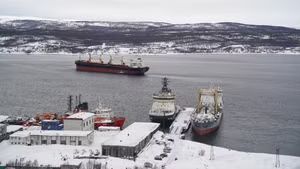
Moreover, as competition in the Arctic intensifies, Iceland’s international standing has grown. Its strategically important location between North America and Europe gives it significant influence over key shipping routes and the security architecture of the North Atlantic.
As the referendum draws closer, a host of arguments over the potential gains and losses remain under consideration. Supporters of resuming EU accession negotiations argue that the economic benefits should be the primary consideration.
Despite steady growth, Iceland – a country of around 400,000 people – has a relatively small economy that remains vulnerable to external shocks.
Against this backdrop, joining the EU would offer an opportunity to strengthen the economy, give Iceland a direct voice in EU policymaking, and help the country enhance its position with major trading partners.
In addition, EU membership is seen as a necessary step towards strengthening Iceland’s security amid today’s volatile geopolitical landscape. Despite occupying a strategically vital position in the North Atlantic, Iceland has no standing army.
The country’s security framework is based on its NATO membership and a bilateral defence agreement with the United States. Iceland’s Finance Minister said that EU membership would bring both economic and security benefits to the Nordic country.
On the other hand, opponents fear that joining the EU could undermine Iceland’s ability to make its own decisions in key areas. Fisheries exploitation is by far the most prominent concern.
As an island nation, Iceland has a vast exclusive economic zone. The fisheries industry is the backbone of the economy, while also being closely linked to the country’s history and national identity.
Opponents argue that, if Iceland were to join the EU, compliance with the bloc’s common fisheries policy would mean the country no longer had full control over fishing quotas and how its fishery resources are exploited, while also having to open its waters to EU fishing vessels.
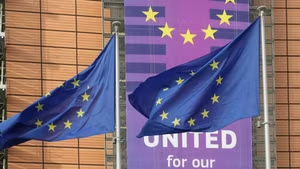
For the EU, admitting Iceland would carry significance extending beyond the usual economic considerations. The move could help expand the bloc’s presence in the North Atlantic and the Arctic, which are increasingly regarded as hotspots of great-power competition.
In addition, the accession of a country with a strategically important location and a dynamic economy would demonstrate the bloc’s continued appeal, providing a major boost to the EU’s enlargement policy.
Analysts believe that, if resumed, Iceland’s EU accession negotiations would proceed quickly. Iceland has maintained relatively close economic and institutional ties with the 27-member bloc for many years, has access to the EU single market through the EEA and is part of the Schengen free-movement area. As a result, Iceland would not need to undertake extensive reforms to meet the bloc’s criteria.
The upcoming referendum is not a vote on EU membership itself, but merely a decision on whether to launch the accession process. Nevertheless, it will serve as a test of Iceland’s readiness for deeper integration with Europe and is an important decision for the country’s future development.