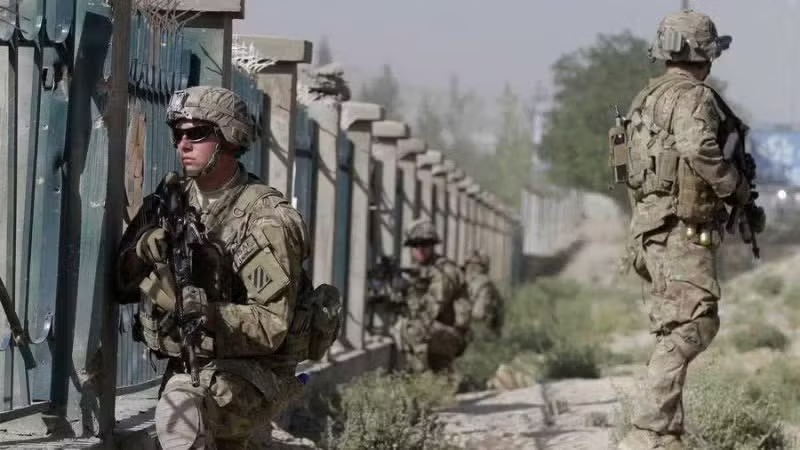
The transatlantic security relationship is undergoing a profound transformation in its nature, moving from one of protection and dependence to an equal partnership. After years of urging European allies to stand on their own feet and share more of the security and defence burden, the US has officially launched a review of its military forces stationed across Europe.
US Under Secretary of Defense for Policy Elbridge Colby stated that this is a substantive review aimed at ensuring NATO is making "rapid and irreversible" progress towards enabling Europe to take the leading role in its own defence. US officials have also repeatedly referred to the concept of "NATO 3.0", under which Europe would be capable of providing for its own security, shifting from dependence on the US to a fairer sharing of responsibilities.
The conflict in the Middle East, intensifying strategic competition in the Indo-Pacific, and other increasingly complex security challenges have created a need for Washington to reduce its commitments in Europe to avoid overstretching its military resources.
A stronger Europe in terms of defence would also help ease long-standing disagreements between the US and its allies. Since President Donald Trump returned to the White House for his second presidential term, the US and Europe have repeatedly shown differences of opinion over the conflict in Ukraine, the Middle East, Greenland, and the sharing of defence spending within NATO.
Nevertheless, the administration of President Donald Trump is also fully aware of the risks of withdrawing troops from Europe too quickly and has therefore opted for a carefully managed force adjustment. For many years, the US has maintained a central role within NATO, benefiting from its transatlantic alliance network and military presence across allied countries, which helps protect the US against security threats. Europe also recognises that implementing the NATO 3.0 model is an inevitable requirement in the new security environment. At the E5 Summit, comprising Germany, France, the United Kingdom, Italy, and Poland — held in Berlin, Germany, at the end of June — leaders agreed to shape a stronger "European pillar" within NATO.
However, strengthening autonomy in security and defence will not be easy. European countries will require considerable time and resources to fill the gaps left by the reduced US presence, particularly in military technology. Experts point out that Europe had previously expected it would take 20 to 30 years to achieve strategic autonomy. However, changes in US policy have shortened that timeframe to around 10 years. Even so, not every European country is in a favourable position to increase defence spending.
By officially launching its review of military deployments in Europe, the US has moved beyond statements and warnings to concrete action. This strategic shift is not merely about changing troop numbers or force deployments. It also reflects a change in strategic thinking and Washington's determination to reshape the transatlantic security relationship into one based on a more balanced sharing of interests and responsibilities, thus allowing the US to focus its resources on other key strategic priorities.
After more than 75 years of existence, NATO is also witnessing significant changes in its security structure, moving toward a new vision defined by the many challenges of what has become known as NATO 3.0.