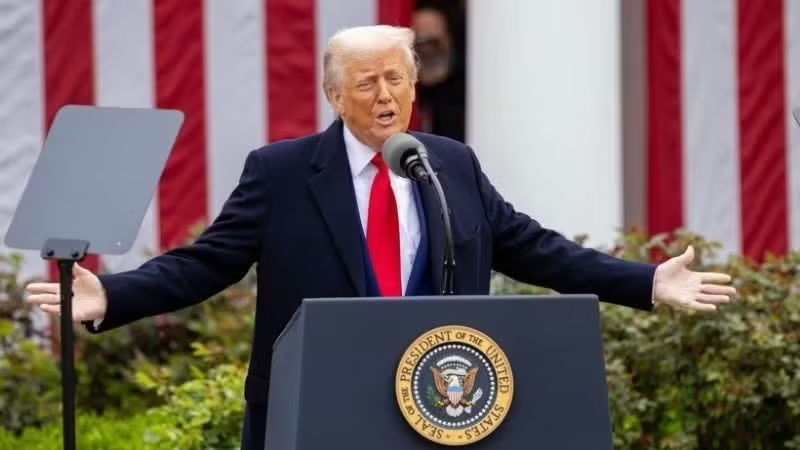
In a recent address, President Donald Trump candidly acknowledged that he is considering the option of withdrawing the US from NATO. The remarks come amid a lack of consensus among members over the conflict involving Iran.
While the US has adopted a hardline stance towards Tehran, many NATO countries have opted to support diplomatic solutions and avoid military escalation in the region. Contrary to Washington’s expectations, European nations have shown caution about participating in military operations in the Middle East, as well as about assisting the US in ensuring security in the Strait of Hormuz. Some countries have openly refused to allow the US to use their military bases or airspace for military deployments, while affirming that they do not wish to be drawn into the conflict.
This is not the first time that relations between the US and other NATO members have been strained. President Donald Trump has repeatedly expressed dissatisfaction with allies, but tensions have now escalated to a new level. Whereas previous disagreements largely revolved around Washington’s calls for allies to share the burden of defence spending, this time President Donald Trump has directly raised the prospect of a US withdrawal from NATO.
So far, the idea of the US leaving NATO remains only an option under consideration by President Donald Trump. Moreover, if pursued in practice, the process would face significant legal and political obstacles. In 2023, the United States Congress passed legislation preventing the president from withdrawing the country from NATO without its approval. Nevertheless, the statement by the US leader has raised significant concerns about deepening fractures within the military alliance.
NATO’s divisions are not coincidental, but rather the inevitable result of diverging interests in certain issues that have yet to be reconciled. Regarding tensions with Iran, it is not difficult to understand why Europe has declined to take part in military operations. Stability in the Middle East is closely tied to Europe’s economy and security. Following the outbreak of conflict involving the US, Israel, and Iran, Europe has been among the most heavily affected regions — with issues ranging from disrupted energy supplies and concerns over refugee flows fleeing the conflict to heightened security risks. These consequences directly affect European interests.
Meanwhile, the issue of burden-sharing in defence remains unresolved. Despite a significant increase in spending by allies, the US still accounted for around 60 per cent of NATO’s total defence budget in 2025. President Donald Trump has described this as a “one-way relationship”, arguing that while the US shoulders the bulk of security responsibilities, its allies have not responded in kind when Washington has required support.
Experts believe that, despite existing disagreements, the US and European countries still need one another. For the US, NATO offers long-term strategic benefits that cannot be measured solely in budgetary terms — namely a transatlantic alliance network and the ability to maintain influence and leadership. In this context, any decision regarding adjusting US participation in NATO requires careful consideration of both short-term and long-term interests.
Conversely, for many years, Washington’s “security umbrella” has provided Europe with the necessary assurances to maintain a stable environment for development, as well as a meaningful voice in global security issues. Therefore, in response to the firm stance from the US, many European countries have continued to reaffirm NATO’s vital role, warning that any US withdrawal would seriously undermine regional security. Against this backdrop, the upcoming visit to the US by the NATO Secretary General, scheduled for next week, is expected to help ease tensions.