Against this backdrop, King Charles III’s state visit to the US is expected to help mend strains, reinforce high-level dialogue, and serve as his most significant diplomatic test since ascending the throne.
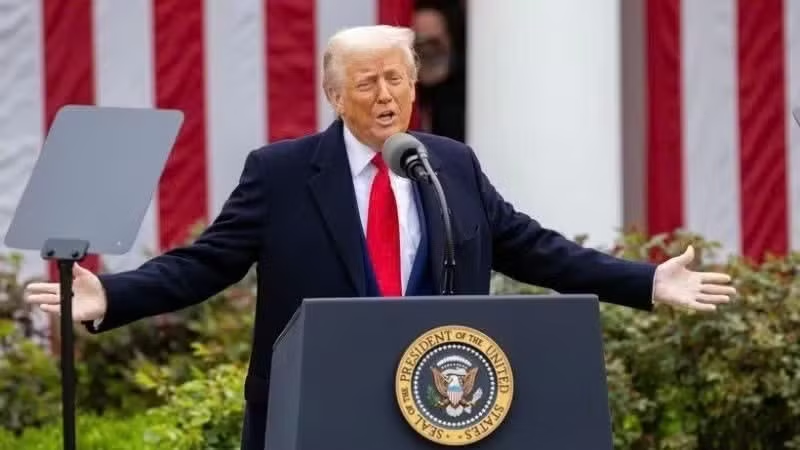
In a speech delivered in the UK in September 2025, US President Donald Trump praised bilateral ties, likening the US–UK relationship to “two notes in a chord”, each retaining its own identity while harmonising together. However, fresh tensions have emerged between the transatlantic allies, causing what was once seen as a resilient “composition” to fall out of sync.
The UK and several of Washington’s European allies have maintained a cautious balancing stance, avoiding deep involvement in the Middle East conflict—a conflict that has struggled to gain public support domestically and internationally and carries wide-ranging implications for Europe. This approach has drawn a sharp reaction from the White House. President Trump criticised UK Prime Minister Keir Starmer for a “lack of enthusiasm” in failing to fully support Washington’s military campaigns, and suggested that bilateral relations were “no longer as good as before”.
During his visit to the US from April 27 to 30, King Charles III is seen as carrying the responsibility of helping to repair cracks in the bilateral relationship. Observers expect the British monarchy’s soft power to be leveraged as a bridge between the two countries. Former UK Ambassador to the US Peter Westmacott noted that while the King would not engage in policy-level negotiations like the Prime Minister, he could use private discussions to address key issues.
The British monarchy, a symbol of continuity and stability, remains a pillar of the UK’s diplomatic strategy. During a White House visit in February 2025, Prime Minister Keir Starmer personally delivered an invitation from King Charles III to President Trump. The move underscored London’s commitment to the relationship and was viewed as effective, given Trump’s long-standing interest in the UK and the Royal Family, including his admiration for royal ceremonies.
However, differences have existed between King Charles III and President Trump, particularly on energy policy. Media reports indicate that the King supports environmental protection and renewable energy development, whereas Trump prioritises fossil fuel extraction and has expressed opposition to wind power projects.
Following the outbreak of the US–Iran conflict, and under pressure from Washington, the UK government agreed to allow the US to use its bases for “specific and limited defensive purposes”, a decision that reportedly dissatisfied President Trump. Developments in the Middle East suggest that, under Trump, the US and UK have increasingly diverged on several key geopolitical issues.
In January 2026, Trump criticised London over plans to return the Chagos Islands to Mauritius. Meanwhile, Prime Minister Keir Starmer opposed Trump’s threat to impose tariffs on European allies over Greenland-related issues, warning that a trade war would benefit no party.
Leaders in both countries hope that King Charles III, with his measured and diplomatic style, will use the visit to reinforce the future of the alliance. UK Ambassador to the US Christian Turner said the visit would highlight the shared history and common values between the two nations.