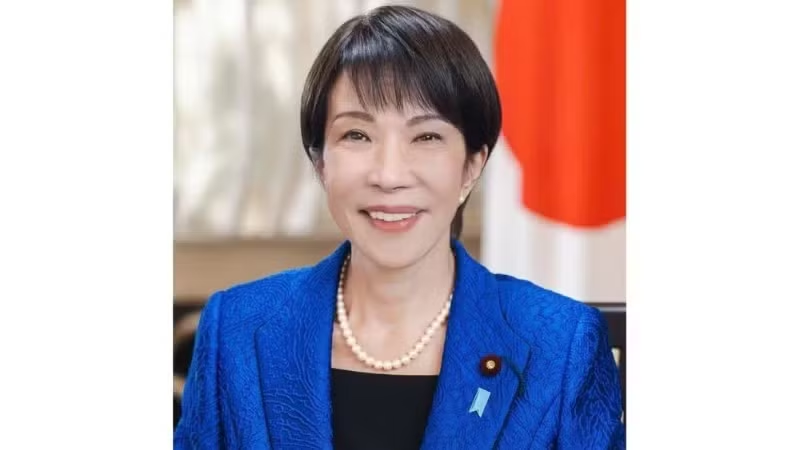
According to the RoK’s Presidential Office, Prime Minister Takaichi Sanae will visit Andong, the hometown of President Lee Jae Myung. This is seen as a reciprocal diplomatic gesture following the Japanese leader’s hosting of President Lee at her hometown in January this year.
Although not a state visit, the RoK’s Presidential Office stated that Seoul would welcome the Japanese leader with the highest diplomatic protocol reserved for foreign heads of state, equivalent to a state visit. This exception underscores the importance Seoul places on its relationship with Tokyo, a partner that shares many common interests.
Despite their geographical proximity, relations between Japan and the RoK have experienced many “low notes”, at times deteriorating seriously because of disagreements linked to historical issues during the 1910-1945 period. However, over the past four years, bilateral relations have entered a cycle of promoting substantive cooperation and jointly looking towards the future. RoK President Lee Jae Myung once affirmed that instead of allowing stories of the past to bind the two countries, he wished to turn a new page in bilateral relations.
After taking office in 2025, President Lee Jae Myung chose the RoK as the destination for his first overseas trip in his new position. On the Japanese side, Prime Minister Takaichi Sanae’s visit to the RoK this time also marks the third high-level meeting between the two sides in less than eight months.
By maintaining regular visits and high-level exchanges, the two countries wish to send a clear message that Tokyo and Seoul neither deny nor avoid historical issues, but they also will not allow past differences to prevent the two countries from drawing closer together for their common interests.
Prime Minister Takaichi Sanae’s visit is expected to open opportunities for the two leaders to strengthen political trust and deliver practical results for cooperation between Japan and the RoK. During the meeting on May 19, Prime Minister Takaichi Sanae and President Lee Jae Myung are expected to discuss orientations for developing bilateral relations and promoting cooperation in trade, technology and social affairs. In addition, international issues of shared concern, including the conflict situation in the Middle East, supply chains and global energy security, are also important items on the agenda.
Analysts believe the RoK and Japan have many reasons to move closer together, especially amid strong global economic fluctuations caused by the conflict in the Middle East. Both North-East Asian economies depend heavily on crude oil imports from the Middle East.
As tensions between the US and Iran erupted, causing serious repercussions for the global energy market, Seoul and Tokyo faced numerous challenges. Therefore, cooperation to maintain supply chains and ensure economic security has become an urgent need for the two North-East Asian nations.
In addition, the meeting could also provide an opportunity for Seoul and Tokyo to narrow differences related to the RoK’s desire to join the Comprehensive and Progressive Agreement for Trans-Pacific Partnership (CPTPP). Japan is an influential member of the CPTPP. Therefore, Tokyo’s support plays an important role in helping the RoK realise its goal of joining the CPTPP, a market of nearly 600 million people contributing around 15% of global gross domestic product (GDP).
Prime Minister Takaichi Sanae’s visit to the RoK is expected to deepen solidarity and trust between the two countries and provide an opportunity to strengthen the solid foundation of Seoul-Tokyo relations. With positive cooperation outcomes, the RoK and Japan could become a vivid example of efforts to overcome historical differences and move together towards a better future.