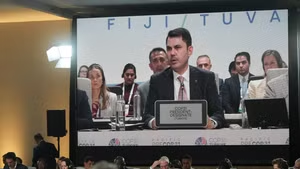
Following a series of rounds of voting at the recent session of the UN General Assembly in New York, the US, five countries — Austria, Kyrgyzstan, Portugal, Trinidad and Tobago, together with Zimbabwe — were officially elected as non-permanent members of the UN Security Council for the 2027–2028 term.
These results clearly demonstrate the growing prestige of developing countries on the international stage. From being rule-followers in established "rules of the game," developing countries are gradually becoming active participants in setting rules in global "playing fields," guiding agendas, and assuming important responsibilities at multilateral forums.
This fact raises a question: Have the world's leading power agencies, including the UN Security Council, given developing countries a position commensurate with their role and status? Africa, for example, with a population of more than 1.5 billion people, is the continent with the largest number of UN member states and is home to many security and development hotspots.
According to statistics, nearly 45% of UN Security Council resolutions adopted in 2025 related to African issues. Most of these resolutions authorised sanctions, peacekeeping deployments, or military operations in Africa. However, the continent has no permanent seat on the Security Council, meaning it lacks decisive influence over issues directly related to its own development and security.
Reforming the Security Council is not a new issue. Although discussions began decades ago, the process has largely remained stalled.
As the only UN body empowered to adopt legally binding resolutions, the Security Council currently consists of five permanent members — the US, Russia, China, France, and the UK — along with 10 non-permanent members elected for two-year rotating terms.
Holding veto power, the five permanent members can block any resolution, from peacekeeping missions to sanctions with broad international impact. However, increasingly intense competition among major powers has made the adoption of resolutions more difficult.
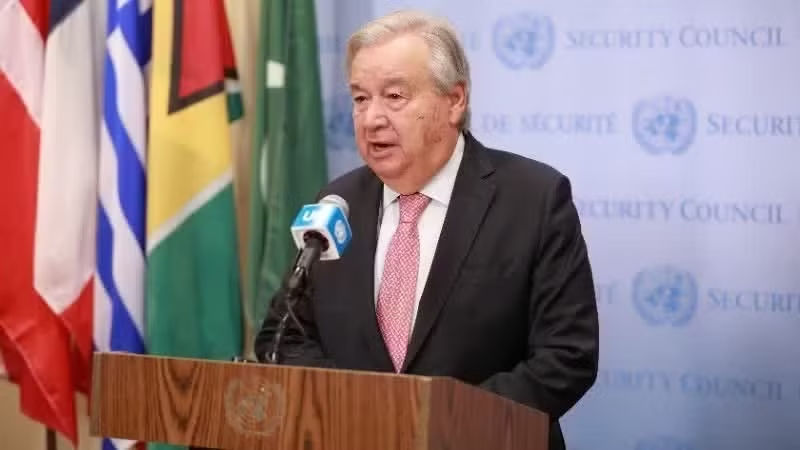
UN Secretary-General Antonio Guterres stated that the Security Council is a core pillar of the global peace and security system, but more than 80 years have passed since its establishment in 1945, bringing many changes. The UN leader affirmed that the organisation’s core mission of maintaining peace, security, and building a fairer and better world for all humanity remains unchanged.
Efforts to reform the Security Council have received broad support from the international community, including from some permanent members. Amid strong shifts in global geopolitics, the demand for Security Council reform is becoming more urgent than ever.
To fulfil this noble mission in the current international context, the “software” installed more than 80 years ago needs updating. Therefore, the Security Council faces an urgent need for reform to improve representation, transparency, and operational effectiveness.
Efforts to reform the Security Council have received broad support from the international community, including from some permanent members. Amid strong shifts in global geopolitics, the demand for Security Council reform is becoming more urgent than ever.
This can be considered one of the most important, complex, and long-standing reform contents of the world’s largest multilateral organisation. Nevertheless, it is a necessary step for the Security Council to continue affirming its central role in maintaining international peace and security, while also meeting the requirements of the new situation as well as the legitimate interests of all UN member states.