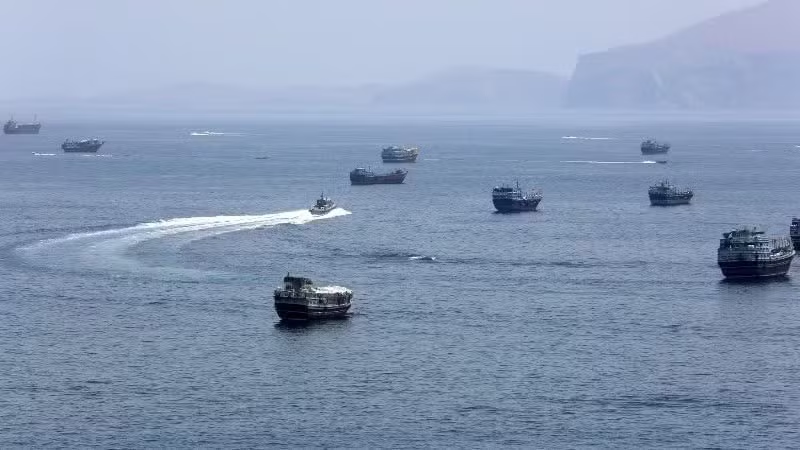
With shipping through the Strait of Hormuz continuing to face disruption, the attacks have escalated the risk to maritime security in the Bab el-Mandeb Strait, the strategic shipping route linking the Red Sea with the Gulf of Aden, posing a grave threat to Saudi Arabia’s oil exports and international trade.
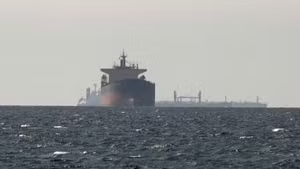
Yemen’s Houthi forces stated they had executed a military operation using cruise missiles, ballistic missiles, and unmanned aerial vehicles against two Saudi Arabian oil tankers in the Red Sea, contending that the vessels had violated recently announced Houthi shipping restrictions.
Earlier, the forces had issued direct warnings to international shipping companies, mandating an end to all cargo transport to and from Saudi Arabian ports and declaring that vessels in violation could be targeted. The Houthis imposed the maritime blockade on Saudi Arabia in retaliation for an air strike on Sanaa International Airport in Yemen, which the group ascribed to Saudi Arabia.
The current tensions originate from long-running disputes between the Houthis and Saudi Arabia. The Houthis have accused Saudi Arabia of maintaining a blockade on Yemen since 2015 through restrictions at seaports and airports, worsening the humanitarian crisis in the impoverished country on the Arabian Peninsula. The group asserted Saudi Arabia had maintained an “unjust siege” of Yemen for nearly 12 years. The Houthi shipping ban was presented as a response based on the principle of “blockade for blockade”.
The group also cautioned that it was prepared for all options and would retaliate on a massive scale to any escalation by Saudi Arabia. In response to the Houthis’ hard-line actions, the Saudi-led Arab coalition in Yemen stated it would take all necessary measures to safeguard commercial vessels passing through the Bab el-Mandeb Strait. Riyadh affirmed that it would continue assisting the Yemeni people and the country’s internationally recognised government through development programmes and budget assistance.
The Houthis’ warnings and attacks in the Red Sea have further escalated tensions in the Middle East and intensified pressure on global oil shipping. The United Nations, the European Union (EU) and the US have all expressed deep concern over the risk of escalation and urged the parties to exercise restraint and resolve their differences through dialogue.
Stephane Dujarric, Spokesperson for the United Nations Secretary-General, cautioned that any blockade in the Red Sea, a strategic shipping route alongside the Strait of Hormuz, could have severe consequences for global trade, energy transportation, and the delivery of humanitarian aid.
He emphasised that the parties must fully adhere to United Nations Security Council Resolution 2722 of 2024 and other relevant documents concerning attacks on commercial vessels in the Red Sea. The EU naval mission pledged to safeguard freedom of navigation along this vital waterway. US President Donald Trump warned of strong military action against the group and stated Iran would be held responsible if the Houthis persisted in attacking shipping in the Red Sea and Gulf of Aden.
Although Iran has not responded to President Trump’s latest accusation regarding the attack on Saudi Arabian vessels, observers noted his statement demonstrated that Washington continued to hold Iran responsible for Houthi activities and was sending a tough signal intended to forestall further instability along strategic shipping routes in the Middle East.
Amid concerns that exchanges of accusations and retaliatory actions could further escalate regional tensions, Oman, an important mediator between the Houthis and Saudi Arabia, is working to revive negotiations in search of a political solution to de-escalate tensions.
The conflicts are pushing the Middle East into a perilous spiral of confrontation. As the situation remains volatile, with US-Iran tensions impacting global energy security and the world economy, the international community is striving to foster the resumption of dialogue between Saudi Arabia and the Houthis in order to prevent the outbreak of a new conflict that could plunge the Middle East deeper into crisis.