Challenges to a long-term US-Iran agreement
The Gulf is once again in turmoil after relations between the neighbouring countries of Iran and the United Arab Emirates (UAE) were escalated to a new level of tension.
#Strait of Hormuz
The Gulf is once again in turmoil after relations between the neighbouring countries of Iran and the United Arab Emirates (UAE) were escalated to a new level of tension.
A series of attacks on Saudi Arabian vessels in the Red Sea threatens to ignite a “new front” in the tense conflict in the Middle East.
The Strait of Hormuz has once again become a flashpoint after the US launched multiple air strikes against Iranian military targets in response to accusations that Iran had attacked commercial vessels. Washington has declared that it will continue to carry out further larger-scale strikes to weaken Tehran's ability to threaten freedom of navigation.

Viet Nam welcomes the announcement by the US and Iran that they have agreed on a peace deal, spokesperson of the Ministry of Foreign Affairs Pham Thu Hang stated on June 15.
The prolonged conflict in the Middle East has had a profound impact on labour markets, aviation, tourism, public finance, and growth prospects across many major economies in Asia and Europe. Experts warn that even if the conflict comes to an end, the scars it leaves behind may take years to heal.
The global energy market is experiencing sharp fluctuations following reports that US President Donald Trump has requested preparations for a scenario involving a prolonged naval blockade of Iran’s ports in the Strait of Hormuz.
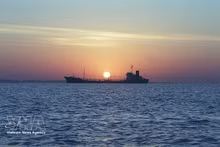
Disruptions in the Strait of Hormuz, a key global energy shipping route, are causing a sharp decline in global oil flows. Major Gulf oil producers are considering diverting exports through alternative routes outside the Strait of Hormuz, while the Organisation of Petroleum Exporting Countries and its partners (OPEC+) have agreed to increase production quotas to alleviate supply pressure on the oil market.
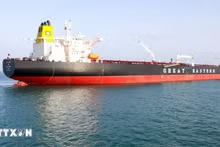
The “bottleneck” in the Strait of Hormuz is shaking the global economy, with millions of barrels of oil disappearing from the market every day. Beyond energy prices, the shock is rapidly spreading to supply chains, inflation, and global growth, raising the risk of a crisis that could be worse than the COVID-19 pandemic.
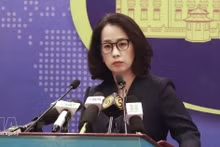
All Vietnamese vessels operating in the Middle East remain safe despite disruptions to maritime traffic through the Strait of Hormuz, spokesperson of the Ministry of Foreign Affairs Pham Thu Hang said at a regular press briefing on April 2.
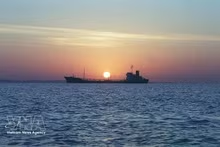
The Viet Nam Maritime and Inland Waterways Administration (VIMAWA) has urged the Ministry of Construction to request the Ministry of Foreign Affairs (MoFA) to work with its Iranian counterpart to support and prioritise the safe passage of Vietnamese vessels and crews through the Strait of Hormuz.
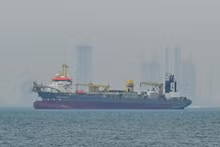
Disruptions to energy transportation activities in the Strait of Hormuz are forcing many countries to implement measures to stabilise supply and reduce impacts on their economies. In response to this situation, domestic management has been carried out proactively, contributing to ensuring fuel supply and maintaining market stability.
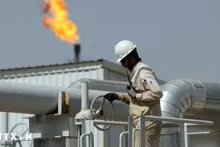
Escalating conflict in the Middle East has pushed the global energy market into a period of serious instability, with oil prices rising steadily while supply continues to tighten. In this context, many countries are rushing to release strategic reserves in an effort to cool the surge in oil prices.
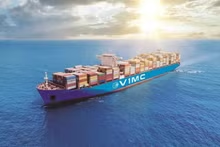
The Viet Nam Maritime and Waterway Administration (VIMAWA) has called on shipowners with vessels operating on international routes to closely review updated information on maritime safety and security conditions before planning voyages to the Middle East to ensure the safety and security and legitimate rights and interests of crew members.
A series of retaliatory attacks between Israel and Iran in recent days has seriously destabilised regional security and raised concerns about a potential new economic shock.