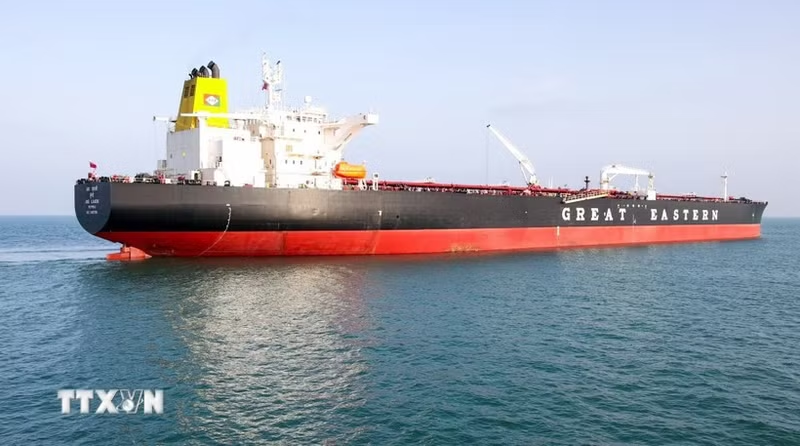
Despite ongoing reports of negotiations between the US and Iran regarding the current Middle East conflict, oil tankers are still facing difficulties navigating the Strait of Hormuz. As a result, observers believe the global market is losing approximately 11 million barrels of oil and petroleum products per day, representing more than 10% of global supply.
At first glance, a 10% disruption might not seem catastrophic. But in the oil market, a 10% imbalance between supply and demand can have enormous consequences. Previously, during the global lockdown due to the COVID-19 pandemic, oil demand fell by about 8 million barrels per day, but this created painful memories of a “terrifying silence” that no country wants to experience again.
The COVID-19 pandemic caused one of the biggest energy demand shocks in history. The current situation is the opposite. Instead of a collapse in demand, the world is experiencing a major supply crisis. However, the impacts on daily life still have many similarities, from reduced travel, higher transportation costs, slower economic activity, and increased pressure on household budgets.
Experts and world leaders have repeatedly warned about the repercussions of the current Middle East conflict. Russian President Vladimir Putin recently stated that the consequences of the conflict could be as severe as the COVID-19 pandemic, causing significant damage to international supply chains, production, and logistics. Meanwhile, the World Trade Organisation (WTO) warns that the global trading system is experiencing “the worst disruptions in 80 years.”
These concerns are not unfounded. The Strait of Hormuz has long been considered a “regulating valve” for the global energy system. When the flow through this area is threatened, the consequences clearly extend beyond rising gasoline prices, triggering a chain reaction. Significantly, if the Strait of Hormuz remains blocked for an extended period, or if the conflict escalates further, the export losses will not be limited to just 11 million barrels of oil per day; the socio-economic impact could be extremely serious.
The current energy crisis is even more worrying than COVID-19, because while the pandemic paralysed demand, governments were able to roll out large stimulus packages without fear of immediate inflation; whereas the current energy crisis is stifling supply, a core element of production. When supply decreases while demand remains, soaring prices are inevitable.
In this context, the policy space for governments is much more limited. Central banks cannot easily lower interest rates when inflation is rising. Governments also find it difficult to expand spending without exacerbating budget deficits. In other words, the “rescue tools” that were effective during the pandemic now require careful consideration.
The impact of the current crisis is also not evenly distributed. The release of emergency oil reserves is helping to mitigate the initial impact, especially in developed economies. Meanwhile, many countries in Asia, Africa, and South America have very little commercial supply in reserve, making them more vulnerable.
Notably, Asia, the engine of the world economy, is one of the region’s most directly affected, as much of the oil passes through the Strait of Hormuz toward Asian economies. If supply disruptions are prolonged, not only will regional growth be impacted, but the entire global supply chain will be disrupted.
The world has learned many lessons from COVID-19 regarding resilience, but the Strait of Hormuz crisis raises another question about the flexibility of the global economic system to cope with a supply shock like the current one. Markets are relying on the emergency release of energy reserves and hopes for de-escalation, but if the bottleneck is not resolved soon, the world economy could face a shock with more unpredictable consequences.