In just one night, the Strait of Hormuz — a route carrying about 20 million barrels of oil daily, equivalent to a quarter of global demand and 33% of seaborne fertiliser trade — has turned into a geopolitical chokepoint.
As this critical shipping route is constrained, the shock extends beyond energy, spilling over into agriculture and food security.
This latest development has quickly moved beyond the scope of a regional conflict, directly choking off the physical supply of the fertiliser market. Unlike previous fluctuations, this is no longer merely a matter of rising costs, but a real disruption to the flow of goods.
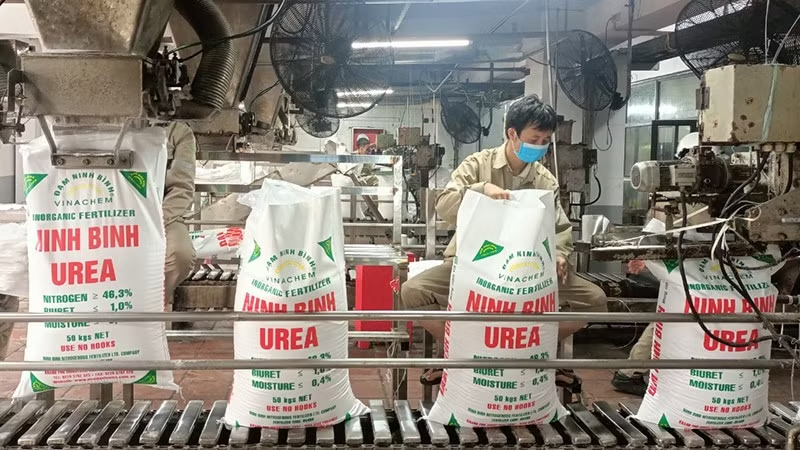
Currently, the Persian Gulf accounts for about 49% of global urea exports and 30% of ammonia. When supply from this region is disrupted, the market immediately falls out of balance, turning the risk of shortages into reality and triggering a severe physical liquidity crisis in the fertiliser market.
When market logic yields to supply disruption
On Wall Street, JPMorgan analysts estimate that the world has only about 25 days of strategic fertiliser reserves before real impacts begin to undermine agricultural production capacity. If the Strait of Hormuz were to close, storage facilities in Gulf countries would fill up in less than a month, forcing large industrial complexes to halt operations. Restarting these complex chemical plants would take four to six weeks, creating a severe supply lag that could paralyse input markets in the medium term, even after hostilities end.
The crisis has broken out just ahead of the Northern Hemisphere’s spring planting season, when fertiliser demand is at its peak. By mid-March 2026, all eight major fertiliser categories had surged sharply in price.
The spike in input costs has dealt a heavy blow to US farmers’ profit margins. After years of financial strain, the high cost of nitrogen fertilisers is forcing farmers to adjust their survival strategies. According to a survey by Allendale Inc., US corn planting area in 2026 is projected to drop significantly to just 37.91 million hectares. Farmers are rapidly shifting to soybeans — a crop that requires less nitrogen fertiliser — to mitigate financial risks.
Facing mounting pressure from farmers, the US government has moved swiftly to intervene in the fertiliser market on multiple fronts.
Legally, the Department of Justice (DOJ) and the Federal Trade Commission (FTC) have launched investigations into alleged price manipulation involving five major corporations: Nutrien, Mosaic, CF Industries, Koch and Yara.
To ease supply constraints, the US President has signed a 60-day waiver of the Jones Act to reduce domestic shipping costs, while tariffs on potash imports from Canada and Mexico have been cut from 25% to 10%. At the same time, Agriculture Secretary Brooke Rollins is negotiating direct financial support packages to help farms weather the price surge. These moves underscore a harsh reality: fertiliser is essentially fossil energy transformed into food; when energy supply chains break down, food security is immediately put at risk.
According to the Food and Agriculture Organization (FAO), fertiliser costs account for between 30% and 50% of total grain production costs. The FAO warns that yields in key regions could decline by 20% to 30% as farmers are unable to access supplies or are forced to apply less fertiliser than required.
The consequences of declining yields will not be immediate. The logic of the crisis lies in “inflation lag”. The FAO Food Price Index typically responds with a delay of six to nine months after input costs rise. This means a wave of food inflation is likely to hit the global economy in late 2026.
In Europe, officials have warned that nutrient shortages during this spring season will inevitably lead to serious food shortages next year. In South America, Brazilian farmers are deeply concerned about potash supply as they prepare for their second corn crop.
At present, the most critical link in the global supply chain is China, often described as the “OPEC of the fertiliser market,” controlling 44% of global phosphate, 30% of nitrogen and 23% of sulphur supply. In response to the Hormuz crisis and to safeguard domestic planting, Beijing has ordered exporters to halt shipments and release national fertiliser reserves 15 days earlier than usual. This tightening of exports has pushed major importers such as India and Southeast Asian countries into severe shortages.
From cost optimisation to strengthening resilience
Amid the crisis, Viet Nam’s fertiliser market stands out as a case study of overlapping import risks and domestic resilience.
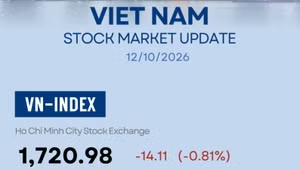
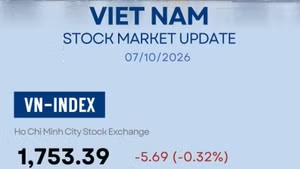
Looking back at 2025, Viet Nam imported 6.19 million tonnes of fertilisers worth 2.19 billion USD. Notably, China was the largest supplier, accounting for 48% of total imports, or 2.99 million tonnes. As such, China’s export restrictions in 2026 have placed direct pressure on the domestic market. By January 2026, fertiliser imports had plunged by 47% due to soaring global prices and logistical disruptions. As soon as tensions in the Middle East escalated, fertiliser stocks on Viet Nam’s stock market, including BFC, DCM and DPM, surged to their ceiling prices for several consecutive sessions.
Despite these external pressures, Viet Nam retains an important domestic buffer: full self-sufficiency in urea production. Major producers such as Phu My Fertiliser (PVFCCo) and Ca Mau Fertiliser (PVCFC) rely on domestically sourced natural gas, allowing the agricultural sector to partially shield itself from the global surge in liquefied natural gas (LNG) prices.
However, Viet Nam remains entirely dependent on imports for sulphate ammonium (SA) and potash. Recognising this vulnerability, leading enterprises such as Ca Mau Fertiliser proactively imported and stockpiled large volumes of DAP, potash and organic fertilisers as early as the fourth quarter of 2025. Thanks to this forward-looking strategy, the domestic market has been able to maintain supply for the Winter–Spring crop and prepare for the Summer–Autumn season of 2026, sparing farmers from the “cash without supply” situation seen in many other countries.
The 2026 crisis has laid bare the fragility of the “energy–fertiliser–food” nexus. Dependence on trade chokepoints such as the Strait of Hormuz is a high-stakes gamble, with food security as the ultimate cost.
Amid disruptions to physical supply, financial derivatives are becoming strategic hedging tools for importing enterprises. Through the Viet Nam Commodity Exchange (MXV), many businesses have proactively established long positions in the futures market to lock in input costs as soon as geopolitical risks emerge.
According to market experts, hedging instruments allow businesses to separate price volatility risks from supply disruption risks. In cases where shipments are delayed due to logistical bottlenecks, gains from financial positions can offset rising spot prices, thereby stabilising profit margins and limiting spillover effects on domestic prices.
Beyond hedging instruments, integration with international exchanges also enables domestic enterprises to access global market signals in real time. Instead of relying on price quotes from intermediaries, importers can proactively build business plans based on transparent and continuous data, thereby shifting from a passive position to proactive risk management.
In an increasingly volatile environment, the ability to manage risks across both physical commodities and financial instruments is becoming a key differentiator among enterprises.
The world is being compelled to rethink “agricultural sovereignty,” moving away from a focus on import cost optimisation toward strengthening self-sufficiency and supply chain resilience. Over the long term, diversifying supply sources, increasing the use of bio-organic fertilisers, and adopting smart farming technologies will be not just economic options, but vital imperatives to protect global food security from geopolitical shocks.