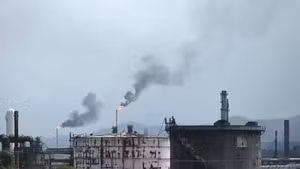
US and Israeli air strikes targeting Iran, together with Tehran’s closure of the Strait of Hormuz, have sent energy prices soaring and pushed global markets into turmoil.
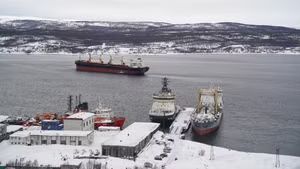
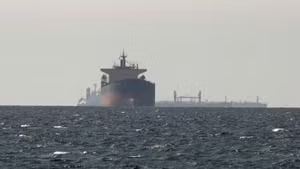
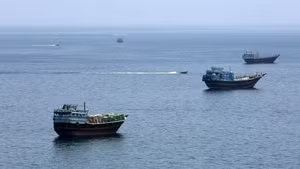
Disruptions to shipping through the Strait of Hormuz — a strategic maritime route accounting for 20% of the world’s traded oil supply — have placed mounting pressure on fuel costs, inflation, and global consumer demand.
In the UK, the unemployment rate rose to 5% in the first quarter, reportedly due to the negative effects of the Middle East conflict. The UK Office for National Statistics (ONS) said the number of available jobs had fallen to its lowest level in the past five years.
Experts have warned that surging energy prices could undermine the recovery momentum of the British economy. The European Commission (EC) has also lowered its 2026 growth forecast for the eurozone to 0.9%, down from the previous projection of 1.2%.
Conversely, the EC raised its inflation forecast to 3%, which is well above the European Central Bank’s (ECB) 2% target.
European Commissioner for the Economy Valdis Dombrovskis said the conflict in the Middle East had triggered a major energy shock, pushing Europe into a dual crisis of slowing growth and high inflation.
The conflict has also driven up government borrowing costs in many countries. Yields on 30-year US Treasury bonds climbed to their highest level in 19 years, while long-term government bond yields in Japan and the UK also reached multi-decade highs.
The global aviation industry has likewise failed to escape the shadow of the Middle East crisis.
British low-cost carrier EasyJet reported a loss of 377 million GBP (more than 500 million USD) in the first half of 2026, mainly due to soaring jet fuel prices and weak travel demand.
Airbus has been forced to implement austerity measures, cutting 10% of non-essential spending on travel, conferences, and outsourced services.
Japan’s tourism sector has also suffered, with international arrivals falling 5.5% year on year to 3.69 million visitors, including a sharp 21.4% decline in arrivals from the Middle East.
The conflict in the oil-rich Middle East is also steadily eroding the purchasing power of workers worldwide.
According to statistics from the International Labour Organisation (ILO), real labour income could fall by 3 trillion USD by 2027 if oil prices remain 50% higher than they were at the beginning of 2026. Under this worst-case scenario, global working hours would decline by 0.5% in 2026 and 1.1% in 2027. This would be equivalent to a loss of 14 million and 38 million full-time jobs respectively, while real labour income would fall by 1.1% and 3%. Global unemployment is also expected to rise gradually, increasing by 0.1% this year and 0.5% next year.
Remittance flows — the primary source of income for many households and a vital financial resource for numerous countries in South and Southeast Asia — have also begun to weaken.
The conflict has further led to a sharp decline in migrant workers in the Gulf region as labour demand in construction, hospitality, restaurants, and transport has plummeted.
Not only is the energy sector seeing issues, but global food prices are also facing severe repercussions.
The Food and Agriculture Organization of the United Nations (FAO) has warned that any blockade of the Strait of Hormuz could trigger a serious global food price crisis in the coming months.
The shock is unfolding in stages, beginning with energy, fertilisers, and seeds, followed by falling productivity, soaring commodity prices, and ultimately food inflation.
The FAO warned that a full-scale food crisis could descend upon the world within the next six to 12 months.
The conflict in the Middle East is clearly creating numerous unpredictable consequences for the world.
A solution to this challenge can only be found if the parties involved make concessions and pursue reconciliation, paving the way for the restoration of peace and security in the region and across the globe.